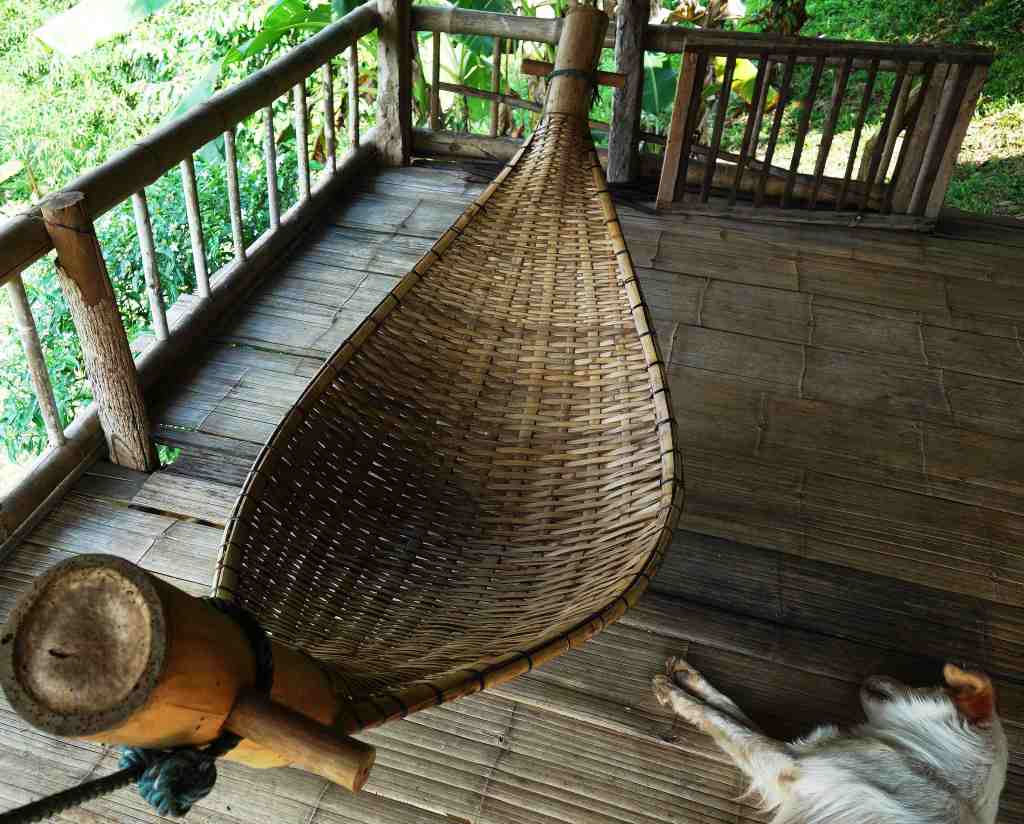
[Above photo: Still life of hammock, porch, and dog.]
25 April 2021
19 April
One of the first things to strike me, literally, when I sat on my veranda in the countryside was the incredible wealth, variety, and artistry of insects. They are of impossible design and extravagant colors. Cities now seem so barren and sterile. Yangon, for example, sports cockroaches, ants, rats, pigeons, crows, and house sparrows. And the very occasional mosquito. That’s it, except in the rare marshy or wooded areas like behind our house, where nature comes to life again.
I have landed in heaven! Bamboo Nest is at the top of a series of nearly vertical pitches, initially paved but eventually giving way to a rutted dirt track. It is a cluster of simple bamboo huts, all with spacious bathrooms and large verandas, set like jewels around the crown of a hill. The views are of lush greenery on the hillsides below giving way to a tilled highland valley with rows of mountains in the distance. Below it, out of earshot or eyesight is a tiny Lahu village whose occupants built and maintain the facility. At the top of the hill, with a panoramic view, is a large open, thatched dining area with a kitchen concealed behind bamboo walls to the rear.
There is, of course, the occasional distant thrum of a motorbike heading up a dirt path toward its rider’s home. Since they are all 4 cycle now, they are quiet. Otherwise, there are only birdsong and gecko calls. I’m aware of tinnitus in my ears, not previously noticed by me because of city noise.
The force behind this operation is Nok, a fit, tiny 48yo Thai woman. As she skillfully guided her large 4WD Mazda diesel truck up the pitches, she described how she enjoys “adventure”. Her parents and her brother, who live in Chiang Rai, were not bitten by the same bug. She started a travel and trekking agency—“I like to trek.”—20 years ago and 10 years ago bought this isolated patch of hilltop. Hiring men from the nearby village, she cleared the land and built the Nest. The details are wonderful—note the hammock in the photo above. It is a traditional Lahu design, woven from a single length of timber bamboo which grows prolifically in the area, and is an exquisite and functional piece of craftsmanship.
I’ll find out from her tonight at supper about trekking in the nearby national forest. A surprise like this is what I sought in coming to northern Thailand. I wish I could transport one of the hammocks home!
21 April
I am the only visitor here. Cookie, an affectionate white dog with brown spots, has attached herself to me and resides on my deck whenever I am in my bungalow, including all night. I won’t bother with the details of the systems (water, waste, lighting, etc.) here but they are ingenious. One issue is that termites love to eat bamboo, so Nok must replace the roofs of the huts every 3 years. She refuses to use chemicals, preferring the extra labor.
I hiked the first day “to the waterfall” but took several wrong turns and ended high up another hill in the middle of a lichee fruit orchard, looking down on the Akha village I was supposed to pass through. There are myriad trails here to fields, to remote houses and hamlets, and for hunting; none are marked. It was a lovely hike, however, and it reassured me that I still can go vertically without much strain. I worried because when I jog, I get quite short of breath. But walking at a good clip uphill is just fine.
Today I headed for “the waterfall” again, only to take another “upper trail” which led me far afield. I climbed and climbed through a gorgeous hardwood forest and then past many stands of timber bamboo. The latter is up to 8” in diameter and 60+ feet high, growing in clumps of 40-80 stalks. I ended up at a high mountain farm with two small huts and a stream running through it. Knowing where I had gone wrong, I eventually retraced my steps, took the correct trail, and found the waterfall, and it’s lower partner.
Four of the 5 dogs that live here, including Cookie, accompanied my hike on the first day. Today we set off together but when I walked through the Akha village I somehow lost them and continued the rest of the way on my own. It was reassuring to have them break trail, flushing out any snakes that might be surprised. When I was alone, I carried a length of bamboo as a walking stick and saw nothing of threat. Nok has said she rarely sees snakes; they really do try to avoid us, as I found in Africa. One exception would be puff adders, which move very slowly except to coil and strike, but they are not here.
It is clear to me that my anxiety, and I think that of many people, is not reality-based, since we have little sense of what the reality is. So we prepare ourselves using our imagination, which can lead to strange behaviors and uncomfortable feelings. Nok says many Thai people who stay here are fearful of the dark and leave the two small lights in their cabin on all night.
Dusk has fallen like a purple veil over the hills and fields. If there were others here to share it with, in addition to Nok, I’d probably stay here for awhile. It may end up being the best segment of my Thailand adventure; it is to date.
As mentioned, I am reading A Fine Balance about the life of the poor in Mumbai, how subject they are to cruelty, coercion, extortion, and neglect at every turn. The government of the time (Indira Ghandi) made absurd decisions, bulldozing slums with no provision for the inhabitants and rounding up people from the streets to serve as indentured labor. Not surprisingly with that kind of leadership, the degree of corruption at lower levels of government service (courts, police) and in the private sector is described as ceaseless. I mention the details here because it is additionally painful to be aware of them in such a bucolic setting. Now we are seeing the slaughter through indifference and ignorance of so many Indians from covid. And mighty efforts to conceal the real death toll.
24 April
I been staying at Baanbua Guest House, a simple, cheap, quiet and clean affair in the middle of Chiang Rai. Thym, the owner, has run it for decades. It consists of two one-story wings at right angles with the kitchen at the apex. There is a large garden with shade trees and flowering plants and Hsu, a Myanmar native (Kayin) makes a lovely crepe with local honey in the morning. I introduced her to putting sliced bananas in the middle and I split a mango with her each morning to add on. I sleep in a large room with a table and two sets of bunk beds; there is an “en suite” bathroom with a hot shower. I’m alone in there for $13/night, with a/c. It is perfect.
Nok also introduced me to Suwanee who runs a cooking school. At 48yo she is intelligent, lively, beautiful, never married, fluent in at least Thai, Dutch, and English, and has lived in Europe for 10+ years. She purchased a few acres on the edge of town and recently built a beautiful modern house and a separate kitchen for her classes. The latter is absolutely lovely: light, airy, open, tastefully decorated, and maximally functional.
I took a class with her for 4 hours, learning to cook a red curry, a stir-fry, a soup, and pumpkin in coconut milk and cream for dessert. All were so good, in part because of her graceful manner of instruction and in part because most of the ingredients she had picked from her surrounding farm/garden an hour before I started the class.
If anyone wants to go to Chiang Rai, I have some good tips. This morning Nok dropped by to take me to the airport, giving me a gift of Thai tea and a lanyard to keep my mask attached when it is off, like when eating supper. All three of the women—Nok, Suwanee, and Thym—are clever and entrepreneurial, making a living doing what they like to do, not to get rich. Nok described to me a design for bamboo hanging bedrooms that she can suspend from trees at her new place along the river; she thinks her Lahu village can weave them for her. She is going to donate the current Bamboo Nest to the villager who has helped her maintain it for 10 years. Like Suwanee, she wants to grow organic fruits and vegetables in her new location. She also wants to cut back from 8 to 4 dwellings: “Too much work.”
25 April
I flew to Phuket today, not knowing if I would have to quarantine for another 14 days. Surat Province, where I am staying adjacent to Khao Sok National Park, is very strict about people entering it, especially from covid “red” zones. Until yesterday, they hadn’t had a single covid positive test in Surat. Fortunately for me, Chiang Rai has been an “orange” zone. I also carry a certificate for a negative covid test from the Phuket Airport and evidence of having one vaccination, so I am hoping I can avoid it.
An advantage of covid travel is that there are very few travelers and I never need to make reservations. A disadvantage is that there are fewer to talk with and I may not be able to do some of the things I want to do. Because of the rise in infections, they have closed all snorkeling and scuba diving in Phuket. Surin Island is currently closed to scuba but might open in early May.
I’m sitting in my eco-hut on stilts, looking out my window at the fringes of a 160 million year old rain forest. Lush is inadequate to describe the vegetation. There are massive vertical karst cliffs covered in ferns, as well. I’ll likely rent a motorbike, with helmet, since it is difficult to get around here and the distances are too great to walk. The two park headquarters, for example, are each about 10 miles from here, in opposite directions. Perhaps I can rent a bicycle.
For now, I’m content and excited to explore this huge and amazing park.

 A Psychiatrist in Myanmar