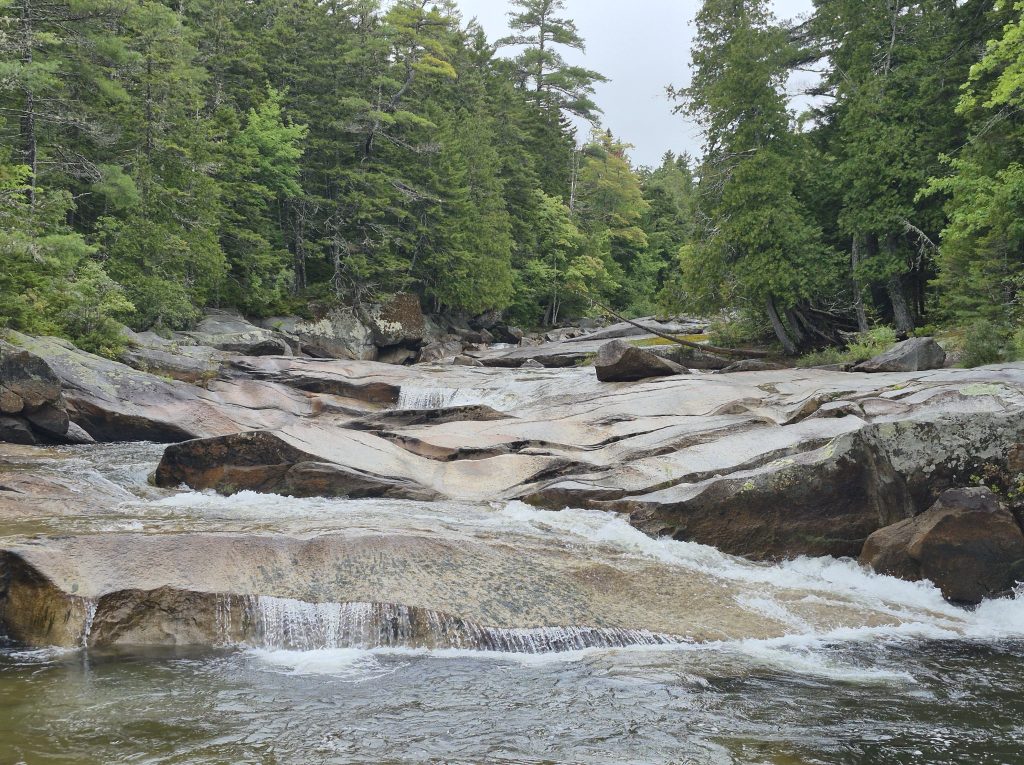
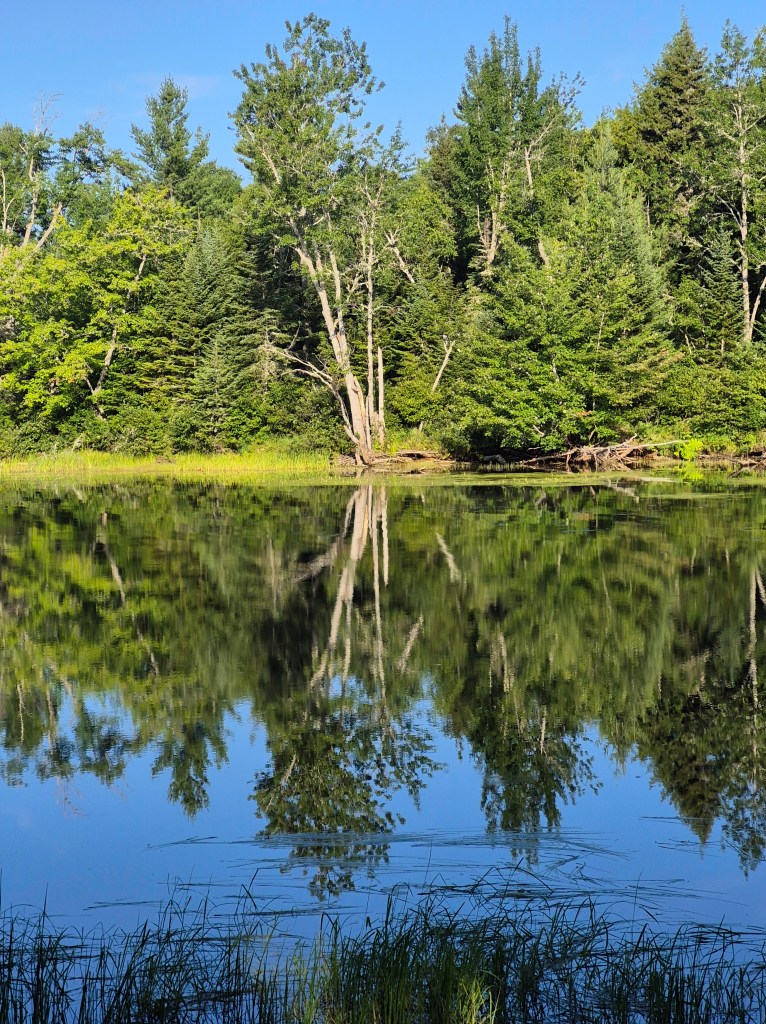
[Above photo: Katahdin Stream in Baxter State Park during a break in the weather.]
September 18, 2026
It surprises me each time I realize I have completed 85 revolutions around the sun; my 86th birthday seemed incredible to me. I, who thought I’d die at 55yo like my father. It is a common misperception, based on a strong identification with a deceased parent. And my sister is 97yo!
I mostly spent summer on the island, worrying about how I’d replace the rotten window sill, shingling one side of the house, catching mackerel with Hugh, and helping Ari with the sheep. I only kayaked once and never got into a sailboat. But I visited with lots of relatives and picked up 6 immense trash bags of plastic in various forms from the beaches: lobster buoys, mylar balloons, chunks of Styrofoam, lengths of poly rope, discarded water and drink bottles, and fragments of all the above. Who knew how many energy drinks are consumed, the bottles tossed into the sea? It’s my little bit to make it more attractive and to address the microplastic pollution. It doesn’t really have much of an effect on the latter but it improves my spirits.
Lindsey and I planned to climb Katahdin in early September but his daughter-in-law required early induction of her labor (Lucy is a darling, healthy newborn.) and the dates coincided. I decided to go on my own, to ascend to Chimney Pond for a night in a lean-to and to assess the feasibility of climbing the mountain the next day, possibly attaching myself to other hikers.
I drove to Millinocket, stayed in a refurbished mansion for the night, and entered the park the following day. It was pouring rain and projected to continue for two days. I enjoy the martyrish feeling of suffering as much as the next person but it lacked a certain appeal doing it alone. To whom would I whine? A sympathetic older state park employee at the S. entrance to Baxter said, “I have just the thing for you, deah.” And she did.
When Percival Baxter started buying up the land to preserve it as wilderness, since the state wouldn’t do it, there were several fishing and hunting camps on lakes in the area. They have been preserved and I snagged a great little one-room log cabin with a wood stove, two beds, and a covered front porch with a rocking chair facing a lake [“pond” in Maine parlance] 15 feet away. And unlimited free split wood. Canoe rentals for $1/hour! This isn’t California, Toto.
Given the circumstances, it was perfect and I read and strolled about in the intervals between storms. The Appalachian Trail ran behind the camp and I got 5 miles in the next day, following Katahdin Stream and chatting with hardcore AT hikers. I also met a guy who grew up in Downeast Maine, has summited Katahdin “many times” and biked the Continental Divide Trail from Canada to Mexico, solo. His early 20’s son confirmed all of this. Talk about driven!
The next day was also a soaker, so I packed the car and decamped for home. But it was an eye-opener and Baxter is a gem! I’ll give it another go next year. It was so wet and cloudy that I never could even see the flanks of Katahdin, let alone the summit. It kind of defeats the purpose, for me, of climbing it if I can’t see into the next county from the top. I’m not at the stage of life where I need to prove my strength or endurance, not that there is much I could prove!
My condo neighbor and I had our front porch rebuilt this summer and, given the immensity of that bill, I decided to paint it all myself. And I threw in 6 windowsills, as well. It has taken a lot of time—-scraping, sanding, priming, finish coat, and cleaning up the inevitable spills or inadvertent messes. I’m gradually whittling it down and it looks terrific.
I do want to recommend Anthony Trollop’s The Way We Live Now on Audiobooks. It is fabulous, the reader incredibly skillful at doing all the voices, and the central character is a dead ringer for DT—a greedy, narcissistic grifter. Trollop was a genius of a psychologist and learned how to put it down well. One dissimilarity with DT is that in the book, as his schemes are coming a cropper for the last of many times, he takes prussic acid and dies. We could only wish.
Ari and I will go to the island one more time to finish the window trim I’m replacing, to close the cabin for the winter, and to bring off her electric fences and other sheep-related paraphernalia. We’ll have a good supper, a few deadly-serious games of Bananagrams, and call it a summer.
I happened to have been reading Kenneth Roberts’ Arundel, a 1930’s account of colonial Maine (Massachusetts, at that time) and Benedict Arnold’s ill-fated expedition to wrest Quebec from the British in the winter of 1775, when Harold, my friend and roommate from medical school, and I set off on a 5 day camping, canoeing, and fishing trip that nearly coincided with part of Arnold’s route.
Their tale was of deception, betrayal, spies, and misery, maplessly traversing mountains, bogs, and wild rivers in bateaux unsuited for such a voyage. They were at times starving and freezing, and many members of the army deserted. Certainly, many were hopeless. At the very beginning of the actual siege in a blinding snowstorm, Arnold was seriously wounded and couldn’t lead or inspire his troops; his counterpart, General Montgomery, was instantly killed. The attack failed.
Harold and I experienced the opposite circumstances, traveling in late July so as to avoid black flies, “Guardians of the Wilderness” as is printed on a tee shirt I have. The weather was warm and, excepting a single brief thunderstorm and shower, ideal. However, with the warmth, the water heats and the trout are pushed from steams into the cool depths of adjacent lakes. Despite our accumulated fly fishing skills—I have fished in the Cascades, the Rockies, the Bitterroots, and the Sierras and Harold has additionally travelled all over the world with wealthy friends on fly-fishing expeditions—we caught only Small-mouth Bass.
What are bass doing in these waters? Maine reputedly has the most extensive native Brook Trout fishery in the contiguous 48. We are told that a [perhaps disgruntled] fisherman intentionally introduced the Bass some years ago. They have flourished, and are more successful predators, supplanting their dainty troutish neighbors with gusto. I wonder if it was a class thing. Fly fishing for trout in my mind is associated with the Middle and Upper Classes, whereas Bass fishing is definitely a Working Class pursuit, ironically requiring less work.
After paddling 8 miles from the banks of the Androscoggin River, across Umbagog Lake, to Cedar Stump Campground [Maine] on the lower end of the Rapid River, we discovered a glorious setting for 3 nights. The river was smooth, broad, and relatively deep in front of us. It was outfitted with a stone and metal fire ring, a picnic table, and an outhouse of dubious provenance. Animals had eaten and scratched several entries to the interior of the latter, perhaps to avoid inclement weather. There was a rich and pungent fragrance of many phenols, so put for gentler sensibilities.
Of the 6 or more sites at the campground, only two others were taken and they were at a distance. A group of 15yo Outward Bound girls and boys were segregated on both sides of the river for one night. It was entertaining for us, and likely thrilling for them when two girls got in their canoe at twilight and crossed the river to mix it up with the boys. The following two nights we enjoyed complete peace.
Fishing upstream the next morning, we were approached by a uniformed young woman from the Maine Department of Inland Fisheries. I trembled inwardly somewhat, realizing my fishing license was back at our campsite. She assured us that she wasn’t Enforcement, just surveying the rivers and fisherpersons in her territory to see what was being caught.
She was very informative, telling us of the varied methods Fisheries uses to perform their monitoring task—telemetry, sampling by gill netting, determining fish age by examining the scales, etc. She assured us that the Bass were The Enemy and that there was no catch or size limit. “Just toss them on the bank if you don’t want to eat them.” Which we did, frequently.
Bony, scaly, and muscular creatures, their dorsal fins are sharp and dangerous. Breaking their necks, as I do with fish before cleaning them, was challenging as they were built very sturdily. Nothing like the sleek and lovely mackerel we’ve been catching and eating at the island this summer. I caught a zillion small ones; Harold wasn’t so lucky but later, back at camp, caught a hefty one which he cleaned and scaled. I’d brought olive oil, lemon, pepper, and salt, hoping for trout, and we fried his. It was fresh and tasty, if concealing many bones.
One day we hiked upstream to the destroyed lower dam on the Rapid River, which connects Lake Richardson with Umbagog Lake. In addition to fishing a number of wonderful, deep pools, we again encountered the Outward Bound group and their two leaders. The kids looked miserable, having to portage their gear and canoes up a 3 mile carry road. Some of the girls were tiny, in truth, and I was unable to imagine that they could carry a 65# canoe by themselves. I think the larger girls and the boys carried them and the littlest ones carried paddles, etc. I felt for them and said admiring words as we passed them.
We also encountered a fellow, perhaps 35 or 40yo, towing his very lightweight (27#) carbon fiber canoe on a wheeled dolly, his gear stowed within. He had rigged the canoe with a seat on the floor and foot braces, and he used a kayak paddle. He’d spent 22 days on the Northern Forest Canoe Trail, which stretches 740 miles from Old Forge, New York, through Vermont and New Hampshire, and ending in Ft. Kent, Maine, with a brief foray into Canada. He was out for another week and planned to finish the route next summer. Harold asked about food supplies; he described a meal mixture of simple ingredients he’d created and could obtain from most stores along the way: red lentils, nutritional yeast, rice, beans, herbs, etc. It seemed like a lot of days and nights paddling, portaging, and camping alone, to me.
Our second campground, #29 [New Hampshire] was across the lake in the direction we’d originally come, in an area of marsh and very still water. However, our return trip was complicated by rising wind and waves. It was a serious struggle to paddle across the lake and we encountered gusts that would stop us in place. We decided to shelter behind a point 1 ½ miles across from #29. I was fearful that we might capsize and, although the water was warmer than the sea, we would be at risk of hypothermia. If we did capsize, we had little possibility of re-entry and so would float for hours, awaiting the wind to push us to the lee shore some miles to the North.
We ate lunch, read, and snoozed on large flat rocks. I explored across the little point to see how the lake surface looked. It was frothy! After something like 5 hours, the wind gradually dropped and we crossed uneventfully.
The birdlife was splendid and included huge Great Blue Herons, Bald Eagles, Stellar Jays, many female Common Mergansers with growing chicks swimming behind, and Loons. The latter called, both day and night, which provided a familiar eerie background music. We also saw a few deer, browsing at the water’s edge. I had hoped that we might see a moose, as it looks like moose territory.
Umbagog Lake is surrounded by a large wildlife refuge. Although it has numerous campsites scattered along its shores, many are accessible only by boat, which usually means canoe. We saw a few kayaks and a few small skiffs with outboards but my fear of jet-skis or speedboats was unwarranted. A friend I went swimming with in Casco Bay yesterday, upon hearing my description of the trip, noted that she prefers civilization and although she enjoys car camping, isn’t drawn to wilderness. Since childhood I have enjoyed the-wilder-the-better and seek it preferentially.
A trip of this sort always evokes nostalgia in me. I think of my childhood canoe, the good family times boating on Lake Washington, and of my many trips into wilderness, including kayak and canoe trips into very wild coastal British Columbia and down coastal rivers in California.
In 1958 Chas and I rented a red aluminum canoe from the University of Washington Boat House for 10 days, assuring them that we’d be using it on local fresh water lakes. We paddled it across the narrow ship canal to the Seattle Arboretum, where we’d parked Chas’ VW bug. We had a sturdy luggage rack, lifted the canoe onto it and secured it. Immediately we headed north to Lund, B.C, which is as far as the coastal road goes, before launching. We were filled with a sense of accomplishment at our deception and with the anticipatory thrill of adventure. But that is another story.
Harold and I are odd friends. He has been massively successful, with a Lasker Award, a Nobel Prize, the Director of the NIH, the President of Memorial Sloan Kettering, and chairs of the Gates Global Challenge Grant Committee and the WHO Committee on International Biomedical Research, among many other accomplishments. He also is very friendly, has an MA in English Literature, and has rubbed elbows with presidents, emperors, cabinet members, and shakers and movers of various kinds (George Soros, David Koch, Henry Kissinger, etc.). In short, he and his wife have travelled in rarified circles.
I have been successful enough, in my own terms, and have led a life of interest to me. But…
However, we enjoy getting into the woods together. Living in the woods is an equalizer, even if Harold is usually the first one on the trail or to have his line in the water. Mutually ignoring the discomforts of simple living, of mosquito bites, sore muscles, sleeping on the ground, and the ever present dirt encourages our similarities. In addition, I always come home with a greatly expanded understanding of the fundamentals of cancer research and treatment, as well as a recommendation for a good book (This trip it is The Way We Live Now by Anthony Trollope).
One evening when he poured out a warm, reconstituted freeze-dried dessert—banana-peanut butter-oatmeal—that looked like the loose, brown product of someone suffering from cyclosporosis, we immediately howled. “Try serving that at an elegant dinner party”. More laughter.
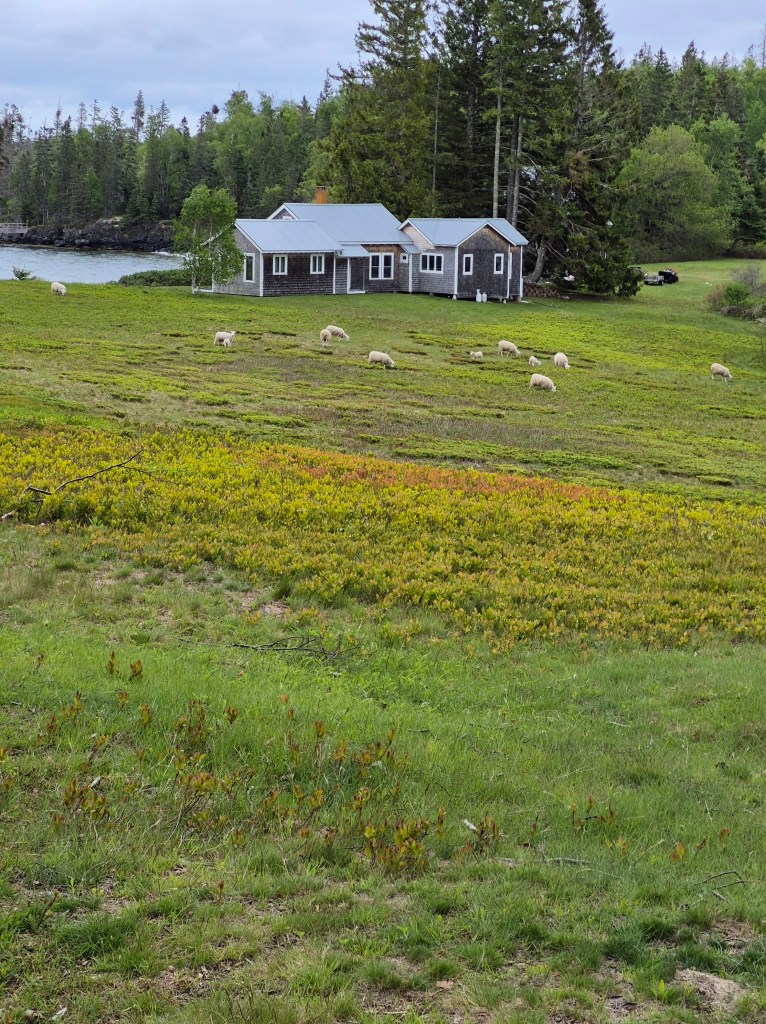
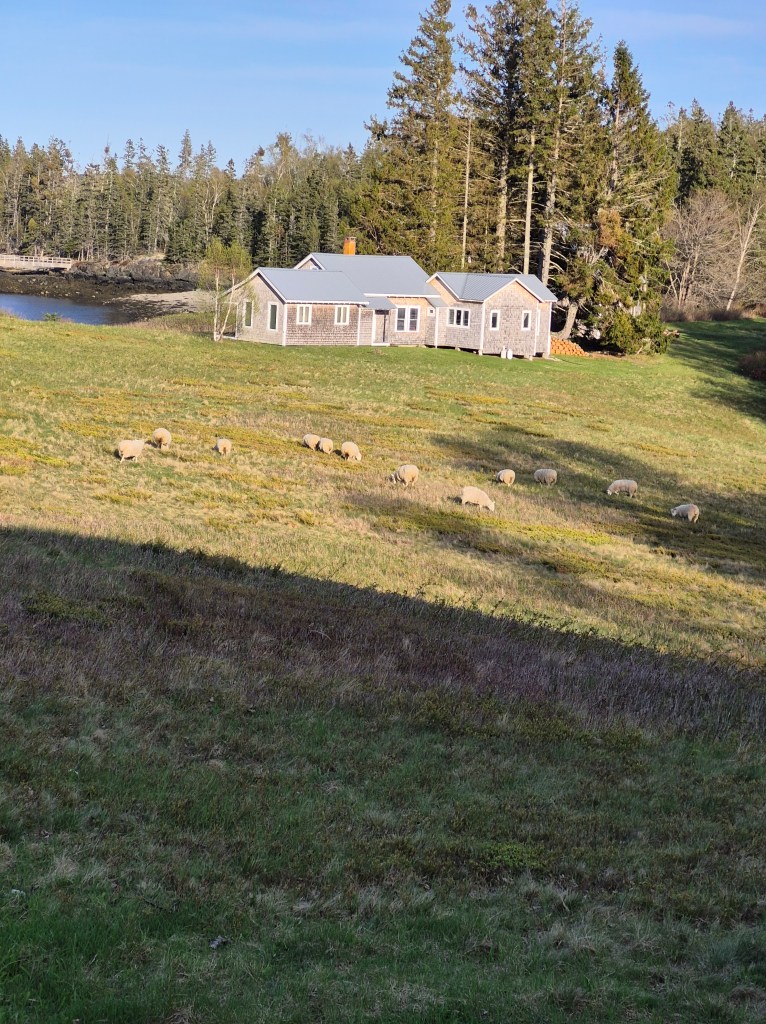
[Above photo: Some of the flock of 12 ewes, a ram (Leland), and 14 lambs.]
May 30, 2026
I awoke at 4:30 AM today. I generally do here, since it is light. I often will snooze or read, sometimes taking a short nap after breakfast to complete my eight hours. A north wind is blowing hard into the harbor, causing whitecaps on the Bay and driving the tops of the large birch trees at the top of the meadow to careen about recklessly.
The prevailing winds here are from the SW. A northerly is generally cooler and is sometimes accompanied by rain and pyrotechnics, although usually clear, dry weather. Our harbor faces north, so boat or kayak launches from the beach are fraught, or at least wet.
The temperature was in the mid-40’s when I arose at 6:30 so I lit a fire in the Jotel 602, a Pullman car-sized stove and in no time the cabin was toasty. After breakfast I saw the sheep at the bottom of the meadow and, following Ari’s lead, walked down the path slowly, shaking a can with a bit of grain in it and carrying a livestock bucket in which to sprinkle it. The idea is to accustom the ram to the process so he’ll be easier to catch. I had no luck but I cannot distinguish him from the ewes—-all looking like fluffy cartoon sheep in their winter coats—so he may not even have been with the present crowd.
This island is a repository of many memories for me, mostly happy ones as a young man and with my family here. There is, however, the single exception of my sister’s unconscionable refusal to share the ownership with my brothers and me. Mom, feeling she’d not been a very good mother to my sister, gave her the title. While it was commendable of her to recognize her failings as a mother, those extended to all of her offspring. Perhaps I should summon more tolerance for my sister about it. If she had ever acknowledged the unfairness in it, I’d feel somewhat more charitable. It bewilders me that she was willing to permanently damage her relationships with two of her siblings, both of whom she clearly loved. Our other brother wasn’t interested in ownership. Her eldest son has rectified the injustice, now that the title has passed to her three children.
It is very pleasurable for me to share this place with friends. And it has been a rare treat to have spent so much time together with my daughter here in the past few years. I also treasure the times that I am alone. Although Michael the caretaker is here, living in a cabin on the other end of the island, it is not visible from my perch. I may see him briefly once per day and we enjoy each other’s company. But solo time on a small island 7 miles out to sea is a treat. “Once you have slept on an island, You’ll never be quite the same…..”
A month ago I travelled to NYC to see friends and to attend my 60th medical school reunion. It is no longer simply [Columbia University] College of Physicians and Surgeons, rather Vagelos College of Physicians and Surgeons. He is an alum who made a fortune working in the drug industry and bequeathed much of it to his alma mater. The gathering of 12 or so of us was not lugubrious, as I had expected. It was my first return to P&S since my graduation. 35 of our class of 113 are dead. Before you gasp, we are all 85yo or older so that is actually pretty good. One of our number, Bart Nissonson, arrived in a loud plaid jacket with slacks to match, his take on our jacket-and-tie dress code.
He’d been the orthopedic surgeon for the NY Rangers, as well as Luciano Pavarotti, whose massive bulk wreaked havoc on his feet. Calling Bart one day when he was in NYC and in distress, Pavarotti needed new, more comfortable shoes. Bart took him to an Italian custom shoemaker and when they entered the store, one of the employees fainted dead away. Pavarotti was a god to Italians.
My classmates were friendly, both interesting and interested. I did well in med school but didn’t like it much. It was the mid-60’s and the deans and faculty seemed stuck in the early 50’s. Plus, I hadn’t found my footing, a sense of what I wanted to do and what I actually felt I was good at doing. I was very self-critical and assumed others felt the same about me. The reunion, my first and last, I’ll assume, was a pleasant closing parenthesis to that part of my life.
I continued south to see my sister, her daughter, and her grandson at their home in Kensington, MD. They’ve done a huge remodel and expansion of their modest house and it is lovely. My niece was incredibly clever and thorough in planning and overseeing it. Jacob has finished his first year at the Peabody Institute at Johns Hopkins, majoring in music composition and production (I think). They all were in good spirits and I was very glad for the visit, although I missed marching in front of the White House carrying a sign saying, “End Presidential Cruelty and Corruption”. As my analyst once said when I asked him about when he’d dust the thick spider webs out of the corner over the analytic couch, he noted, “They’ll fall of their own accord sometime.” The Trump Divestment process will occur on its own schedule without me being arrested, I suspect. I certainly march in my local No Kings Day gatherings and shall soon begin to shadow ICE in Portland.
Regarding ICE, I was directed to a website for a De-escalation and Self-defense course as a pre-requisite to being a formal witness. I must have missed the correct button for the 2 hour Zoom course and enrolled in a 4 hour in-person course. I was the only man and soon realized it was to help women to strengthen their interpersonal boundaries and be able to physically fend off unwanted sexual advances. Um, not my problem. One of the women, very fit and attractive in black leotards and a matching top, was paired with me for an exercise. When she was fending off my approach she quickly, and savagely, demonstrated a couple of moves with her elbow that would have floored me had she chosen to connect. “Where did you learn that?” “I’m a black belt martial artist.” “Then what are you doing in here?” “Oh, I can defend myself. I just have poor boundaries.” It was an interesting afternoon and I came away with an increased appreciation for the crap women get from men. Often it’s not that simple, as she noted, but the fact remains…..
I have a hummingbird feeder on the outside of the screen on the front porch here so the ruby-throated miracles feed up close year after year. Often on my first trip out in May they will hover where the feeder should be, as if saying, “Well, where is it?” At the beginning of September each year, 3 or 4 tiny hummers begin their life by stocking up at the feeder for a flight to S. Florida or Central America (Some fly all the way to Panama!).
A bird feeder with seeds I’ve had hanging from a birch tree for years never seemed to draw many to it. I figured it was too exposed and the feeder looked weird so I bought one of the metal shepherd’s crook hangers and a new Audubon feeder and placed it at the edge of the lawn, adjacent to thick bushes and trees. Last year I attracted the occasional bird, a goldfinch, a cat bird, or a sparrow of some sort. This year the word is out and it is regularly visited by a female northern cardinal and a male red bellied woodpecker. The latter has spectacular garments with a bright red cap and a dramatic zebra-striped back. However, his belly isn’t red, yet another in the naming anomalies of birds. I suppose there were enough red-headed woodpeckers, as indeed many of the males sport such plumage. The person naming it didn’t let the bird’s appearance deter him!
I saw an early dolphin on one trip to shore, which means that mackerel are arriving. Seals abound and herring gulls are abundant, including the one-legged gal/guy who rests on the pier each year. It seems that being an amputee hasn’t decreased his ability to survive; legs aren’t crucial for catching fish or scavenging, I suppose. I haven’t seen the osprey yet, so perhaps they won’t be nesting in the woods behind the pier this year. Nor bald eagles, who visit from other islands but haven’t had a nest here in 15 years.
I love living amid the cycles: trees fledging and shedding, tides ebbing and flowing, meadows filling, birds arriving, snow, rain, wind, calm, night, day, warmth, and cold. They combine into a pulse, like the beating heart of Mother Nature. Decay, death, birth. Sorrow, joy. On it goes, the fluctuance of existence.
Oddly, I also like the tropics, and the constancy of vegetation, temperatures, tides, and daylight hours. While there is some migration of birds, many more species stay put. There is the monsoon. However, for me, living in equatorial areas seems more timeless, since the absence of fluctuation doesn’t continually remind me of time’s onward march. But I miss the extremes, the drama of change which is more pronounced in temperate zones.
I’m pushing 86yo (3 months away) and one of these summers will be my last on the island. My consolation is that I won’t miss it. All of my feelings, memories, skills, and knowledge, will vanish in a trice—I hope. I don’t want to dwindle, gradually losing my brain functions. After taking my sister, 96yo, out to lunch, as we exited the restaurant she said, “It’s so nice to have a cousin to go to lunch with.” “Who is that?” “You.” “I’m your baby brother, dear.” “Really?” And yet, we can have pleasant conversations and she clearly takes pleasure in living. I likely would as well in her shoes, but as of now could hope for a more prompt exit.
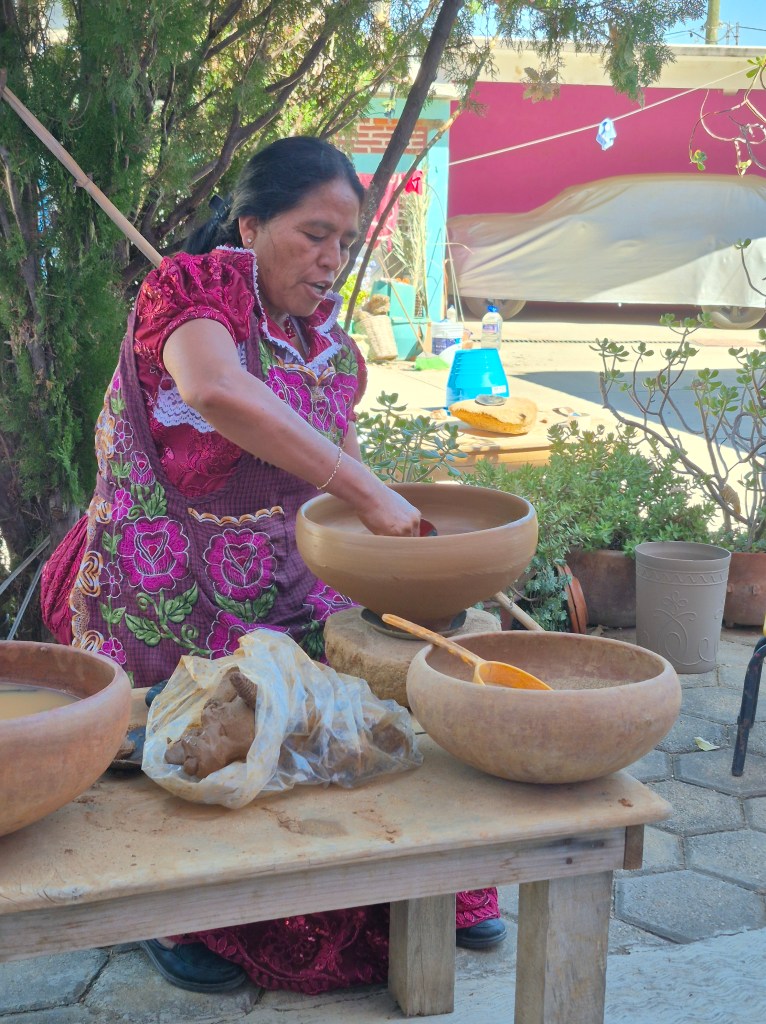
[Above photo: Zapotecan pottter Macrina Mateo Martinez turning a pot.]
February 10, 2026
I was invited to join friends from long ago—I don’t want to say “old friends, although we are getting there—for a week in Oaxaca. Two of them are nurses I worked with when I was in Family Medicine at the Neighborhood Health Center in Alviso [between San Jose and the southern tip of SF Bay] 1968-1971. The other is the husband of one of them with whom I have done a little construction. Both of the nurses, being smart and not afraid to work hard, have gone on to positions of prominence. Esperanza was the head of the Community Health Workers in California, as well as the Chairperson of the National Board of Planned Parenthood. Kate is a full professor emeritus at Stanford and has developed self-management health care modules—-arthritis, diabetes, cancer, etc.—which are currently used all over the world (including in both Israel and Palestine). Arch is an engineer who worked on the BART extensions and, in retirement, has built houses with Habitat in the Bay Area and in Portland, OR.
The primary logistical problem for my trip was going from a frigid, snow-bound Boston to a semi-tropical Oaxaca with daytime temperatures in the 77-83 range. I drove from Portland to Boston with my friend, Eliot, the day before my flight. He had an extra ticket for a concert of the Boston Symphony Chamber Players at Jordan Hall. It was fantastic! I’d never been to Jordan Hall before; it is beautiful with excellent acoustics. The best piece was the Brahms Piano Quartet #1 with the first violin, viola, and cello of the BSO plus Song-Jin Cho, an international ascending star.
We then drove to Eliot’s sister, Leslie’s, home, a massive house on a hill south of Boston. She’s married to a former governor of Massachusetts and the two of them are a lively couple. She cooked us a wonderful supper, I retired to a huge apartment over the garage(s), and awoke to 5’ of new snow. Eliot whisked me to the Braintree-Logan shuttle and the rest was a snap. I left my warm clothes in his car, to retrieve in Portland after my trip, taking only my long underwear and a light Uniqlo down jacket for my departure and return.
Esperanza had secured us a terrific 3 bedroom, 4 bathroom house 2 blocks from the Zocalo (the large old central square, which includes the cathedral). After entering a door on our street, one walks a long way back in the compound to our place, which means that it was totally quiet, peaceful, and secure. We spent a lot of time on the patio, which had a large table and chairs and was roofed by 3 colors of bougainvillea. There was a bird’s nest, with bird, in one of the branches.
I hadn’t been to Oaxaca since 1966 after graduating from medical school. I only visited it for a few days before moving on to San Cristobal de las Casas and a stay in the middle of the Chiapas Highlands with the Lacadon Indians, a group that were so inaccessible the Spaniards didn’t bother trying to harass them. We flew in and out in a small Cessna back then.
It was so easy with my friends, meals together, lots of catching up. Despite there being quite a few tourists in the center of town, the vast predominance was locals. It never felt spoiled, the way Venice or Paris can in high tourist season.
I’d arise around 6:30AM; they’d all sleep until 8:30 or 9. Then I would stroll around the Zocalo until one of the cafés opened. I’d either have breakfast, often huevos con chorizo, or just a cappuccino and watch people warming themselves in the sun as their days began. The chorizo in Oaxaca lacked the punch of chorizo I’ve had in different parts of Mexico, but I enjoyed the revival of my memory, eating the same in a tiny simple food stall on a back street in San Cristobal with my then new friend, Winifred Pulst, an anthropology PhD candidate at the University of Heidelburg.
There is a terrific museum in an old stone mansion near the Zocalo with a remarkable collection of pre-Columbian ceramics. One of the great Mexican artists—Rufino Tamayo—spent 20 years collecting and displaying it, donating it all to the state for care. It helped me to realize there were many more than just Aztecs and Mayans there, and the other groups had their own distinctive takes on the world: Olmecs, Mixtecs, Toltecs, Zapotecs, etc.
Also, in the immense former convent, Santo Domingo de Guzman, were several wonderful exhibits, including an ancient library (many 5-600year old volumes), vast amounts of exquisite Mixtec gold jewelry and adornment from Tomb 7 of Monte Alban, and a retrospective of Manuel Jimenez, famed for carving animals of wood and painting them with hallucinatory brilliance (alebrijes). His work evolved from the simple to incredibly sophisticated painted carvings. He had 4th grade schooling and tried to be a farmer, a laborer, a trumpet player, and many other occupations until he realized that carving animals was his thing. The exhibit was magnetic.
Finally, Esperanza arranged for us to visit a living legend, Macrina Mateo Martinez. In the small village of San Marcos Tlapazola, about an hour outside of Oaxaca, she founded an all-women pottery collective which we visited. She is Zapotec and learned pottery from her mother. At 15yo, speaking no Spanish, she determined to go to Mexico City to sell her work, despite her parents’ strong objections. The rest is history. She now is internationally celebrated and has travelled the world.
She told us her story, and that of her clay, as she created a lovely serving bowl. Her technique was fascinating. Our indigenous pottery from the southwest is coil-built. She has a stone base with a shallow depression carved out of it. On that she places a thin, curved piece of shell or pottery and uses her hand to rotate it as she turns her piece on top. It was miraculous to watch this thing of beauty arise from her skilled eye and hands.
We spent time, alone and together, in the huge central market in Oaxaca. As in most central markets, you can buy most of what you need—or want—, from huaraches to mole, there. It is fun to get lost in these markets, discovering, as you do, new delights. We went to “Smoke Alley”, in a separate part of the market, one night for grilled meat with delicious fresh vegetable sides. I discovered that I was withoutmy glasses later that evening, so the next day I returned. As I approached, the keeper of our booth quietly reached up and handed them to me. He refused to take any money, which was my experience throughout the trip.
Mexico has gotten a bad name from the violence perpetrated by the cartels. I guess I’d avoid Sinaloa and some of the border towns but my experience in Puerto Vallarta, Yelapa, Guanajuato, Oaxaca, and Merida (Yucatan) over the years have all been positive with kind, generous, and helpful people. I’ve found it to be a wonderful place to travel, so very different from the US and yet so close and accessible.
We are having a long snowy, cold spell, unlike any winter I’ve experienced since moving here in 2021. The sidewalks have 2-3 foot snowbanks on each side. Some nights have been in the negative numbers. I’ll drive to Bennington, VT on Friday for a couple of days of cross-country skiing with my medical school roommate, Harold. I seem to be more sensitive— toes, fingers, and nose—to cold than I used to be. It’ll be fun to see him and cruise through the woods on skis.
Of skis, I realized the winter Olympics were starting and I impulsively bought a TV on which to watch , having raced for 4 years in high school in Denver. The TV is big—55”—for me and with good definition. Watching the men and women descend the downhill course at Cortina d’ Ampezzo was terrifying.
It made me realize that I never really liked downhill racing; it always scared me. Jumping didn’t, however, as it allowed for much more control, even though there was considerable speed at the take-off. And it was in a downhill race that I lost my line, went into the trees, knocked myself out, and spent the night in the hospital. The benefit of that was it was the pretext the Air Force used to not directly confront my refusal to be drafted for Vietnam; I was honorably discharged with a 4F. I didn’t have to go to Federal prison (like DT should).
The racers’ comments about the downhill course in Cortina were “You just are struggling to survive.” It looked like it, as well. The network uses drones to follow the skiers down, which makes for an incredibly immersive experience.
This is droning on too long. I had a wonderful time with my friends in Oaxaca; it is so easy with people you’ve known for a long time. You can get to real talk so quickly, simply continuing a conversation that began and was left off many years ago.
I plan to do a workshop next January in Thailand for my Burmese students who are living there. Then I’ll go on to Malaysia to travel for fun. The prospect of the long flights out and back are not to my liking but it will be wonderful to see them all and return to SE Asia for a bit during Maine winter.
[Above photo: An evening view of Le Pont-de-Montverd and the Tarn River, the terminus of our hike.]
4 October 2025
Robert Louis Stevenson broke the trail in Travels With a Donkey in the Cevennes. Maria and Tom created our Action Plan and led our troupe. Mme. Marie-Ange supplied the donkeys. Upio, Hashtag, and Bellou did the heavy lifting. The other 7 of us did our share of donkey duty and hiking.
From Langogne to Pont de Montvert we walked, some 8-14 miles per day, a group of pilgrims honoring not our lord but the charm of rolling hills and tiny valley towns, and always, local baked goods and pate. Sometimes we’d stay at a hotel, sometimes a gite, a more primitive accommodation. Often the latter lacked linens, so those of us with microfiber camping towels would shower, having slept in our own sleeping sacks underneath their blankets. Some used t-shirts or other clothing to dry after showers, depending on how desperately soiled they felt.
The food was variable, with an excess of sausages for supper and, in the Abby de Notre Dame, bread and coffee only for breakfast. The nuns were consistent with their stoicism, providing thin, narrow, scratchy toilet paper. Since we’d come from lovely Lyon, the home of many Paul Bocuse establishments and the current centre gastronomique of France, the contrast with peasant fare was striking, although venison stew and wild boar pate complimented the wild cepe mushrooms foragers were bringing to each restaurant. Cepe tarts are heaven embodied.
We’d rise at an agreed-up hour, depending on the length of the day’s hike, eat, assemble our belongings and prepare the donkeys. Halter them, curry, brush, clean their shoes and hooves, place the saddle-blanket and saddle, attach the cinches loosely, balance the saddle bags for weight and hook them onto the saddles. Full water bottles, lunches, and waterproofs and layers in our day packs, we’d set off.
The Stevenson app was a great help, as the trail changes and the signs and markings lag. The little Cicerone book was usefully descriptive of each day’s destination. We also encountered numerous adults hiking the same direction and they assisted with good cheer and tips.
A pair of French hikers, Remy and Karl, were lively meal companions for a few days. A Viennese youth, heading “around the world”, was sweet and engaging. Quite a number of the other hikers, French all, were at least of late middle-age, fit contrasts to the obese adults waddling around our cities.
The older walkers were reassuring to me. I’d worried that this might be the trip to convince me that I was actually 85yo. I was awakened but not because I couldn’t keep up; rather, the long days simply took a lot out of me.
I’m not certain that it was easier to have the donkeys carry my 8kg of stuff than carrying it myself. Leading a donkey is not a relaxing prospect, at least not for the 6 days we did it. As 24 hours grazers, sleeping in shorts intervals, if they don’t feed every 1 1/2-2 hours, they become discomfited by stomach acid and become headstrong. Lunging for their snacks required each of us leading one to decide to allow it or to assert our dominance. We were instructed by Dorian, Marie-Ange’s daughter, to be firm but kind. We were to convince them that we were in charge. It was a psychological game, as well as one very physical. The upper body workout with a hungry 600-800# animal was considerable; I developed a tendonitis and swelling of both my hands from pulling on the lead or grabbing the halter itself. In extreme instances I grabbed both the halter and the animal’s nose to gain control of the head.
It often takes 2 to drive a donkey, one on either side of the head or one in front looking ahead with a loose lead and one in back poking or pushing the animal’s hindquarters when they pause. Shaking a small branch with leaves often helps to get them started again. Tugging, as in trying to dominate a toddler who has just learned “No!” or as in trying to argue with an unfortunate suffering with anorexia nervosa, is sure defeat.
At lunch-time we’d remove their packs and saddles and put each animal on a long lead attached to a tree so they could graze and rest. They liked to stay close to each other; once we had to drop small wedges of apple, Hansel and Gretel-fashion, to draw Hashtag close enough to a distant post to tether him. At times there wasn’t adequate feed beside the road for them and we’d have to move further along. They loved the leaves and stems of a sumac-like tree.
We purchased and carried oats, apples, carrots, endive, and lemons as treats for them. 2 of the three liked to squeeze the juice out of a lemon half and spit the pulp on the ground. I have no idea of the discrimination of donkey taste buds. Are they capable of sweet, sour, bitter and salt like us?
I bonded with Hashtag on the first day and walked with him much of every day until the last when I switched for Bellou. I’d assumed that the former was old and, thus, headstrong when hungry. I discovered at the end of the trip that his temperament was a result of adolescence. I initially assumed I was a better donkey-whisperer than I actually was, although I was comfortable with them. I liked them all; they are sweet and hard workers but demanded much more of us physically than I’d assumed.
A couple of frightening times included Upio getting stung by a hornet and bucking and galloping down a trail untethered. The next day as I was letting Hashtag graze, he stirred up an entire nest of hornets which pursued him up the hill into a gathering of the other two donkeys plus hikers. All three then burst into a gallop down a long road and out of sight up a side road. We’d learned the day before to simply let go of them if they ran. Tom, Maria, and I followed and they were shoulder to shoulder, looking back at us, wide-eyed. Adrenalized, they’d outrun the hornets. We let them settle for some minutes and resumed our journey.
On the last part of the final day, as we descended the lower slopes of Mt. Lozere, the trail was narrow, rocky, and steep. There is nothing quite like leading a large beast down a steep slippery trail, hearing their metal shoes sliding behind you on the rocky ledges they must traverse. But they were sure-footed and mindful partners in the venture, knowing the trail well. No one was crushed or even stepped on.
Of my companions, each had an interesting story. I shall not attempt to repeat them in detail—I’ve not Chaucer’s gifts—but all revealed humor, grit, and kindness. This sort of trip is a good filter. One woman had lived in her 20’s at Findhorn in NE Scotland, for those of you who recall it from the 60’s. Her parents were Polish, captured by the Soviets and they spent 2 years in the same gulag as Alexy Navalny. Others had spouses with varying degrees of infirmity, adjusting their lives to address the now very disparate needs of two adults in later life. One had a knee that was in trouble but still walked the trail most days uncomplainingly. A recently-married son of one is an accomplished sustainable-energy engineer who cannot find a job since our government has pulled all funding for those programs and must rejoin his Taiwanese wife there, jobless. There was always plenty to discuss and we rarely fell back upon the obvious—the outrageously corrupt and dangerous conduct of DT and his cowardly or malignant sycophants.
The countryside began as gentle hills gradually becoming steeper and higher. Much was forested with spruce, pine, larch, beech and birch. There were endless stone walls encircling emerald meadows containing immense dairy cattle, gigantic bulls, and horses. The latter were usually curious and ran over to where we were. Some were draft horses, some leggy, athletic runners. There were no Quarter Horses or Appaloosas. All were handsome and well-fed. We saw sheep only once, a group of 5 or 6 in a darkly-shaded pen. Previously, this was sheep country but the market for wool has vanished world-wide, replaced by petroleum-based polyester fleece.
We encountered deer hunters with a baying pack of hounds on one day. Soon after seeing them, a doe with two fawns ran frantically up a nearby meadow, then down it, and up again. Bambi! No gunshots were heard, thankfully.
We covered the middle section of Stevenson’s journey. If we’d gone further into the Cevennes National Park, we would have traipsed through the Central Massif of France with longer and steeper climbs. As it was, our climb to the Finiels on Mt. Lozere reached 1699m, a bit higher than Maine’s Mt. Katahdin (1606m). That day’s walk was about 14 miles, an exhausting end to the trip, given our donkey-work and the treacherous descent.
I spent the next two nights in a comfortable hotel in Le Puy-en-Velay, a darling medieval town with an 1100 year-old chapel (and frescoes) atop an extinct volcano. On a higher plug was a tall statue of the virgin Mary cast from Russian cannons captured during the Crimean War after France was victorious at Sebastopol. The Cathedral of Notre Dame is the oldest point of departure in France for pilgrims on the Camino de Santiago de Compostela. The town has wonderful restaurants, food shops, and an astounding 500 year-old lace industry. There is a large school for those who want to learn the practice of making lace by hand, a trying craft.
Totoom runs a very agreeable shuttle service and I was at Lyon-St. Exupery with time to spare for my flight to Porto. My nephews met me at the airport and whisked me to their lovely farm/orchard where I’m enjoying the pleasures of their and my sister-in-law’s company and the Portuguese countryside.
The Chemin de Stevenson was an unusual experience. I’m unequivocally glad that we did it as we did. I wouldn’t repeat it with donkeys, however. I would enjoy hiking the final section in the Cevennes with companions in the future, carrying my pack or with a baggage transfer service.
[Above photo: All 12 accounted for. It could be Barra or S. Uist in the Hebrides, except the house would be smaller and of sod or stone.]
6 July 2025
My memory these days appears as evanescent as the wild strawberries that for two weeks cover our meadow. How can something so sweet and lovely be present for such a short time in our lives? And then, how can our lives, filled as they are with sweetness and sorrow, be so brief?
I hadn’t realized how widespread our wild strawberries were until this year when I was here early enought to witness their blossoms—white with yellow centers—covering the floor of any sunny, grassy open space on the island.
They evoke for me, in layers, memories of my college years. Erik Erikson showed the Ingemar Bergman film “Wild Strawberries”, among others, in the class he taught. It was entitled “Identity and the Life Cycle”, certainly topical for a group of students about to leave the safety and structure of school for the wider world.
I recall bits of the film, basically an old man travelling to his summer place in coastal Sweden. He picks up a young couple who are hitchhiking and, feeling their vigor and romantic attachment, reflects on a summer from his youth, which includes memories about a frustrated romance with a lovely young woman at that time.
Wild strawberries have that valence for me. Summer, youth, romance, joy and heartbreak. The berries are painstaking to harvest. Either they aren’t quite ripe and you must enjoy eating the attached tiny leaves and stem or you have hit the time exactly correctly and they fall off into your fingers like tiny garnets of intense flavor. All while lying on the ground and smelling the grass and earth. Sharing that moment with a lover is exquisite.
Fireflies are also in an amazing profusion here; I’ve never seen the like. At dusk, as we drifted back to our cabins, ears ringing and eyes stunned from our modest fireworks display on the beach, we were treated to a much subtler and more magnificent show: the meadow silently pulsing with entire rafts of fireflies. It is a wonder each night. How much mating can they do? Quite a lot and while I envy them their passion, I hope they continue, as I find I love being a voyeur to their courtships. Of course, I’d rather be lighting up myself but that isn’t my fate at the moment. Or, more accurately, I haven’t the motivation to create the opportunity right now.
In addition to the mystery of their synchronous ignition, fireflies are remarkably efficient. The chemical reaction that causes their glow generates no heat, unlike even our most advanced lightbulbs.
The island is in full swing, with 19 Varlands and David and Kirsten bringing 8 friends, including kids. That’s 31 people, including Michael, the caretaker, and myself. Oh, and 12 sheep. All the humans drinking from one surface-fed well.
At Ari’s urging, we set up a gutter and water-collection system (two 50 gallon tanks) at my house for the sheep. After a couple of good rains, both were full. Now that two houses and the barn have metal roofs, I think we could supplement our well amply. The occasional drought or dry spell, combined with many of us using the well, has challenged its capacity in the past. And if sea-rise mixes salt water into the low area where the well is situated, we could likely collect enough roof-water to suit our needs.
Note my inclusion of myself in the future, “we/our”. The sea won’t rise sufficiently in the years remaining to me to ruin the well. However, it is a challenge to think about the future here without including myself in it.
Chas is facing the same dilemma, although more immediately than am I. Susan has worked tirelessly to accommodate his needs and he appreciates it deeply . Imagining my world without my brother in it is difficult for me, despite our differences. We’ve known each other for so long and have shared so much fun and hardship earlier in our lives.
Speaking of hardship, the careless cruelty of the recent legislation—and of the entire first 5 ½ months of DT’s reign—is breathtaking. It is astounding to me that our system of government is so vulnerable to a bully with charisma (for some—revulsion for me) who aligns with our most regressive, greedy, and callous impulses. And that he has cowed and twisted the agencies of government, including the Supreme Court and Congress, into unrecognizable positions, while forcing others to lick his boots and pay him tribute. The detention center in the Everglades resembles nothing so much as a Nazi work- or death-camp. In a very perverse way, his ascent is quite miraculous.
Ezra Klein’s recent podcast with Kyla Scanlon on “How the Attention Economy is Devouring Gen Z” is fascinating. They think—and I’m paraphrasing here—that the secret of DT’s appeal is that he embodies Twitter algorithms, lives them. He utters an unending sequence of brief dramatic bits causing many to become “addicted” to him like many are to social media on their smartphones. Dopamine hits. A previous staffer said trying to brief DT was like chasing a squirrel around in your back yard, his attention span was so brief.
I’ll march and give money and write postcards and email legislators but also fish for mackerel and socialize with friends and family, be supportive of my daughter and my brother and his wife, paddle my kayak, and bathe in this wonderful bit of Nature in Penobscot Bay.
I watched with wonder as my uncle Fran was true to his love for his daughter, she with rapid-cycling Bipolar Disorder. Lucy was in and out of mental institutions on both coasts, periodically being scraped off the kitchen floor in an apartment where she’d lain for a day or two following an overdose. Her older sister had graduated from Oberlin Phi Beta Kappa and killed herself the following year. Fran didn’t collapse or withdraw, given these terrible blows. He was a fun-loving and civic-minded man, a founding partner in Seattle’s best liberal law firm, a hiker, and a raconteur, as well as a strong and constant support to Lucy. He was able to celebrate the good parts of his life. His has been a good model for me to emulate.
[Above photo: Poor Baby, complete with diaper, relaxing in the living room of our cabin. Ironically, she’s chosen a spot beneath an oil painting of a Border Collie looking down at, I imagine, a loch in Scotland.]
18 June 2025
I’m alone in our cabin. Michael, the caretaker, and Robin, the college-age son of one of the other owners, are in two cabins at the other end of the island. It rained overnight and continues to drizzle.
As I look through a window down the meadow, the 12 sheep are peacefully grazing and lying in the wet grass. They are enclosed in an expansive electric fence which provides them with adequate forage for a week or two. There is a plastic watering trough with 15 gallons of rainwater in it, although they drink from it only occasionally. They are used to getting their moisture from seaweed and grass. Unlike Gemsbok (or Oryx), those showy elk-sized herbivores in Southern Africa and the Arabian peninsula, the sheep don’t excrete uric acid pellets. Oryx don’t drink water at all. They are so constructed that they get all their water from desert plants and then conserve it fiercely. Maybe when Elon Musk moves to Mars he’ll be able to do the same.
I didn’t think we’d be able to fence the sheep. Ari and I walked and plotted their routes, constructed elaborate chutes of fencing, and otherwise hypothesized the many ways to succeed in our quest. But the woolies never cooperated, always one page ahead of us.
We attempted several times to move them around the beach and into a pen behind the barn. “We” included Ari, her sheep-partner Suzanne, and Suzanne’s daughter, Rosie. Rosie is a bit of a magician with animals but wasn’t able to advance time and training for Ari’s puppy, Storm, in order for her to assist us. Pearl, Jon’s border collie, is a gorgeous, affectionate animal, a showdog, really, who is afraid of sheep. When Ari first brought a few sheep to her spread on land, Pearl was terrified, jumping into her arms!
Finally, Ari gathered a group of friends, including two of Suzanne’s sons, both of whom are competitive runners. 10-strong, we tried to move and enclose them one morning but at the last moment the sheep darted into the dense undergrowth and escaped. We retreated to our cabin where Poki had made a wonderful lunch. Rested and enjoying the cool of late afternoon, we tried again. We moved the sheep from their preferred beach, Bare Ass or BA Beach (named in my mother’s day for evening swimming exploits), around half the island’s circumference to Harbor Beach, below the barn pen. There they broke, leaping up the bank where half of them ran into the pen which we then closed. Ari ran 15 miles that day, according to her pedometer. The boys likely ran 20. It all was exhausting, if exciting and fun.
There was gratification but still some anxiety, since 6 were on the loose and we had to return four of our group to Buck’s Harbor, leaving a smaller number to herd.
The next morning we tried again. The tides had cooperated, being dead low early in the morning, which gave the sheep a greater incentive—sense of security, really—to stay on the beach rather than ducking into the thick forest for cover. This time they broke at the last moment up the bank and our hearts sank, knowing they had gone to an area where the fence was secured. Then one at a time, as in a hypnogogic state, they hopped over the fence to flock with their, we prefer to think, better halves.
At this point, enclosed in a double fence and no longer being pursued, they responded like a distraught infant to swaddling, and relaxed, grazing and gamboling as sheep are wont to do.
Exhilerated, under Ari’s newly-achieved expert guidance, we moved them into the hard pen. Sheep can easily run through or over an electric fence if frightened. But the hard-sided pen, with metal posts, welded wire fencing, and hog-panels for gates, was small enough that they couldn’t get enough of a run to hop out and was sturdy enough to withstand their pushing against it.
Then the shearing began. Ari and Suzanne each grabbed a sheep by one back leg, dragging it, struggling, over to the 4×8 plywood sheet salvaged from the beach, gripping its head to force it down, and then flipping it onto its back. In that position the sheep were calm, dissociated, I think, from the trauma of being overpowered and their helplessness to resist.
Ari loved it and has worked hard to get a lot of shearing practice subsequent to her week-long course at UC Davis this Spring. She shears for a couple of older Maine shepherds she has befriended. She has done this on Richmond Island (“Gross and bloody, they were all covered with engorged ticks.”), on Metinic Island (“The most fun I’ve had since summer camp in 8th grade.”), and in Machiasport this weekend.
She, with a fancy battery-pack electric clipper, and Suzanne, with hand shears, gathered 4 huge bags of wool to be processed and spun and another for garden compost. For the sheep, it was like a child’s first haircut: terror, followed by relief and a bit of braggadocio.
All the sheep are now contentedly munching away, their pasture and water changed once per week. It would be better for them, the island, and Ari, if, after shearing, they could run wild. More fun for islanders, as well, especially the children. But for the harmony of the community, she’ll manage them this way through the summer.
Toward the end of summer we’ll build a shelter out of driftwood for them in a secluded area at the top of the meadow. Next December, we’ll select a stretch of good weather and run the 12 miles in our boat to deliver a ram so there will be lambs in the spring, sheep gestation being about 5 months. And so the cycle continues.
There are so many life lessons in all of this. First about community, that of the sheep and that of the shepherds. Did I mention that one of the three rams in Ari’s barn was particularly aggressive, butting the other two and slamming Suzanne hard in the crotch? Ari jumped into the pen and wrestled the animal to the ground. Suzanne dispatched it with a captive-bolt stunner to the head, and they skinned, butchered, and placed it in the freezer, all before 10 in the morning. No Little Bo Peeps, these shepherds!
“But what about Poor Baby?“ you ask. Poor Baby was the second of twins of a Merino mother who couldn’t feature two babies simultaneously and rejected her. Put in diapers (upside down they snugly fit a lamb), she is being bottle-fed until she can graze. She is imprinted on Rosie and follows her like a puppy. Poor Baby is incredibly cute, jet-black with a white skull-cap, more Amish than yarmulke. She terrifies Pearl, sniffing around her, and is totally immune to fear of Storm, growling in her cage like a ravening wolf.
There are many Poor Baby’s in the world. I’d imagine all of us have felt like a Poor Baby at times in our lives. Especially Donald Trump, whose early life must have been void of love and strong values, other than greed and the acquisition of power. I suspect he was bottle-fed. My sympathy wanes when I imagine how many people he is hurting and killing from his policies, how he is making America and the world so much weaker, more dangerous, and crude.
The monomania of these billionaires to acquire and control is an illness. It expresses the same degree of salience for them as heroin or crystal meth grips an addict. It is their primary and most reliable pleasure. They are all mentally ill, although their diagnosis is not well defined in the DSM-5 or well-managed with our current treatments.
How can his Base not appreciate this? The Dems have certainly not helped, with their tacit supports of Big Business and their wimpy half-measures for the working men and women of our country.
Don is certainly the perfect moniker for DT. But the No Kings protests demonstrate how others can prevail. Poor Babies all.
I’ll never whine about the price of a woolen sweater again. And if I question Ari’s judgment, I’ve suggested she just say to me, “Remember the sheep.” A certain genius there.
Ari and I have spent most of the past month, starting in late April, on the island in 3-5 day chapters. I’ve not visited it before the 1st of June previously. We left Center Harbor in Auk, our 19’ Seaway, loaded with gasoline, water, food, electric fences, metal fence poles, a large and heavy roll of welded fence wire, two dogs, and last summer’s end of season laundry, on a mission.
The sheep need shearing. And they also require containment on the meadow over the summer so they don’t poop everywhere, nibble lettuce from gardens, and upset some of the residents. I get it, although sheep poop is odorless and decomposes quickly, fertilizing the sandy, thin island soil.
Ours have been expeditionary visits, to see if they had survived the winter and to attempt to map their habitual routes so as to better trick them into a pen. It turns out, they may be smarter than we are, despite at least 37 combined years, excluding kindergarten, of high-end and expen$ive schooling between us.
We landed at dead low tide. It wasn’t planned or desired. It is just much easier to travel early in the morning before the wind and waves pick up. It turns out that landing at dead low is best since the beach then is less sloped and Ari could unload wearing her rubber boots without the water cascading over their tops.
There is no float yet, no moorings (although we set one up on a subsequent visit in anticipation of a brisk northerly), no water system, and no motorized vehicles to carry our stuff up the hill to our cabin. Still, we managed to lug everything up, even getting buckets of water from the well for the dogs and washing dishes.
The osprey, loons, crows, black-throated green warblers, eider ducks, song sparrows and hermit thrush all make a symphonious racket. Mackerel aren’t yet in the bay so neither are the porpoises.
Happily, the sheep are still a flock of 12 and look very healthy. It turns out that they are descendants of the first sheep to come to the New World—or at least this part of it—, 200+ years ago. They are North Country Cheviots, hailing (Do sheep hail?) from central Scotland. They were raised for meat but their wool is marvelous. These look like puffballs, so thick is their coat.
They sheltered under my house in the bitter of winter for quite awhile, judging from their scat. I raked out a few bucketloads and spread it on my blueberry plants and my garden patch. They moved things around under there, tossing 4 sawhorses out onto the lawn, dislocating much of the plumbing, and breaking the drain from the kitchen sink, a minor issue now repaired. We’ll build them a shelter for next winter; there is enough driftwood, including plywood, on the beaches for a mansion. And we’ll put chickenwire around the base of my house so they don’t intrude.
We ate like royalty, as Ari is a terrific and discriminating cook. And walked and walked and walked, tracking the beasties by remnants of their wool left on wild raspberry vines, low spruce twigs, and other impediments. We strategized on how to catch them. We played Bananagrams at lunch and Scrabble after supper, she winning most games. And we laughed a lot, especially at the antics of her 9 month old pup, a pure-bred Border Collie who as of now is just very excited by the sheep without the discipline or training to work them.
It is strange, because if Ari had a working sheep dog, it could put the sheep in a pen in 10 minutes. Meanwhile, we erected long swaths of electric fencing which eventually form a chute leading to a sturdy pen we built where they will be contained for shearing. If they go into it. I certainly never would have guessed my daughter would desire to be a shepherd but since she does, I’ll be supportive.
I noted to her how fun it has been to work together on the island this Spring and rebuilding her boat last Spring. She agreed and noted that, living in Maine, it was likely we’d be working together every Spring. Not bad!
I won’t explore the frightening mess the thieves and liars and rapists—Oh, shouldn’t they be heading to that hotel in El Salvador?—are making in DC. But I’ll lift my sign and my voice on June 14th , joining the multitudes. It seems like we need a nationwide work stoppage soon.
Maine weather is such a tease. When I came back from the island three days ago, it was 68 degrees and the E. Prom was filled with people at play. The past two days it has been in the low 50’s and rainy. Summer, however, will come. My tulips are up and one of my lilacs has 6 or 7 blooms, despite not getting adequate sunlight.
[Above photo: A lone sailboat heading away from the shores of Portugal (Nazare), it’s sole witness a herring gull. Probably the skipper is feeling some of the same mix of fear and excitement as did Vasco de Gama, Ferdinand Magellan, Henry the Navigator, and more, moving from warmth and safety toward the cold and wild unknown.]
2 April 2025
Since it is risky to assume our courts will save our democracy, given our Scofflaw-in-Chief and the regressive warp of the Supremes, we need to support Republicans in Congress to grow a spine or at least don a spinal brace. I’d say “Man up” but that ignores both the courage of women and the treachery of our female GOP legislators. How can we encourage them, protect them from Trump’s paramilitary and fanatics, and assure them that opposing him will be a popular position at the polls?
I’m not sure. But a time-honored method of protesting government malfeasance, used all over the world since medieval times, has been banging on pots with a wooden spoon. For the two months I remained in Myanmar after the military coup of 2021, at 8PM in Yangon a holy din arose. We contributed. It sounded like half of the 5 million citizens joined in with their soup pots, banging away for 10 minutes in the dark. Then they sang a patriotic song. It sent a powerful message to the military. And, it was fun, free, relatively anonymous since done in the dark and in backyards, and was legal.
In the Middle Ages pot-banging was used in Spain as a mock moral scolding to newly-weds when they began their married life in bed together. It also was employed in noisy street processions designed to shame men who married very young women (girls). Since then it has evolved as a universally-recognized form of government censure, used both on the Left (Salvadore Allende) and Right (Pinochet) in Chile and in other S. American countries, Europe, and Asia.
I think it could be used here to put the current crop of greedy juveniles on notice and might spread like wildfire, since it is fun, effective, and non-partisan. It might contribute to the orthopedic rejuvenation of our GOP legislators. We could all start at 8PM, each in our time zone, bang away for 10 minutes, and conclude with a verse of America the Beautiful. It would relieve tension and promote togetherness without the need for thought, argument, public speaking, or wealthy donors.
I’ve written to Bernie, left a voice message at AOC’s office, contacted Indivisible, and the Maine Democratic Party. I’m preparing a leaflet for my neighborhood in Portland but don’t want to have it start and fizzle because I haven’t gotten the word out adequately.
Any suggestions? Or leads for people in your area? Get in early as it might turn into something.
It was warm and sunny yesterday; today it is cold and sunny. At least the snow is gone and hopefully we won’t have more. Maine Spring lives up to its reputation, once again. I rented a rack space for my kayak at the East End Beach, just down the hill from my home. I can keep it there from 1 May through 31 October, giving me easy access to the coast and islands of Casco Bay. I can’t wait!
I’m taking 3 courses—film, African Politics, and crime fiction. It is great fun to watch a film a week together with 45 other people and then have an hour of group discussion, something I only did once in a class led by Erik Erikson. The use of film in education was new at that time. Our current theme is “limnal space”, or transition. In this case, we are looking at the period between adolescence and adulthood.
The politics course is taught by a Congolese who is getting his PhD. He’s smart, knowledgeable, and cares a lot about it. He also has the advantage of having grown up in the midst of that craziness.
The crime fiction course is taught by a detective novelist and the eight books we read and discuss are all set in Boston, where I went to college and where my mother grew up and all my sibs were born. The discussions are lively and perceptive and it is startling to view new slices of Boston I’d never considered in vivid, often blood-red, hues.
At Mainely Character we are deep in the work of selecting 13 scholarship recipients from 375 applicants. It’s the only scholarship in Maine (anywhere?) based solely on character. Achievement with grades, sports, musical instruments, etc. doesn’t directly affect our assessment, other than as platforms for the students to demonstrate their courage, concern for others, responsibility, and integrity. All 13 of us on the Board love it and many of the applications cause tears, as we note how remarkably some kids rise after terrible blows. They give me hope.
Let’s all join the barricades on April 5th! We’ll remind them that their cause isn’t just and that they won’t triumph!
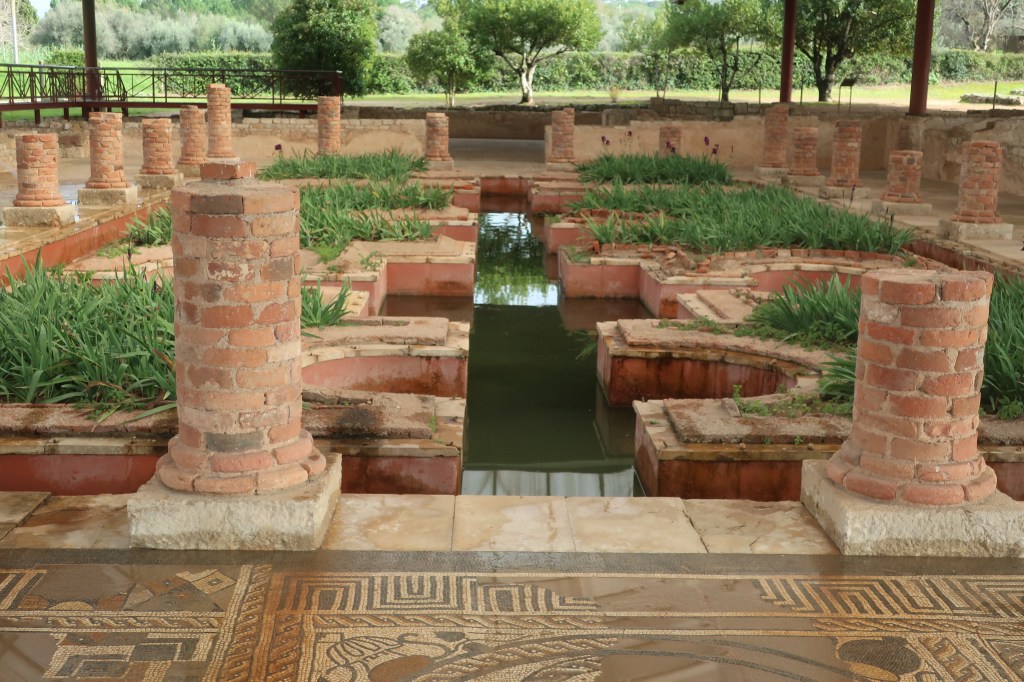
[Above photo: The entrance to a wealthy Roman’s home in Conimbriga, Portugal, a timely reminder that money only gets you so far.]
3 March 2025
What is happening now in our country is suffocating. However, we have to breathe what air we can find and rise up. The revenge bus, those of us shouting “Told you so.”, only goes to the dump and back. It is a terrifying time, noting that it apparently took Hitler only 53 days to dismember the German Democratic Republic. DT is trying to break that record.
A chainsaw is an apt metaphor for EM’s operation. If you want to save money by making government more efficient, you analyze the various elements to discover what is actually inefficient, not simply close down entire agencies.
Cutting off USAID means condemning millions of children and their parents to starvation and more. Stopping funding for PEPFAR will condemn pregnant HIV-positive mothers, who were probably given the virus by their galivanting husbands, to give birth to HIV-positive infants and for children and adults to no longer receive life-saving anti-retroviral medications. Nuclear inspectors, cancer research, early warning systems for hurricanes and on and on. It will mean hundreds of thousands out of work and overburdened, ineffective government. Jeez, the IRS returns $12 for $1 spent when auditing wealthy tax cheats, so why cut those services in the name of efficiency? In a totally different category, either a surrender or a re-alignment, given your understanding, is closing off our crypto-surveillance of Russia? Let’s cozy up to the samovar, eh?
It’s nothing about efficiency. It is all about cowing the American public with a show of overwhelming, if illegal, force and restructuring government to funnel money to the super-rich. Kleptocracy, a la Russia, is the main course being prepared in the White House kitchen. Loveless and insecure schoolyard bullies will feast on it. Those who oppose them, and their families, are in potential danger, given the repeated endorsement of violence by DT. I do wish some members of the GOP would demonstrate the spine of Liz Cheney and Adam Kissinger’s, however. Bubba Schumer should not be on TV representing the Democrats; none will follow him.
When I had lung cancer, one of my many crazed chemo-brain fantasies was to form a cadre of terminally ill but like-minded people to assassinate those who endangered our democracy. Even then they were scheming. It would be a dreadful thing to initiate a cycle of violence, then or now, and it would be totally counterproductive. It is surprising to me how quickly my mind turns to violence in this situation, however. I suspect that I am not alone.
I just fired a contractor whose brother was fixing rotten sills on my front windows. It was a one-man job but I was paying for two. After 3 days work they’d cut off and refaced only 2 of 6 sills, working a few hours a day and disappearing. A promise to come and work an entire day to finish off the job was demolished when the brother showed up at 1 on a Monday, so drunk he couldn’t finish a sentence. Then I discovered that a box of my bits, one of which he’d used, had vanished and, a few nights of restless sleep caused me to end the entire debacle.
I hate dishonesty. I don’t cheat on my taxes, although knowing where they are now likely to go may change that. But interpersonal dishonesty infuriates me. We had one of these experiences when we had a kitchen redone. Poki, thankfully, went over the billing and found time-stamped receipts when the carpenters had charged us as being on the job from 8-5 but they actually were on their way to work, stopping at a hardware store 45 minutes away from us at 11AM. And more of the same. This cannot be of interest to anyone except myself, but I need to write it down and send it out—self-exorcism.
I am looking at hiking with a small group in southern France next September, following the route of Robert Louis Stevenson’s Travels With a Donkey in the Cevennes. We won’t sleep outside, rather in BnBs with stables, as we’ll want to bring along at least one donkey for the full experience. We may use a van to transport our luggage or we may hire a number of donkeys. I loved the name Stevenson gave his: Modestine. He seemed to have invented the sleeping bag; his was a sack of waxed canvass lined with sheepskins. It likely weighed about 60 pounds but kept him snug when living rough. The woman assembling the trip is a professor of French literature and a lively soul. Afterward, I’ll slip over the Pyrenees and visit my sister-in-law and nephews near Porto.
Ari is training her Border Collie, Storm, walking 10 miles per day so the dog won’t tear things up. She is becoming very knowledgeable about dog training and sheep, such an interesting turn for this city creature. I can’t wait to see how the 12 sheep on our island fared this winter. I expect the meadow to be remarkably verdant, what with the grazing and fertilizing. Ari has the patience of Job with this dog. Smart, sweet, and very athletic, Storm has a mind of her own and is not easy to bend to another’s will. I couldn’t do it; it is way beyond my patience.
I’m trying to think of catchy slogans for a placard I’ll carry in the soon-approaching mass protests. “Serve not Steal”. “Democracy not Kleptocracy”. “SOS” or “Save Our Ship”. “On Life Support”.
In a push to complete my memoir, I’ve signed up once again for the 4 day writers’ workshop, Black Fly Retreat, at the Schoodic Institute near Acadia. I need nudges but I am making progress. It isn’t turning out to be what I’d imagined, a collection of interesting experiences. It is more an internal monologue, a description of my inner world and the experiences are only placeholders. But sometimes it just feels like an indulgence and boring. We’ll see.
Call and write your congressperson, local and national. The louder the uproar, the better. And there will be a huge MAGA backlash as the cuts will hit red states more than blue. The leaders of this destruction all have more money than they can spend so why take it from working people? I assume all the destroyers’ mothers had sour milk. Or sour personalities.