23 May 2021
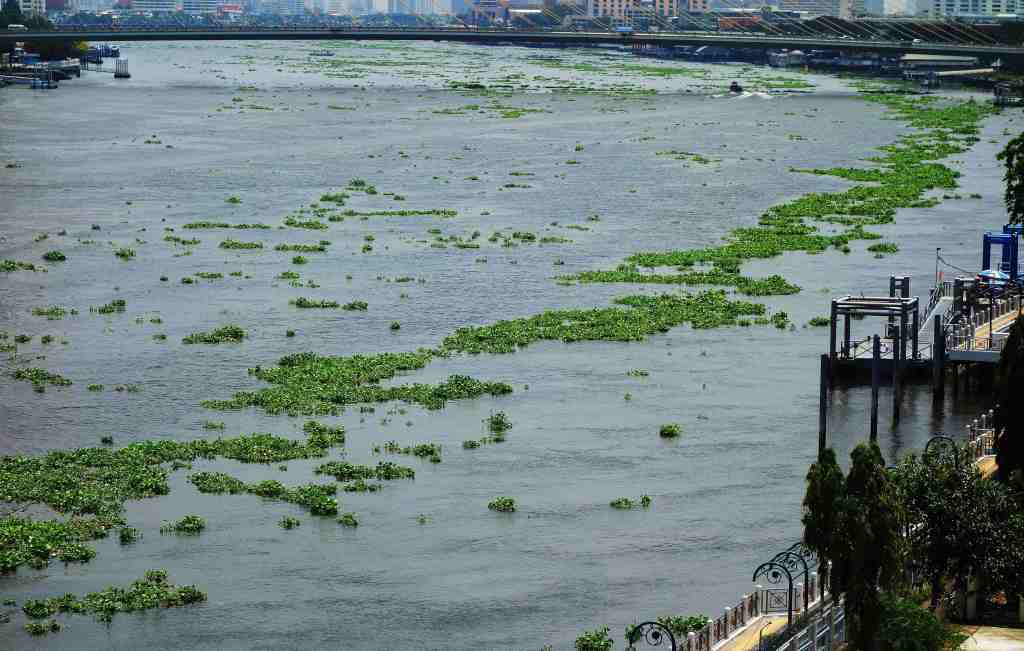
[Above photo: I’m not fully back from Thailand. Water hyacinth thrives in the Chao Phraya in Bangkok. I hope our kale does as well.]
I awaken each day at 4 or 4:30 as the sky lightens to a cool rose hue. Ike, Ari’s small dog (“Bred for hors d’ouvres.”), is alert as I roll over to ease my sore left shoulder. He slowly arises from the foot of the bed, comes closer for a pat, and crawls under the covers to stretch alongside me for a quick nap, his pack instinct kicking in. It feels wonderful to have a living animal next to me. I loved it as a child when my cat had kittens and all the babies would crawl around under the covers. Touch, even animal touch, activates a lot of systems.
As I get up, he jumps to the floor, fully alert. I put on my slippers and descend the steep farmhouse stairs into the nippy living room. I put on his leash and take him out the front door to pee. I return into the kitchen where I light a burner under the kettle. Retrieving his bowl, I break 2 biscuits into it, and pour a bit of the warm water over. He is spinning like a top now, fully activated with anticipation of the same meal he’s had twice a day for who knows how many years. But who am I to judge? I can eat oatmeal with walnuts, prunes, and bananas on it morning after morning with a similar relish. I don’t spin around, though.
Then I crumple up paper and lay logs in the Jotul. It often takes me two tries to get it going but quickly the cool edge of morning melts. Then back upstairs to shave and the rest before I fix my breakfast and tea.
I’d thought it would be difficult to write about the familiar. The exotic presents so many stark contrasts and easy surprises, almost cheap scenery. The advantage of the familiar, I think, is that it encourages me to focus otherwise. We’ll see.
We’ve taken three lovely hikes. Two to Harriman Point, a beautiful woodland leading to long pebble beaches and rock shelves, donated to the Maine Coast Heritage Trust. Then we bounced up Blue Hill, which is a smaller version of the many hills in Acadia NP, topped by a granite cap from which Eastern Penobscot Bay can be viewed. Ari could see Beach Island; my unaided eyes weren’t up to the task.
Ari’s home is lovely. She has worked like a beast of burden to make it so. As with old homes and extensive outbuildings, it presents one damned thing after another, which is one view of life, I guess. This is planting time for flowers and vegetables and she has extensive beds for both. Since it has been dry here, daily watering is necessary.
While the watering is a repetitive chore, I notice that I quickly become acquainted with each plant and how it is faring. It’s a bit like having many, many children and watching them all grow. I transplanted some kale that were too tightly spaced. One bunch was actually two varieties, Siamese if you will, but trying to separate them would have killed both, so intertwined were their roots. The latter attempt, plus moving them at high noon, induced a swoon. Transplant shock. Each lay on the ground as if giving up, the kind of event that can occur after a traffic accident with minor injury. They didn’t look much better the next day. Ariane seemed non-plussed so I put on a good face but inside myself worried about them. I guess I just needed a worry, since I’ve been eating kale from the market without compunction. Yesterday they were pertly vertical; Ari was right. We all, plants included, are more resilient than I sometimes imagine. I think I can sort out my transition back successfully.
It was leeches in Khao Sok. Here it is dog ticks. My god, they are thriving. I’ve awakened twice at night to feel one crawling up my body, looking for the right combination of warmth and moisture, I’d guess, before tucking in for supper. It is a banner year for them and the population won’t peak for another month. I cannot imagine more; we’ll be overrun.
Speaking of reproduction, the global population boom has levelled off, excepting in Africa. Asia—Japan, S. Korea, and China, notably—all are contracting. China is predicted to have half its current population of 1.4 billion people by the turn of the century, whereas Nigeria’s population is expected to exceed that of China by then. 2.1 children per family is the replacement number, the UN-listed birthrates for Bangladesh and Myanmar. I suspect Myanmar’s birth rate will contract more with the coup, although in a draught some plants produce insane numbers of seeds. Southern African countries average 4-5 children per family. S. Korea is at .9, and that must be a special child! The factors causing the shrinkage are many, as are the implications of less consumed and a much older population. Change is the only constant.
I’m hoping Ari and I may take her boat out for a spin today. I’d love to get on the water and she needs a break after three intense days of work. However, the warm day has just turned chilly as dark clouds have moved across the sun. It may rain.

 A Psychiatrist in Myanmar