26 September 2021
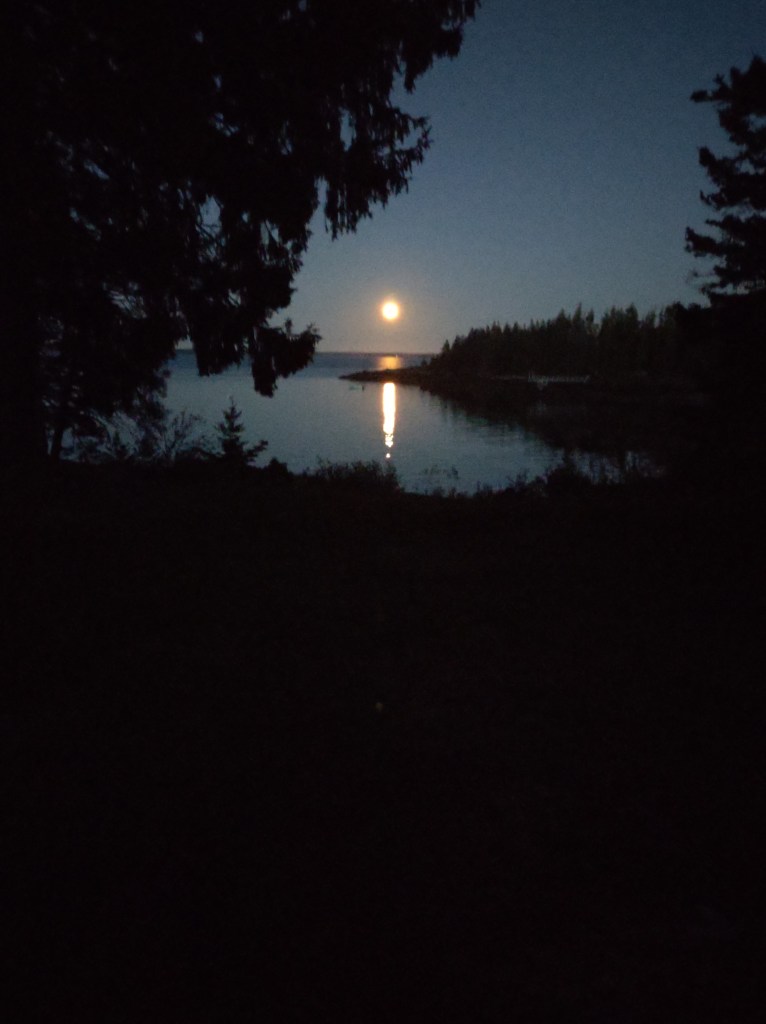
[Above photo: Harvest moon rising, reflected in the harbor.]
Running last errands on shore this week I noted brilliant scarlet patches amongst the green of birch foliage and white spruce. Maples? Another year has passed and the gradual shedding of Nature’s cloak is beginning in Downeast Maine. There are so many reminders of time passing, including birthdays, that I want to hide all the clocks! I’m 81! I don’t want to shed my mortal coil yet.
Three days ago I was doing a bit of desultory weeding in the garden when I heard a hummer over my back, very close to me. They have never approached me before and although they seem less skittish than at the beginning of the year, this was different. It hovered for a bit. I didn’t turn to look for fear I’d spook it. Then it was gone. And the same day all of the hummers left for Mexico; the feeder was vacated for the year. You may think this is sort of woo-woo of me, but I think the mom was acknowledging my steady hand in feeding her and her brood all summer. Saying goodbye, in a way. I’m a big one for not anthropomorphizing animals—or inanimate objects, like rocks—but I was moved.
I am probably ready to be moved, since endings are always a challenge for me. I attribute it to early endings in my life, like my father’s untimely death when I was 9yo. But, who knows the cause? It isn’t unique to those with early loss to feel sad at endings. I felt a single tear forming, which I squeezed back, when Chas and I drove away from 675 Bellaire Street in Denver in my 1936 Ford, “The Flower (of the Automotive World)”, leaving home for the first year of college. Incongruously, we had the radio on and a disc jockey was saying, in a break between songs, “Hey little girl in the high school undies”. (The correct title was “Hey little girl in the high school sweater”.) My loss at leaving home (and my mother) was soon forgotten at the prospect of meeting more age-appropriate objects of my affection.
Leaving here, however, is leaving the only real soul-center of my family, since we have formed our own diaspora, including those departed for parts unknown. The tall spruce in the top of the meadow marks the site of the ancestors’ stones—my parents, my brother, my uncle, my aunt, my sister’s two husbands, her daughter’s husband. It is grey and wet today, as it was yesterday, filling the rowboats and testing the shingles.
Michael and I pulled 3 of the 4 moorings, removed the pennants and mooring balls and tied ropes with floats to each, letting the chains spend the winter resting on the sea floor. We scrubbed the balls of marine growth before putting them in the field behind the barn. When we hauled the chains, they were heavy with mussels. Apparently, the green crabs don’t climb up the chains and eat them. It will be fun to set up a small, for local consumption only, mussel farm next year. Once set up, you do nothing until they are large enough to harvest, in perhaps 2-3 years. Mussels were abundant here until 5 years ago; small green crabs have efficiently swept the harbor floor and rocks nearby of what once seemed to be an endless supply. Steamed, with garlic, tarragon, and white wine, they are superb.
Next, we donned hazmat suits I purchased on Amazon, fired up our chain saws, and took down two large apple trees and three small and one medium-sized oak. All had been heavily infested with brown-tail moth caterpillars, giving those of us here in June and early July full-body itchy rashes. They are a plague on the Maine coast. The apples, by the way, are remains of wild root stock which had been grafted and planted here over 100 years ago. They were familiar and beloved by some, although not producing apples. But the caterpillars made them a hazard. I cut a small porch table for drinks from one log and carved a seat out of one stump for my 92yo sister to rest on as she comes up the hill for a visit next year.
I then cut most of the trees up for firewood. I was so exhausted that after tea and a piece of chocolate at 5:30PM, I showered and collapsed into bed. Awakening at midnight, hungry, I arose and toasted a bagel brought by my guest from NYC. Then slept another long dream.
The following day I spent a few hours splitting the wood with a maul and wedges, and stacked it under cover so it will dry, perhaps by next summer. Apple is beautiful wood, with a cream outer growth and a dark brown center; it is tough to split but wonderful for a fire. The oak split beautifully; I read it is better to do oak when green but most other woods when cured. It is one of those endless debates, however,—-wet vs. dry—with no end of experts, of opinions, or to the argument.
Ari came out for two nights with me. Ari has a generosity with food, leaving me delicacies and treats whenever she uses the house. She cooked a terrific chicken adobo for us one night. Then Jon and his collaborator on photography books, Jesse, with 9yo son, Rowan, were here for two days. They are from Wooster, Ohio, living on 7 acres with 7 or 8 different owl speces endemic. We zipped in Tern to Butter Island and climbed to see Tom Cabot’s bench and the view. Rowan was in his element, climbing the rocks like a goat.
Yesterday I kayaked to the rowboats and bailed the day’s rainwater from them. It was pouring when I did it, so I decided to enjoy the damp and circumnavigate in the little plastic kayak. The nearby islands were shrouded in mist; when they were visible it often was just their lower halves. The shores looked wild and serene. I’m already thinking about next summer here, worrying that city lights won’t provide the view I desire.
A wonderful gift was the harvest moon, seen above, rising like a massive Valencia orange over a calm sea, another of Nature’s spectacles. We are finally seeing documentation of how the oil companies—Chevron, Shell, BP— knew about global climate change and its causes 40 years ago, but hid the data. And their scientists’ predictions of the damages to come to the planet were spot-on. Shouldn’t the executives, those who made the final decisions about not sharing the information, be imprisoned? They have probably already killed many by draught and famine.

 A Psychiatrist in Myanmar