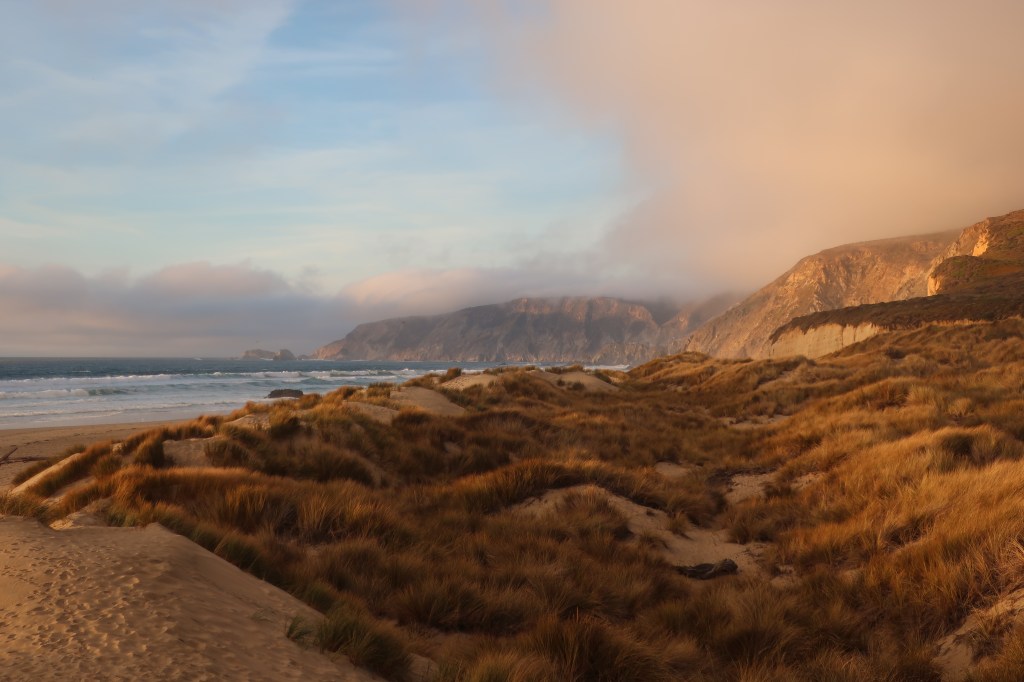
[Above Photo: Kehoe Beach at Pt. Reyes National Seashore.]
20 November 2022
I returned to Portland last evening from Oakland to find that the
temperature has turned brisk. I can finally break out my down jackets
without censure—-only wimps with poor circulation wear them before November.
That would be me in more accepting circumstances. California, when I arrived,
was wet and colder than Maine but not now. Note that there are 6+ feet in
Buffalo and it is still snowing. 85” in other parts of upper NY state.
I love that kind of weather event, death and destruction notwithstanding.
I’ve always enjoyed storms. In college we’d run outside when it really
poured and streams flushed out the streets. Monsoon in Myanmar was just up my
alley. I recall walking down 19th street in Yangon on the long block
between Anawrahta and Mahabandula when it flooded, hoisting up my longyi until
the water was at mid-thigh. Then I’d go home and shower and scrub and scrub. A
favorite memory is lying underneath an immense cantilevered granite boulder
with Harold during a huge downpour in the Sierras. We were returning to
camp from a day hike to a high, trout-filled lake, and watched the sheets of
rain and the lightening play across the valley. On another trip we returned to
find my tent afloat; I’d pitched it on pine duff but hadn’t realized the latter
was filling a granite basin. Then there were all my counterphobic solo sailing
adventures on SF Bay in high winds. Endorphins and neuroamines certainly course through you
when the fight/flight system is activated.
I had a terrific visit in the Bay Area, having lunch and dinner with
different friends nearly every day. Everyone was warm and welcoming and full of
news. I have offers of 8 or 10 places to stay whenever I return. I took
walks and hikes and the BART. I saw an engaging retrospective, “American
People” by Faith Ringold, a Black activist and painter, at the DeYoung. I
spent an afternoon and supper with my college roommate, Peter Barnes, at his
stunning house overlooking the Tomales Bay estuary in Pt. Reyes Station. Peter also bought the
house next door 25 years ago and created the Mesa Refuge, a writers’ retreat
for those completing books on progressive environmental, social, or political
topics. I met his lovely wife, Cornelia, who created a wonderful meal.
I spent a couple of days in Santa Rosa, first visiting my
cadaver-mate in medical school who was recovering from shoulder surgery. Next I
visited an old friend and his wife; he is an accomplished musician and
delivered a house concert, complete with himself on fiddle and guitar, his
playing buddy on guitar, and a remarkable 26yo tiny woman from Texas with a
huge voice strumming, singing, and yodeling high calibre cowboy songs. It was such fun and so moving,
transporting me to my three summers as a horse wrangler in the Colorado
Rockies. Of an evening we’d go to the local bar to play pool, drink beer, eat salty snacks, and
smoke (but not inhale) self-rolled Bull Durham cigarettes. Such a time! In my horseshit-smeared
Justin cowboy boots.
Ed Levin’s memorial service was perfect. About 8 of us spoke for 5 minutes
or so each, then we ate and visited. As I wrote my bit, it seemed dry, not containing
the feelings I had for Ed. I wondered where the affect was; when I read it in
front of the group, I discovered my sadness at his loss.
I found the Bay Area vibrant, stunningly beautiful in parts, very congested, and filled with the homeless. I am happy to be back in Portland, ensconced in
my cozy townhouse and driving my electric car. I miss the warmth of friends who
have known me for many years. But I don’t feel regret about settling here and
will keep forging ahead on the social front. I heard a wonderful concert
of Celtic music with a friend last night before collapsing. (I’d arisen at
2:30AM to return my rental car and catch my 5AM flight.) I think I’ll apply for
a United Airlines credit card; the obligatory plane transfer and consequent
long transcontinental flight times on Southwest are wearing. Plus, a TSA pass to circumvent the secuirty line.
A friend gave me The All of It by Jeanette Haien, a vibrant jewel of a
novella. It recounts a kind of “secular” confession to her priest by a woman
whose brother has just died. He—“In his role as priest he has cut himself off
from some of the more human aspects of his life.”—, however, is the sinner
and is thus most transformed by the experience. Before that, I read
Elizabeth Strout’s Olive Kitteridge. Her writing recalls that of Alice Munro, whose short stories mesmerize me. Seemingly simple lives described with simple language to great effect. I especially like Strout’s ability to activate the reader’s mind by creating characters of such honest
human frailty and complexity that we experience a great range of feelings
toward them. Just like in life.
It was both awful and wonderful to meet with my students again today. The
situation in Myanmar is dire and dangerous and the outlook so devoid of hope.
The bands of youth—-the People’s Defense Force—has little support in terms
of arms from the outside. They make their own of pipe and other metals. 3 have
died in simply making and testing the “weapons”. Despite their sorrow and
worry, the students are bright and lively. When presenting difficult
cases in detail, they make themselves vulnerable to the group in remarkable
ways. Then we all learn. It’s a process, one of them switching from English to Burmese when
my explanations and their understanding don’t succeed for everyone.
The election was a remarkable referendum on America.
Reading an article in the current New Yorker on the assault on education from the ultra-Right in a
Nashville school district was scary. However, I tend to forget how dark our
history has been in earlier days: a civil war, lynchings, the anti-immigrant
fanaticism of the Woodrow Wilson era, internment camps in World War 2, and
McCarthy’s Red Scare. I’m untutored in history, I’m afraid, so it is easy for
me to focus without perspective on the present. I think I always disliked
history for the same reasons many do: a recitation of dates and battles and
“great accomplishments”, not the evolution of ideas, social movements and their significance,
and so forth. “The arc of the moral universe is long but it bends toward justice” sort of thing. Now I find it fascinating. I wish I’d further exploited the
resources of the Harvard History Department. Ah, regret. However, it’s not too late!
We have a lot to be thankful for. Many of us do, at least.

 A Psychiatrist in Myanmar