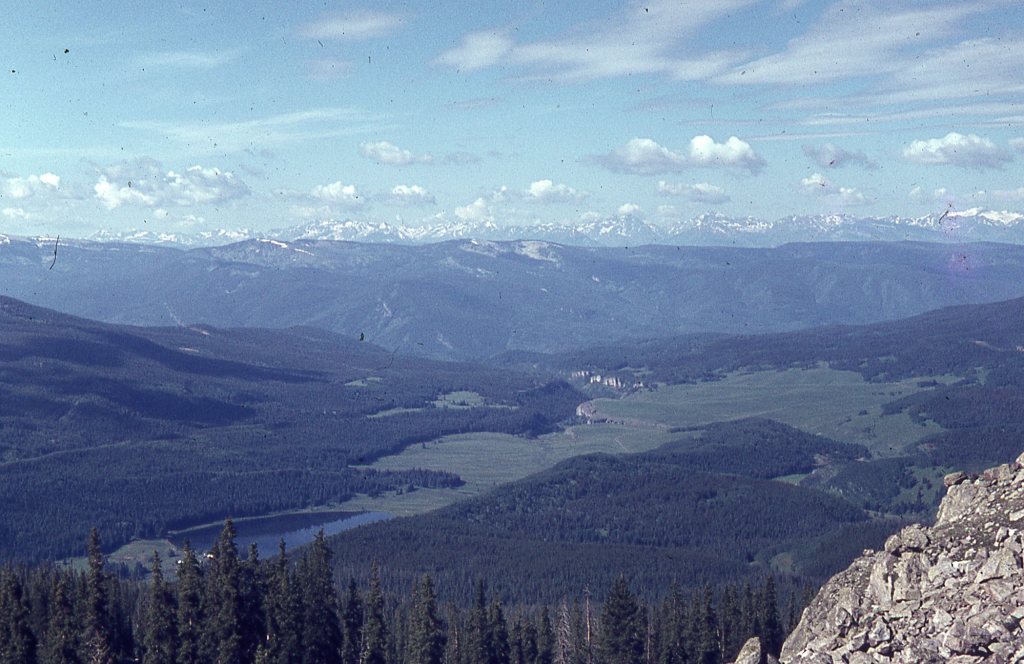
[Above photo: A view of the Rockies from the western slope, from a hill above Woods Lake.]
12 February 2023
As the title suggests, I am moving on. I have learned as much as I want to from writing my public diary and random thoughts on a Sunday morning. Heather Cox Richardson, Robert Hubbell, and Judd Legum, plus the NY Times, the New Yorker, and the Washington Post provide plenty of perspective on current events and, frankly, my life at the moment is not particularly interesting, and certainly not varied or exotic.
I’ve taken a brief (Winter semester) story-writing course and I am intrigued by the exercise of trying to craft an engaging tale while limiting my words. I am going to write 5, as a start, short—-1000 words or so—reflections on my life. I also may use these sketches as scaffolding for a more ambitious project. Setting myself a weekly obligation will help.
A Cowboy’s Life
He stood up, realized nothing was broken, dusted himself off, and heard with some alarm as Blaze left the trail, slowing without a rider as he smacked into trees. George had been at a full gallop but, realizing he was about to head steeply downhill, attempted to slow the beast. A rein broke and, in a flash, he jumped off, hoping to avoid the catastrophic somersault which undoubtedly awaited him if they hit the slope together at a gallop.
The horse was new to the ranch. He was a large, 5-gaited, red-gold American Saddle-bred, a mix of Arabian and Thoroughbred. He’d only been used in a ring and without those external confines just wanted to run. Headstrong, no one else dared to ride him and George, being 19yo and correspondingly foolish, enjoyed the challenge—-and the notoriety. Blaze was his horse for the summer.
This was his third year working on Frank Buckley’s ranch in Middle Park, Colorado. He had completed a year at Harvard and had a summer job installing sprinklers in Denver but when business slowed, he was let go. He asked Frank if he could return one last summer and Frank was glad to have him.
The ranch was a project for Frank, not a money-maker. He owned a ski shop in Denver and during the school year ran the Eskimo Ski Club. George and others raced for the Eskimo Ski Team all over the state. The old farmhouse was sited in a meadowed valley with peaks on 3 sides and a creek running through it. It must have been a few hundred acres but it might as well have been a few thousand, as there was no one else nearby. Frank employed 3 or 4 late-teen boys each summer to help run the place: fencing, building, and, at the end of the season, haying. Turning off US 40 onto the ranch road, which was a rutted 4 mile dirt affair, you passed the Swenson spread. Once he’d seen President Eisenhower fly-casting into the Frazer River, apparently a friend of the Swensons.
That summer, his last on the ranch, George minded the 30 head of horses. Teenagers would come from Denver for the weekend, stay in Winter Park at an old log “hotel” from the late 1800’s he and others had refurbished the previous summer. Bob Carruthers, a wiry, tough-as-nails Denver University hockey player from Winnipeg, was hired to lead the rides and supervise kids in the hotel.
Bob provided a side-drama. His beautiful blond girlfriend, LeAnn, would visit and spend a few nights. Then her mother would show up in her mink and her Cadillac, berate Bob and try to drag her daughter home. Bob and LeAnn were likely in love and certainly in rut.
Even though the pay amounted to about 13c/hour, it was a glorious way to spend the summer. The boys paraded around in their Justin cowboy boots and tried chewing tobacco but, dizzy and nauseated from that, settled for rolling their own from little sacks of Bull Durham carried in their shirt pockets. They never inhaled, of course. The bartender in nearby Frazer tolerated that they were under-age and let them nurse a beer while devouring salty bar snacks and playing pool. The bar was never crowded so they could strut their stuff; if real cowboys had come in, they’d have melted into the woodwork.
Their bodies got hard from the work—lifting, digging, pulling, carrying, stretching, and riding—and their skins tanned. Frank liked George and the latter was generally responsible. Frank let him drive the old Lincoln, and later, the Cadillac, to Denver on occasion to visit home. On most trips George spent considerable time washing and waxing whichever car he was driving, partly to reinforce Frank’s good opinion of him.
He returned to the ranch after his sister’s wedding in Denver with two bottles of champagne he’d stolen from the garage. He and his friend, Chuck, shared the first. George wanted to open the second but Chuck, wisely, said he’d had enough. George, with a certain bravado, drank the other alone. He was then violently ill for the rest of the night, sleeping with his head propped on the toilet bowl. Word got to Frank the next day. He never spoke directly to George about it, but Frank made him jog for two miles on a dirt road while the other boys rode in the truck. And George spent the next two days operating the small John Deere bulldozer clearing downed timber in the back 40, a noisy, dusty, and physical job. He learned a life lesson, trying to grow up.
Haying at the end of the season was the best. For two years he drove the massive old Minneapolis-Moline tractor, pulling the mower and then the side-delivery rake. There was no seat and no steering wheel, just a large metal platform on which to stand and pull the brakes that were used to steer it. Frank would hire a local rancher with a bailer and the boys would follow him in the field, each with two metal hooks to grab the bales and toss them onto the following wagon. They’d boast to each other how much their bale weighed, heavier if it was “green”. The smell of the hay was nearly as intoxicating as a woman’s hair and, lacking girls at the ranch, they thought a lot about the scent of women.
There was a romance. One of George’s best friends in high school was “going with” a classmate, Lucy. Craig worked nearby at a dude ranch and was envious of the life and work at Frank’s. Lucy let it be known that she liked George and he spirited her away from Craig, somehow, even though that summer they hardly saw each other. He and Lucy had one memorable ride during which a bee got into her brassiere. He offered to help her but their relationship hadn’t yet progressed to that stage. His memory of wooing her is shrouded in time and mountain mist but, come September, Lucy was his girlfriend, not Craig’s, and he felt guilty.
Frank’s wife, Nancy, was a petit, dark beauty. She had a pronounced limp, perhaps from polio or congenital hip dysplasia. It was disfiguring and complicated the boys’ erotic fantasies about her. In addition, she had a scalding tongue and seemed to dress Frank down regularly. It diminished Frank in George’s eyes that he seemed to accept it.
The glorious, lingering memories of those times were complicated for George as, moving on to college and his later life, he felt he had never let Frank know how much it had all meant to him, how much he admired Frank for taking the risks he did with the boys, and what a fine example of a man Frank was for so many. George wondered if he’d had a similar effect on others, if he’d been important to them in ways they hadn’t mentioned to him. So much of life goes unsaid.

 A Psychiatrist in Myanmar