Yangon to Portland, ME: 32 hours 49 minutes

DSC03612 (1)

[Above photo: Our balloons being prepared for ascent.]

19 November 2019

I’m a bit sleepy from taking the China Eastern Airlines overnight flight from Yangon. It is now 8:45AM and I have negotiated customs in Shanghai, retrieved my checked bag, and had a halal burger with fries and yoghurt in a Turkish joint within the airport.  I do love the flavoring of Eastern Mediterranean food.

I have a ten hour layover so I need a place to sit. Terminal 2 is an ultramodern, immense room with an arching ceiling and acres of terrazzo floor. I had to ask at the information booth, however, to find a chair.

A logo on a sweatshirt waiting in the customs line in Shanghai said: “When you are no longer thinking about the past, you are getting somewhere.” So true. Not to forget the lessons of history but living in this, not that, moment makes for a better, more productive time.

Anyone who thinks the global center of gravity— economic, demographic— isn’t going to shift decisively in the next ten years from the US and Europe to Asia, including China, India, and SE Asia, hasn’t been paying attention. Just compare the toilet paper in the Men’s loo in Shanghai’s Podung International Airport (thick, double-ply) with that at O’Hare (worse than Malawi—single ply, thin and fragile. I won’t go further!)  Our bright moment as the planet’s apex superpower is dimming. I’m all for democracy but our form of representative government isn’t necessarily the most efficient approach to national infrastructure planning, just as free markets don’t solve all problems. Plus, the population numbers overwhelmingly favor Asia. Unfortunately, what we do have enshrined, if imperfectly practiced, that is very special—freedom of speech, of the press, of religion, a love of preserving natural beauty, the rule of law, relatively fair election processes, and the other aspects that make us unique and superior to tyrannies all over the globe—-is being disparaged and degraded by our current Ogre-in-Chief and his henchmen.

I’m halfway through Factfulness by Hans Rosling, a Nobel-prize laureate from Sweden. I am enamored of the book so I was saddened when I learned last night at a party that he died 2 ½  years ago.  He was a physician involved in Global Health on the ground in Mozambique and, subsequently, with numerous health crises in Africa, including Ebola. He became fascinated by how we reach conclusions and, thus, decisions.  He lectured, entertained, and scolded all over the world, including to presidents, WHO leaders, and titans of industry. He was enamored of Data when collected and interpreted well. His book has changed how I view the world and I suggest it to anyone who wants to better appreciate what is happening all around us. It is a very entertaining read.  Besides, you want to know more than a chimpanzee, to which he also gave his quizzes!

The party yesterday was Irene Fraser’s musical night and it was magical! She has a wonderful voice and sang traditional Scot songs.  Three of her friends, Deep, Esther, and Sheila, are amazing lounge singers and John was a studio guitarist in Nashville for years. Plus, Duncan played supportive but unobtrusive percussion. An additional young lad played electric guitar with an enviable fluency. There was food and drink, laughter and conversation. At one point Irene herded us onto the back deck which faces, across a lawn, a wall of trees and vines. It was dark and we couldn’t guess the surprise. When all assembled, a piper began, those eerie sounds recalling to me Montgomery’s march across the battlefields of N. Africa, with his pipers unnerving Rommel’s forces. Then Irene stepped onto the grass and accompanied the piper with Celtic dance steps.

I did not want to leave the party, returning to my apartment to get my bags and to hail a taxi, the beginning of my global transit. My lengthy route was determined by the FlyAmerica Act.  In order for my ticket to be reimbursed by Fulbright I must fly only on American carriers and their affiliates. I could go from Yangon to Portland, ME for 2/3 the price, at most, and 8 hours quicker with my own booking.  But the cost to me is between $100-200/hour saved, so the longer trip is worth it.

My Short Course in Child and Adolescent Psychiatry in Mandalay went well and feedback was positive and honest. People want more so I think I may be able to devise a series of trainings in more depth on different aspects as a way of gradually upgrading the General Psychiatrists’ skills. 35 attended each course, for a total of 70 which is pretty good penetration. Many came from far away. Their questions showed serious thinking and with their prior training and experience they absorbed what we had to say quickly.

The conference was held at Hotel Marvel in Mandalay. It was something less than that. It is built over the central train station so the rumble of arriving and departing trains repeated all night. Most disturbing to me on the 5th floor was the loud whistle of the trains, sounding as if immediately outside my window.  Some engineers seemed to do many little repeated blasts for reasons unknown to me, similar to the Yangon taxi drivers who beep for both circumstance and emotional expression. Still, the people on the 6th floor had it far worse as there was a very popular karaoke bar on the 7th floor and people partied until 4AM. My room was, it turned out, a smoking room which added to the appeal. I was very glad to fly back to Yangon and enjoy my little penthouse with its (relatively) fresh (for a big city) air, coming as it does off the river.

When I first arrived in Mandalay I was starving so I walked to the Golden Duck and ordered a small portion of roast duck and a green leafy vegetable sautéed with garlic. The duck was half of a bird the size of a small dog. I wondered for a minute but it didn’t have a curly tail and it definitely tasted like duck. I was loathe to waste any, so I overate, then felt remorseful. In penance, I set out to walk the moat around the ancient palace which is in the center of Mandalay. It seemed interminable, especially in flipflops but it also was pleasant walking by the water and seeing all the street/park activity. I later found I’d walked 9 miles, two on each of the 4 sides of the palace moat and at least another mile to and from my hotel.

I also had a very pleasant meeting with the Professor and Director of the Mental Health Nursing Program at the Mandalay University of Nursing and members of her faculty. I’ll submit an outline of a 3 day training in Child and Adolescent Psychiatry they want me to do for the faculty. After the meeting I noted to Professor Tin Oo that after my Fulbright funding concludes in March, I want the government to pay me something for my work. “How much?” “A little.”, I said, knowing his salary is $200/month as head of the entire Psychiatry program at the most prestigious medical university in the country. “I’ll try but it can be difficult. I’m sure the Psychiatric Society can come up with something.” I replied, “I wouldn’t take money from them. I want the government to have a bit of skin in the game, to acknowledge that this is a national need which they have a responsibility to support.” He understood and will apply. As a next step I want to develop a creative and sensible plan to address the general mental health needs of children and adolescents here. What an amazing opportunity! I have no illusions that the opposition, inertia, and obstacles will be formidable. But most good things take tenacity and I believe in the mission so that will propel me.

Students in the classes were all very sweet and appreciative, bringing me lovely longyis, jars of pickled quince, a bracelet of jade, and, amazingly, a very beautiful sculpture made by one’s cousin from a small tree stump with roots. Missing were frankincense and myrrh. Their interest and appreciation do add to my motivation to prepare well and deliver in a fashion to maximize their learning. It is so strange, these three years teaching (Malawi and Myanmar) have released a latent desire to teach which I’ve never really known in myself. I feel relaxed and smart and my students learn and love it.

Finally, I went into a jewelry shop in Mandalay to order some presents. When I returned in the evening to collect them, the manager said they didn’t accept Visa. They directed me to an ATM two blocks away.  I walked there but it was being fixed—“Just 5 minutes.” Then, “Ten more minutes.”  The woman sent me to another ATM 3 blocks from that one. I hauled myself there in the heat; it was completely shut with no attempts at repair. Returning to the first, “Maybe 10 more minutes.” Then they locked it all up and closed the bank and went home. Back at the jeweler’s, they fretted until a petite young woman signaled me to follow her. We mounted a scooter and she dodged traffic until we found a working ATM, I retrieved some cash, and we returned to the store. I paid, they delivered, and I took a tuktuk back to the hotel. I’d like to take a tuktuk back with me for local errands. Efficient, capable, and I could probably pick up a few fares along the way. But wait, I’m not going back. I’m staying in Yangon except for summers on the Island. At least for now. It seems like a smart choice.

And, blessedly, my brother, Chas, greeted me in my stupor at the base of the escalator in the Portland Jetport.

Feeling Alive, Useful

[Above photo: Named the “Nuclear Catastrophe Overcome Pagoda” on a gilded sign beneath it, this pagoda demonstrates the prescience of the 12th century Bagan kings.]

10 November 2019

This is a 4 day holiday weekend, Tazaungdaing, in celebration of the end of the rainy season and the end of Kathina, when the monks are offered alms and new robes.  Of course, it has been raining hard for the past 4 days (or nights). I heard an amazingly loud, live pop musical number half an hour ago.  From my deck I saw a truck with a long flatbed transformed into a sound stage with two female vocalists and an amplified band parked on Anawaratha Street, 300 feet from my building. It has now moved on, suggesting the next few days will not be restful!

My wish to train and supervise mental health workers through UNICEF is getting closer to fruition, I think. My consulting fees are being discussed.  Although I have retirement income and don’t need money to live, I still want to get paid. It feels right to be reimbursed for taking the responsibility of doing serious work.  I can use the money to develop pet projects, like the national conversation on bullying in schools which I want to facilitate. It sounds rather grandiose to say that, yet it is possible since I am the only (seasoned) child psychiatrist here and now have some connections.

I’ve begun to consider settling here. When I think of living in rural Maine, sitting alone in a lovely cabin overlooking 3 feet of snow and Penobscot Bay for months on end in the winters or trying, somehow, to buy myself back into the Bay Area, very expensive, smoky and congested, I wonder what would I do? In the Bay Area I’d have friends to see and Seneca to consult with.  In Maine I’d have my daughter, the natural beauty, and no crowding.  The friends I have in Maine are generally through Linda and I don’t want to infringe on those relationships,  But I don’t see a vital role for myself in either place. No grandchildren planned. I do not want to start a practice again, and don’t think I should, given the painful effect on patients of a therapist who dies or gets dotty.  In Maine I could write, volunteer in schools, and get active in local politics, which might be gratifying.

However, here I can help develop something sustainable and of significant public value. It’s as if all the good work my teachers and supervisors and colleagues in the past have done with me can come to a useful fruition in a substantial way. It is also an easy hop to breathtaking and interesting vacation spots.

The downside is being away from friends and family, living in a land not my own, and having, finally, to learn Burmese. I’ll see how it goes on this vacation—I leave 8 days from now!—and decide based on that. And, of course, it isn’t an irreversible course, though I’ve noticed I am not actually getting younger as I’d hoped with this mineral water and quinoa diet. I don’t have a partner with me here, as I don’t there, but perhaps that isn’t the end of the world. I have friends in a variety of places.  My mother was widowed at 48yo and lived alone cheerfully and productively for another 30. She did watch a bit of TV and drink some Jim Beam in the evenings but that hurt no one and was her coping strategy. I’m sure she would have been happier if my father had not died suddenly at 55yo, as I would be if our marriage hadn’t soured or if Linda and I had managed better.  As to a land of my own, sometimes I look at America and our politicians and their constituents and think, I don’t know them. This is not my land.  Who are these minions of stunted, fearful, hate-filled, self-entitled, anti-thinking people?  I realize that is a description of only a slice of his base, but seeing those behind him at his rallies smile and shout approval as he dribbles his lies into the microphone chills me: mass hypnosis, as always acting against their own best interests.

Jose and Kelly and, later, Irene, with whom I drank beer and played pool at Byblos last night, were very enthusiastic about my leanings. I can make a community here if I wish, despite my being virtually everyone’s senior.  And it feels so good to pass on some of what I’ve learned. Glancing at Erik Erikson’s later Stages of Psychosocial Development, I’m not doing so well with Intimacy vs. Isolation, very well with Generativity vs. Stagnation, and increasingly well with Integrity vs. Despair. I could see myself quite despairing, living alone in a lovely cabin in the woods in Maine. I think I may find more like-minded friends and colleagues here in this large community of helpers, in fact. And as much as I love the beauty and solitude of Nature, and I always shall, I am drawn to the thrum of humanity, messy and craven as it often is. We foul our own nests in the most careless way.  If we see that in an animal—poop in their bedrooms, say—we are disgusted and think they are very low creatures. But who messes their nest, Planet Earth, more completely and permanently than we do?

At the conclusion of teaching my second day of the Short Course in Child and Adolescent Psychiatry for Psychiatrists 3 days ago, two of my students took me aside to present a case to me that they had seen that afternoon in clinic. An 11yo girl from a very remote village in a very remote part of Rakhine State was hospitalized here for mutism. Three months ago she had a fever for 3 days. Her father is an alcoholic fisherman and he and her mother had a loud argument, after which the girl fell to the floor stiff, with her eyes rolled up in her head. There was no incontinence, no loss of consciousness, and no clonic movements. She has no prior history of seizures. After that she became totally mute, except for a single sentence a few weeks later when she asked her mother for a pan thi (apple). Complicating the picture is her maternal uncle who lives with the family and is very close to the girl.  Of note is that she has heard her parents argue many times in the past and often tries to get them to stop. She is an only child.

My students did a good job evaluating her but were anxious, intolerant of their uncertainty. Had she been sexually abused? Physical exam by the pediatrician demonstrated nothing and she communicated slowly with a nod or a shake of her head, denying abuse, as did the mother who seemed protective of her.  How to formulate a management plan without a clear diagnosis, my students wondered? More searching for a diagnosis, I’d think.

I saw her the next morning with the students and she was a cute, alert girl. She seemed confused at following directions at times but it was not easy to know if her confusion was possibly language-based, since Rakhine differs considerably from Myanmar. She repeatedly refused to draw—a tree-house-person, a family member, anything. But when I drew she began to copy what I did with precision. She wrote her name in exquisitely beautiful Myanmar script. I did a mini-neurological examination and found—-eureka! She couldn’t move her left eye past the mid-point. Her mother had never seen it before and the girl hadn’t complained of double vision.

I thought, if her mutism is the consequence of abuse or of another psychological origin, perhaps if she becomes familiar with me she’ll be more cooperative. So I saw her again yesterday in the hospital with a junior pediatrician interpreting.  I learned little new. I left her an empty copy book and a pen so she could write or draw anything if she wanted to communicate with me.

I’ll see her again on Monday before I go to Mandalay for the second Short Course. I think she has a forme fruste (attenuated) autoimmune encephalitis affecting her speech production and her eye movement. You may recall we saw two young girls in clinic within two weeks of each other with anti-NMDA receptor encephalitis and psychosis following viral infections. One responded promptly to prednisolone orally, the other didn’t. The second had been mis-diagnosed with childhood schizophrenia 9 months before and treated simply with antipsychotics. Patients with this disorder tend to do poorly, even dying, if not treated early.  The girl from Rakhine is getting a CT scan with contrast in 3 days to look for a structural cause of her ophthalmoplegia.

So unless I gather evidence pointing clearly to a psychological etiology, when I see her on Monday, I’ll suggest a lumbar puncture and evaluation of the CSF for specific antibodies. As before, I may have to pay the $60 or so for the test or it cannot/will not be done.

All this keeps my brain alive, lets me demonstrate to the students how to live thoughtfully with uncertainty, and allows me to learn more about an illness of which I’d never heard until 6 months ago.

Alternately, I could sit in my cabin and watch CNN, curse the president and his crowd, and sip Jim Beam, although I prefer a single-malt whiskey.

I’ll still spend summers on the Island with family and friends.

Bagan

[Above photo: One of the many and greatly varied temples seen from above.]

3 November 2019

Two days after graduation I jumped on a plane for Bagan, the massive temple area in mid-Myanmar where 10,000 temples once stood. Now there are “only” 2000+, reaching back to the 11th century..  Some are small but some are massive, as above.  They are set on a flat plain abutting the Ayeyarwady River in a largely rural area where ground nuts and sesame are planted together in alternating rows.. I visited here with Poki (my-ex) and friends in 2012. A huge earthquake in 2016 caused significant damage to the tops of some of the larger temples; they are currently being repaired.

It is hot and dry in Bagan this time of year. You visit the temples in the morning and late afternoons, lazing by your pool with a book after lunch for a few hours. While you can get around by tuktuk or a horse-drawn carriage, I prefer the new e-scooters. They are silent, max out at 30mph, and run all day on one charge: $4/day, with helmet.  They are a bit dicey in the deep sand found around some of the temples.

I stayed at the Bagan Thande Lodge in Old Bagan. It was built for a visit of the Prince of Wales in 1922. It has been well-kept and has spacious grounds, shaded by massive acacia trees. I got an economy room which was terrific, overlooking the lovely swimming pool. The expensive rooms are stretched along the river with fine views. There is a nice riverfront bar from which to watch the sunset and the breakfasts were excellent.

On day 1 I walked for a few hours  but got too hot and hailed a tuktuk. After taking me to the market in nearby Nyaung U, he pulled into a hotel parking lot and stopped. “What’s up?” “I thought you might want to go in here.” Ha. He obviously gets a commission for delivering tourists to Golden Eagle Balloon. I hadn’t planned on it but I signed up anyway, recalling how much fun it had been in Cappadocia. After a swim and a rest at my hotel, he picked me up and we visited a Kayeh weaver and then a terrific lacquerware shop in New Bagan, where I bought some things after touring the workshop and watching the artisans decorating it. It is so lovely and durable, lacquerware.

I was picked up at 5AM the next morning for the balloon ride. We assembled in a field where 5 companies had numerous balloons being readied. We had coffee and a pastry while the pilots sent up trial balloons, testing the wind. It was too strong so the flight was cancelled. I asked a woman across the table from me, the only other solo traveler, if she’d like to visit temples on the back of my scooter. She assented and I had good company.

Her hotel was several kilometers from mine so after I rented an e-scooter, I picked her up. and we spent the day driving around. You are not allowed to climb temples as they are wearing down from the traffic of tourists so I paid a kid on a motorbike $3 to lead us to an elevated spot from where we could watch the sunset. It was a crumbling brick structure several miles out on the plain and numerous other tourists were there as well. It was festive as we watched Sol sink into the Chin Hills, blushing as he went.

We travelled around in the day and ate together most meals, simply enjoying the company. She was on holiday by herself and had travelled to Bagan from Inle Lake.  I wondered about a single woman travelling alone but she had not had any difficulties. Myanmar people are so kind and helpful, as I keep repeating.

She left Bagan a day before I did and I just continued sightseeing, eating good food in inexpensive restaurants, and having my evening beer by the riverside as the sun set. All these temples, like any massive monuments (the structures in Siem Riep, the pyramids, the great cathedrals) make me think of slavery or impoverished workers driven too hard.

I realized how much more fun it is to travel with someone than myself. I never would have done the 2 months in southern Africa last year without Linda. I might have done small bits of it like Vic Falls, but so much of the pleasure comes from the interaction.

I am back inefficiently preparing for the short course (3 days) I’ll teach to 30 psychiatrists this week in Yangon and next week in Mandalay. I’ll do the first two days and Dr. Khin Maung Zaw, who practiced and taught in UK for 40 years, will teach Day 3. We lunched yesterday and aligned our teaching message. It is pretty impossible to achieve much in 3 days. We agreed that maybe they won’t use quite as much medication with children and can begin to think about them more.

Ed Levin just sent a terrific Perspective article from the New England Journal of Medicine about Psychiatry’s Identity Crisis, which fits right into the course. I submitted a letter to the editor suggesting that teaching programs need to reinsert Human Relationship back into the center of psychiatric training, so the practice of new psychiatrists isn’t simply match-the-diagnosis-with-the-drug. With my luck (skill) it will not get published but it helped me clarify my thoughts, so all is not in vain.

I’m very excited about heading to the US on 18 November. I’ll go to Maine first, so as to get my driver’s license and see friends and family. Then I’ll head for California for almost 3 weeks to see many pals. I’ll return here during the first week of January to finish out the last 3 months. I met an entire coterie of new people last night at a 2 for the price of 1 buffet at a fancy hotel and had a great time. It is possible, I think, to develop friendships and companionship here, although it has been a pretty solo year. I’m acutely aware of it now that I no longer meet all day 4x/week with my students.

America has the chance to demonstrate if we deserve a democracy founded (mostly) on freedom and honesty or if we’ll choose a demagogue. How the Senators sleep at night I cannot imagine. Even mesmerized, his lies and self-dealing must impress them a bit. Pretending that what he does is OK is puzzling and worrisome. Do they really think it is all right? Do they just not want to cross him and risk his wrath and their re-election? Some of both? Hopefully the public hearings will help sway public opinion.


Graduation

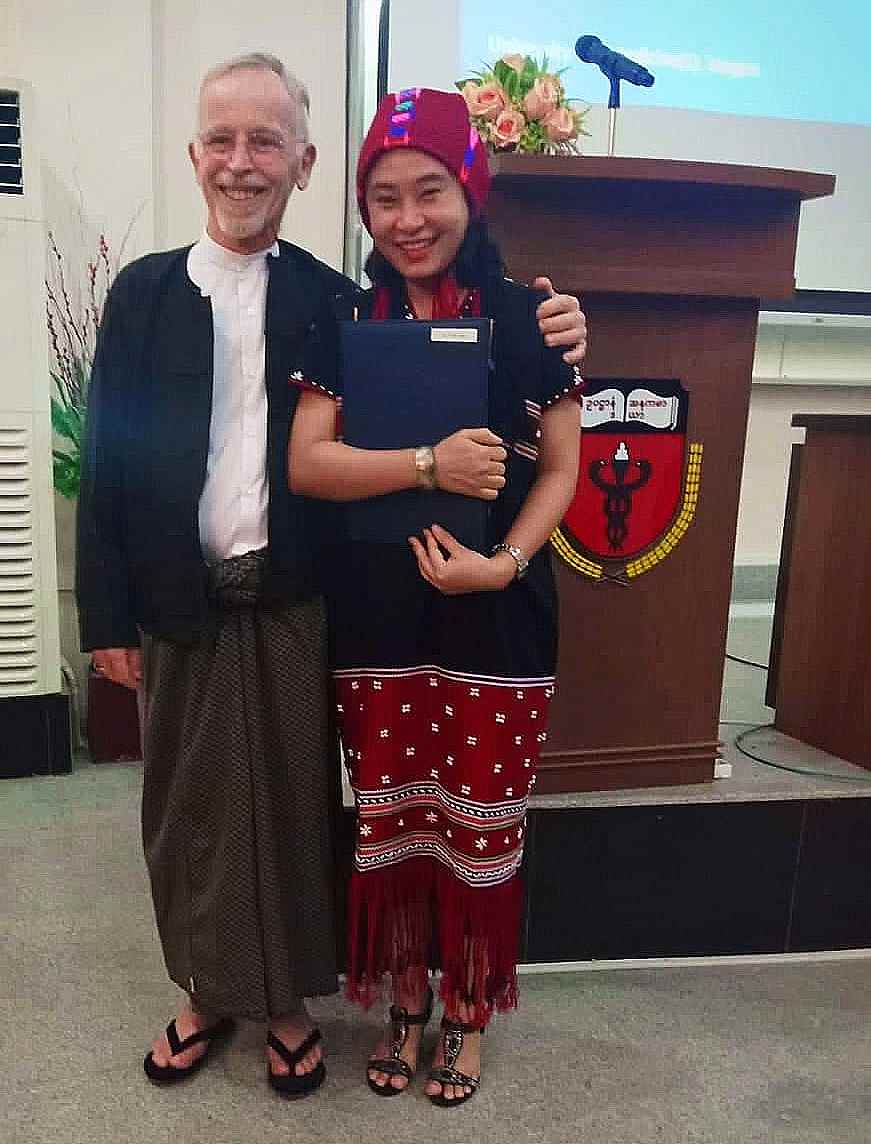
[Above photo: Graduation Day: Dr. Hnin Aye, holding her certificate, wearing traditional Kayin dress and Professor Stewart in traditional Myanmar formal dress.]

27 October 2019

The events last Monday went something like this: 9:30am gift giving, 10:30 review exam questions and course feedback, lunch with my students, back to my apartment to change into formal Myanmar wear, 3:00pm graduation ceremony, supper sponsored by the Myanmar Psychiatry Association at a snazzy restaurant..

I gave to each student a briefcase in which to carry their child evaluation toys and documents, a carved jade cat (symbolizing their group identity), a cast brass bell (To keep order when teaching. One of them gave me a little bell early on in the course.), a cat tote bag from Chiang Mai, and a personalized card. The presents from them to me were astounding, in addition to the many intangible gifts and kindnesses. They gave me a teapot and 5 tea cups carved of jade, a very traditional style framed portrait of me, taken from a photo and rendered in mixed media, including chips of alabaster, ruby dust, and other mineral grains, and a bracelet with 5 solid gold ornaments woven into it: 2 stars, 2 cats, and a squiggle that looks like a “G”. On the portrait it is written, We love [Baba] George. The Baba means uncle and was rendered in Myanmar script. I now learn that Baba was the name they used for me amongst themselves.

Since I think of the value of tests as primarily for learning more than for assessment, reviewing the written exam was a useful exercise,.  This included learning to be careful on the exam: 2 selected delirium tremens for a delirious 4yo with pneumonia! They all knew that wasn’t right and were rushing through the test. I again made—hopefully cemented—points about early attachment and the Internal Working Model which so powerfully influence all of our subsequent relationships.

Skipping to graduation, it was a fairly formal affair, except that many of the students were weeping that the course had finished and I’d be moving on. I’ll admit that tears crept down my cheeks as I was giving my talk, encouraging my Cats to go forth to practice and teach what they had learned. Then one of the best of the students—she who always scores highest on the exams—gave her take on a group appreciation of me during which she broke down weeping. I think it was a first for the senior faculty who were gathered, as well as an eye-opener for the new Pro-Rector. My style of engaging the students really fostered a lot of feelings on both our sides. To his great credit, the 2nd in charge at the Embassy, George Sibley, made a point of telling me afterward how terrific he thought all the emoting was in such an ordinarily staid event.

The next day the students took me on an outing to the huge WW2 military cemetery (Perhaps it wasn’t  conscious but there has been a death in all our lives with the conclusion of the course.) in Bago. Then on to a nature preserve/wood sculpture garden of immense dimensions where we drove around and wandered and ate lunch. Not content to leave it at that, we stopped for soft drinks at a spot on the way home where several of the women disappeared into the toilets to weep. I think all the outpouring was, as one of them said to me “about bonding and attachment”. Good, they took that message away. It also was about my dropping the pretense, defensiveness, and rigidity to which they are all accustomed with many of their professors.

To better explain my thoughts, I’m including my graduation speech.


Mingalabar (Hello, Welcome, Bless you, an all-purpose word)

Pro-Rector, Members of the US Embassy Staff, Professor Tin Oo, other Faculty, other guests, and the Graduates.

I am very pleased to be with you today, honoring our graduates and their commitment to learning child and adolescent psychiatry.  It is a bold first step for Myanmar.  And to honor all of you who helped make this day possible, in ways both large and small.

I am aware that I have undoubtedly made many cultural mistakes in Myanmar; I probably am doing so right now. You all have been very gracious in accepting me despite these.

Also, since Bama zaga ma pyaw bu [I don’t speak Myanmar language.] I especially appreciate the graduates as you have worked hard to learn a new discipline—that of Child and Adolescent Psychiatry—in English, a language that is not your mother tongue. I have been very impressed by all of your efforts, as well as your patience with me when we were not understanding each other.

When I began to teach the course, I was aware of the idea of ana deh—to me it meant don’t make another person uncomfortable or embarrassed. In an educational setting that could mean don’t challenge what your professor says because it might question if he or she knows everything or is actually mistaken and thus he or she might feel bad.

In any case, I suggested to the class on the first day that this person, Ana Deh, did not like students’ asking hard questions of their professor and, thus, did not belong in our classroom, so we locked her out. All of us make mistakes and no one knows everything. What is important, it seems to me, is to accept our mistakes as learning opportunities and to try not to repeat them. Also, we all need to know how to look things up if we don’t know them. Students’ questions make me learn more and we know that students engaged in active learning also learn more in the development of their critical thinking.  Quietly and obediently writing down what you are told in a lecture makes for a bored professor and bored students, in my experience.

Hence, our often vigorous, if not rowdy, classroom discussions. At one point early in the course, trying to get the students’ attention so I could move ahead with the day’s lesson, I said, “This is like trying to herd cats.” Suddenly they were making cat sounds: “Meow, Meow.” I knew then that these cats would be good learners. Cats are independent thinkers and they are both observant and curious, all qualities central to being a good psychiatrist. And these cats had a sense of humor, as well, a necessity in our work.  They are kind, however, unlike most cats.

I wanted their openness to thinking, to questioning, and to discussing to mirror what their patients would feel when seeing them: safe, open, listened to and able to say whatever was on their mind without fear of criticism or judgment. As psychiatrists we are in the unique position of being able to provide that for our patients.  The Buddha has a perfect wisdom for the talking part of a psychiatrist’s work: “If you propose to speak always ask yourself, ‘Is it true? Is it necessary? Is it kind?’”

This has come to pass and the students are all good observers, listeners, and speakers. They have each completed supervised evaluations on numerous children and participated in evaluations and discussions of over 100 more, as well as conducting many follow-up visits. Follow-up visits are a gift to us, where we can see if our work is helpful or if we need to modify our approach.  Each one of the graduates now has the skills and knowledge to be a safe and helpful child psychiatrist.

Psychiatry is an infinitely interesting and complex specialty, a reflection of the human mind told in varied and fascinating stories by our patients. The students will hopefully be lifelong learners. It would be a mistake to think that completing a course of study such as this is the end of our learning. It gives us the foundation for future learning, a beginning only. Imagine living in a house without walls or a roof, only a foundation. And it would be too bad if in 10 years we are practicing the same as we do today. Like a plant, as psychiatrists we must grow or we professionally shrink and die. [Block these metaphors!]  With your excellent library facilities and a little bit of discipline, it is now easier than ever to stay current in our field. Imagine, reading only one new research or review paper a week adds up to over 50 papers in a year. That is a lot of knowledge on the way to wisdom.

50% of adult mental illness is apparent by 14 years of age; 75% is visible by 21 years. Approximately 1/3 of the population of Myanmar is under 18yo, a child or an adolescent. Identifying and treating mental illness early is humane, is more effective than doing so later, and makes good economic sense. Recent studies from Harvard University demonstrate that money put into children’s health and education has the highest rate of return by far of any social or human resource program, returning many times its costs.

Training child and adolescent psychiatrists alone will not address the mental health needs of all the children in Myanmar, no more than they can anywhere. Child psychiatrists are sub-specialists and our training is extensive and expensive. Public health advocacy for measures such as ending corporal punishment at home and in schools, strengthening the laws and their enforcement regarding child sexual abuse, and addressing school bullying is an important, if unpaid, aspect of a child psychiatrist’s professional life.  Yet another role for our child psychiatrists, after they acquire some experience, may be to train non-physicians to triage and provide basic mental health services for children and families in distress. The limited numbers of child psychiatrists can then save themselves for more complex referrals, consultation, and teaching, whether in academia or not. For example, there is a great need for child psychiatrists to provide information about mental health and mental illness to the schools, to the courts, to the juvenile justice system, and to the public in general.  Professor Tin Oo and I have begun to discuss how to meet these needs.

There are challenges to making progress in any country and Myanmar is no exception. As a great American writer, Mark Twain, once commented, speaking of the card game of poker as a metaphor for life, he said, “Life is not a matter of holding good cards. It is about playing a poor hand well.” We are all trying to play a poor hand well, given the obstacles we face.  A phrase I have often heard here is, “This is our life.”, a mature and honest acknowledgement of the struggles you all face.

So, in concluding, I want to say to each of my Cats, go forth and practice what you have learned. Your tasks are to listen with compassion, to attempt to understand, and, only then, to try to help, although listening and understanding are already powerful therapeutic interventions, as you know.  I know that you can and will succeed at this. Know that I will be with each of you on every step of your journey. It may get confusing or frightening at times, but with careful, critical thinking you can most often have good outcomes. Another quotation I like, attributed to John Watson, a Scot, is: “Be kind, for everyone you meet is fighting a great battle.”

Thank you from my heart for giving me this opportunity—a rare journey in anyone’s lifetime—to get to know you, to teach you, and to learn from you. I will always remember you, your kindnesses, your generosity, and our time laughing and learning together.

I want to thank, especially, Professor Tin Oo for his unswerving vision and support of children’s mental health training and services in Myanmar, as well as his many thoughtful personal kindnesses to me. And Dr. Kyi Min Tun, who in addition to being a member of the graduating group, has been my chauffeur, my IT advisor, my cultural consultant, my fashion resource, and my go-to man for any help— where to buy eyeglasses or watchbands, how to find a tailor—all while supplying me with a steady stream of longyis.  Dr. Kyi’s generosity of self is exemplified by his most frequent English phrase, “Sure, no problem.” And of course, I want to thank the United States Department of State Fulbright Program, which has enabled and supported my participation here.

I want to end with two quotations from the Buddha that seem entirely appropriate and timely to me. I apologize for only having the English versions.

The first fits the graduates, who have introduced me to sharing in many ways, but especially with food at lunch times:

“If you knew what I know about the power of giving, you would not let a single meal pass without sharing it in some way.” You now have the obligation, and opportunity, to share what you have learned— with patients, with parents, with other psychiatrists, with pediatricians, with medical students, with schools, with the public.  It will return to you much more than you give.

And apropos of our chosen work, the Buddha said, “If anything is worth doing, do it with all your heart.”

Thank you.


It has been a moving few days and I’ll begin to teach the next group in January for three months. Hnin Aye, one of my wonderful students, has two tee shirts she wears with the Lewis Carroll quotation: “In the end, we only regret the chances we didn’t take.” I certainly have many regrets in my life but none for my Fulbright experience.

Now I’m off to Bagan for 5 days of viewing amazing monuments, zipping to and fro on an electric scooter and generally relaxing. We’ll see how I do with that.

A Lull

[Above photo: What a bucolic view of the world. How very different it seems today. Clearly, it was difficult to keep the deer out of the classroom.]

20 October 2019

I had a good and varied time in Chiang Mai on Sunday. I switched hotels from the Empress to the Sumitaya, a smart, modern, clean, and economical enterprise in the middle of Old Town. While the quarters are small, they are well-designed with lots of wood and metal and glass, all very functional. It has all I need for $29/night, including breakfast and much better wi-fi than the Empress.

I wandered about, getting lost quickly which was fine and fun. I visited a number of ancient wats (temples), noting in one that a gift left for the Buddha was one cigarette with a box of matches on top of it, mixed among the candles and flowers. At one gloriously gold wat a group of 50 monks were chanting and meditating, eventually circumnavigating one of the glittering stupas several times while reciting prayers. Sunday, today, is a massive night market with many streets closed off so I strolled for hours, buying a few gifts and eating street food. I had the best spicy sausage and the crispiest gyoza, washed down with fresh coconut milk.

I then went to the Ta Pae Gate, one of the 4 gates to the city, where there was a large celebration with music, flowers, military in dress whites, and hundreds of Thai men in yellow shirts.  All was in remembrance of the good deeds of the prior king of Thailand, who died 3 years ago today. Understanding no Thai (except “Ja” and “Kap bon krap—Thank you”) I didn’t last long with the speeches. On the way to my hotel, I passed a sports bar and stepped in to watch Japan crush Scotland in the Rugby World Cup, played in Japan. No alcohol is served on Sundays here, so I had a Diet Coke. Then to the hotel for a shower and sleep.

The following day I again wandered about Chiang Mai, a place of coffee houses, “tourist information” shops, restaurants, and temples. This time I took my good camera and managed a few shots I liked. I wished I had more time (and energy) to leave town and trek or see more remote parts of N. Thailand but it wasn’t to be. At noon I settled into a coffee shop-café for lunch and at 12:15PM it began to pour. A torrent. It continued for 3 ½ hours, by which time the street in front was 8” deep in water with a significant current. As the rain let up, the street drained and I meandered back to my hotel, collapsing early.

The flight the next day to Yangon was painless. I was surprised to feel my shoulders drop as I stepped off at Yangon International, back in familiar territory. The Thais were as pleasant and helpful as possible but it was relaxing to lose my alertness as I returned “home”.

It is strange, owning neither a car nor a house, anywhere. I’ll need a car in Maine, eventually, but it is lovely not to have the expense of one here. My driver’s license expired in September and, being over 70yo, I cannot renew it online. I’ll head to Maine first to renew it. Otherwise I cannot rent a car, etc. Cripes, what a nuisance.

At the airport I jumped in a cab and was rushed to a conference venue where I met the Vice-President’s wife and gave a talk to 200 people about principles of behavior management at the MSEA annual conference. MSEA is the Myanmar Special Education Association, a local NGO that trains special ed teachers, since the government doesn’t. There isn’t an occupational therapist or speech therapist in the country.  Behavior management isn’t my forte; I’m largely self-taught. It went well enough, I think.

The next day I hopped a plane for Nay Pyi Taw for the second half of the conference. This was pretty impressive, with the Vice President and the Union Ministers (top dogs) for Health and Sports, Social Welfare and Resettlement, and Education all present and giving talks. I met a lot of interesting and committed people with some requests for help. Two women approached me on behalf of an organization they have started for orphans; one had lived in New York for 9 years. Really? What was she doing there? Her husband was the Myanmar Ambassador to the UN. It really was a star-studded cast and all smart, thoughtful, strategic, and kind people.

Tomorrow is graduation. I’ll do feedback with the students in the morning, take them to lunch and at 3PM we’ll descend on the University of Medicine 1 for the ceremony. The Rector and Pro-Rector will be there, as well as the US Ambassador and other dignitaries. I’ve written a speech I like so I’ll probably use it for my blog entry next Sunday. I have crafted it too much, so now I must read it. I’d have done better to just get main topics and wing it but the words and ideas have become important to me so I don’t want to miss any.

My major concerns are: Must I wear my polyester black taikpon (jacket) or can I wear the nice light brown cotton one I just purchased? Am I acknowledging the guests in the correct order? And, mostly, I don’t want to cry as I might in such a situation. It does feel as if these are my children and they are leaving home. I’ll miss spending time with them. It has been an incredible experience for me; I think it has been for them, as well, in different ways. More later.

Since I’m of the age when I’ll need a black suit, I went to a tailor yesterday who was recommended to me by one of my students. The tailors are renovating their shop so I went to their home, a huge mansion in a lovely leafy part of town, down a quiet road. After ascertaining what material and color I wanted—wool, medium-weight, charcoal—, how many buttons on the sleeves, what kind of a vent, pleats or not, wide or narrow lapels, and on and on, he began to measure me, shouting out the numbers in Myanmar to a woman copying them down. The long and the short, I’ll get fitted in 10 days and have a beautiful fully-lined suit in 4 weeks. $177. I saw some of their work and it is exquisite. I may have them make me a sports jacket and some trousers, as my wardrobe at home is old and purchased pre-lung cancer when I weighed 15# more.

The experience recalled the tale of my father going to England in his bachelor days and having a number of 3-piece suits made for him. Before 1929 he had enough money so he didn’t think he’d have to work. He went to medical school to be a “gentleman doctor”, my mother thought. When they met at Columbia P&S, he had a Chrysler touring car, a 40 foot yawl, and a mistress in an apartment in NYC. My mother “encouraged” him to divest himself of the mistress and the automobile.  They used the yawl in the summers to sail up the coast to Beach Island. But when the market crashed, he lost every cent. My mother said it was the best thing that ever happened to him, always looking for the pony when she’d fallen into horseshit.  Her attitude was admirable and he did move on to support our family nicely until his early death. But he always wore his suits—I don’t know if they were Saville Row but they fit him beautifully.—to work.

It’s time to retire, so I’ll post this as is. It feels rather flat but I don’t have the juice to pump it up.

Chiang Mai

[Above photo: After making eye contact, I told her a joke and am awaiting her response. Note my unsought military-style haircut. Thankfully, it is growing in.]

13 October 2019

I am about to leave the elegant Empress Hotel in this city for another, half the price and smack in the center of Old Town, which is a more interesting place to be. There are numerous old temples and modern coffee shops surrounded by an ancient wall [in places] and a moat.

I came to Chiang Mai with my two students, Drs. Nan Tin Moe Khine and Nwe Oo Mon, for the biennial ASCAPAP (Asian Society for Child and Adolescent Psychiatry and Allied Professionals) meeting. It was wonderful and reminded me of many AACAP (American Academy of Child and Adolescent Psychiatry) annual meetings I’ve attended.  I met terrific people from S. Korea, Thailand, Singapore, India, Nepal, Taiwan, and Australia, especially. It was great fun to be amongst such colleagues. However, instead of 5000 child psychiatrists, it had 300 attendees total, including behavioral pediatricians, early childhood interventionists, psychologists, social workers, and occupational therapists, as well as child psychiatrists.

Consequently, it was much more intimate, interesting, and convivial, despite my many good friends and acquaintances in AACAP. The pharmaceutical industry presence in the meetings was much less prominent here. And the meeting had the wonderful spirit of a multidisciplinary team working together to develop quality child and adolescent mental health services, all learning from each other, rather than the guild organization into which AACAP has devolved. Orthopsychiatry was an analogous multidisciplinary organization in the US with its own excellent journal but it has passed on.

I met a Dutch child psychiatrist who has been coming here 2 weeks a year for 15 years and has trained numerous paraprofessionals in the basics of children’s mental health.  It’s her vacation time and rejuvenates her much more than sitting on a lovely beach somewhere sipping pina colladas, I suspect.

One of my students, Dr. Nwe Oo Mon, gave a 20’ talk about our course. She was subsequently asked to be the representative from Myanmar on the ASCAPAP Executive Committee. She wisely suggested that the President send a letter requesting the same to Professor Tin Oo. “I’m just here on my own. I cannot join without permission.” Formality and hierarchy are important to remember here if you want to be effective. I am a bit of an iconoclast, so I am not always maximally effective. Myanmar is now a member of ASCAPAP, which is the regional professional organization for child mental health in Asia. It includes all of SE Asia, plus India, China, Taiwan, Japan, S. Korea, and the Philippines. Australia and New Zealand formally became members at this meeting, as well. Our little enterprise grows.

Yesterday I signed up for a tour of the Maerim Elephant Sanctuary. I have never joined a tour from a hotel before and I hesitated but it turned out wonderfully. I met a young couple from UK travelling for a year, eventually heading to Australia to do bar tending or farm work. If you want to stay in Australia as a tourist for more than a year, you must do farm work, they are that short of labor.  Solar farm work is hard but pays very well. Banana farms are awful—very hard labor in heat plus lots of venomous snakes. Avocados are a better bet.  Then I met an older couple from Waterloo, outside of Toronto. They travel a lot, it seems, and we enjoyed each other. And there was a group of 30ish friends from Mexico City; two were pals from kindergarten, and all knew each other for 13 years.

We were told amazing facts about elephants. The males hang out alone in the jungle until they smell the pheromones, leaked out of a gland near her eye, of a female in heat.  The bulls can detect the scent from 20km away and they come trotting, eager to interrupt their solitude. The interruption is brief, however, as intercourse takes between 15 and 30 seconds.  So don’t feel too bad, guys. Of course, they ejaculate 1-2 liters of semen! Gestation is 2 years and newborns weigh 200 pounds. Psilocybin mushrooms grow happily here on elephant dung and are illegal to possess, use, or sell. The guide showed us a few.

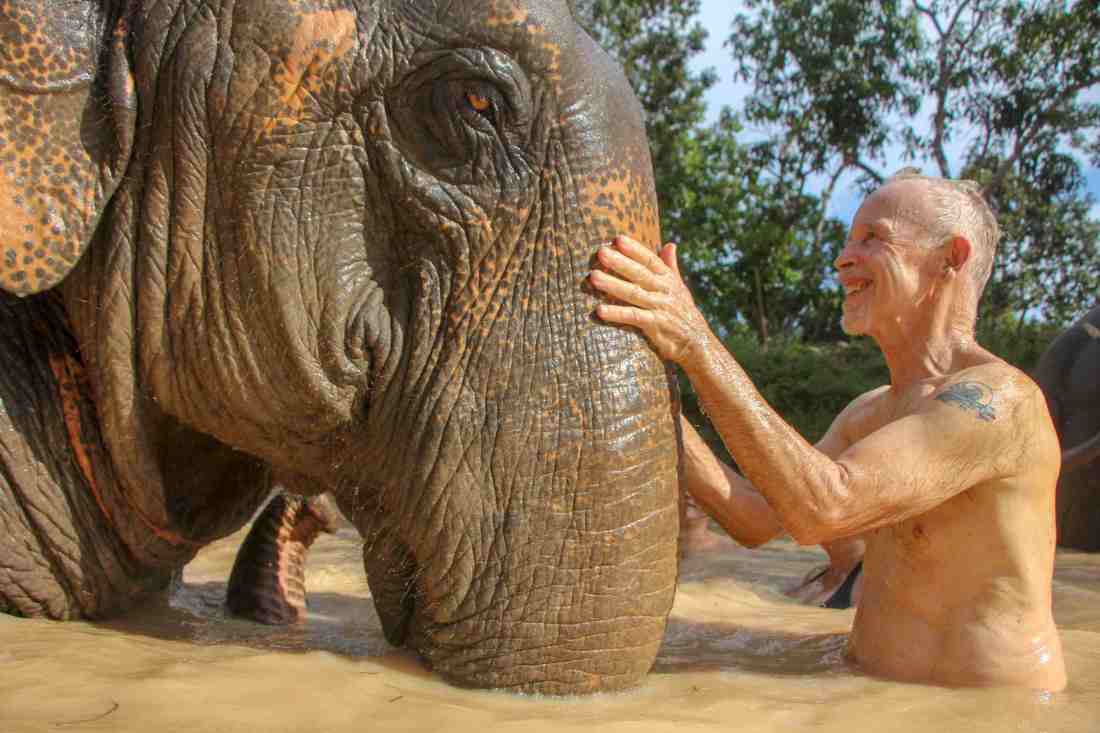
We all learned to approach and pat elephants, while shouting, “Ja!”. “Ja” means “Hello” or “Welcome” in Thai. You shout because elephant hearing isn’t so good in the high frequency range of human speech. We fed them copious amounts of bananas and squash, shoving some directly into their massive mouths. Asian elephants are smaller than their African cousins but they still weigh 3-4 tons. These had all been rescued from logging or riding operations.  After hiking to the nearby banana plantation, we cut down some trees for food—they like the leaves and the inside of the trunks. They delicately dissect the tasty heart of banana tree stems from the more fibrous outer layers with their trunk and jaws.

After making our own yummy Thai noodle soup, we walked to a large muddy pond. The elephants lay down in the muddy, soupy water and we did, too. Then we scrubbed them—and ourselves—with the mud. We were assured the mud was only 40% elephant dung and the liquid only 60% elephant urine. We kept our lips zipped. I recalled that turkey vultures in California shit down their legs, which is excellent antibacterial protection for them.  Maybe, at last, my athlete’s foot from using communal showers after playing squash and rowing in college will go away.

Finally, we rinsed off and got in a lovely swimming pool with a cold beer and relaxed until it was time to return. I am sold, especially as a solo traveler, on signing up for these tours. They may vary in quality but they support the local economy and provide me with a little social life on the road.

I don’t know how Paul Theroux, Bruce Chatwin, and other travel writers go it alone for so much of the time. I fancy myself as being OK alone but I notice that I always want to talk to and hear from others if they are there. I am more social than I imagine, I guess, which gives me some pause about winters in rural Maine. Still, it probably will be good, and interesting, for me to get to know myself well without the company of others. I can always break up the solitude with visits to friends.

NEWS BRIEFS: -My trip to the refugee camps in Rakhine State is on hold, as permission from the government is not forthcoming.

-I was formally approved by Fulbright for a 3 month extension to launch the next group of Child Psychiatry trainees, so if they can start in January, I’ll be able to help them until April.

-The noose tightens as the web of intrigue, shady characters, misdeeds, and canaries grows.

Exams Are Over! All Passed! Bright Futures!

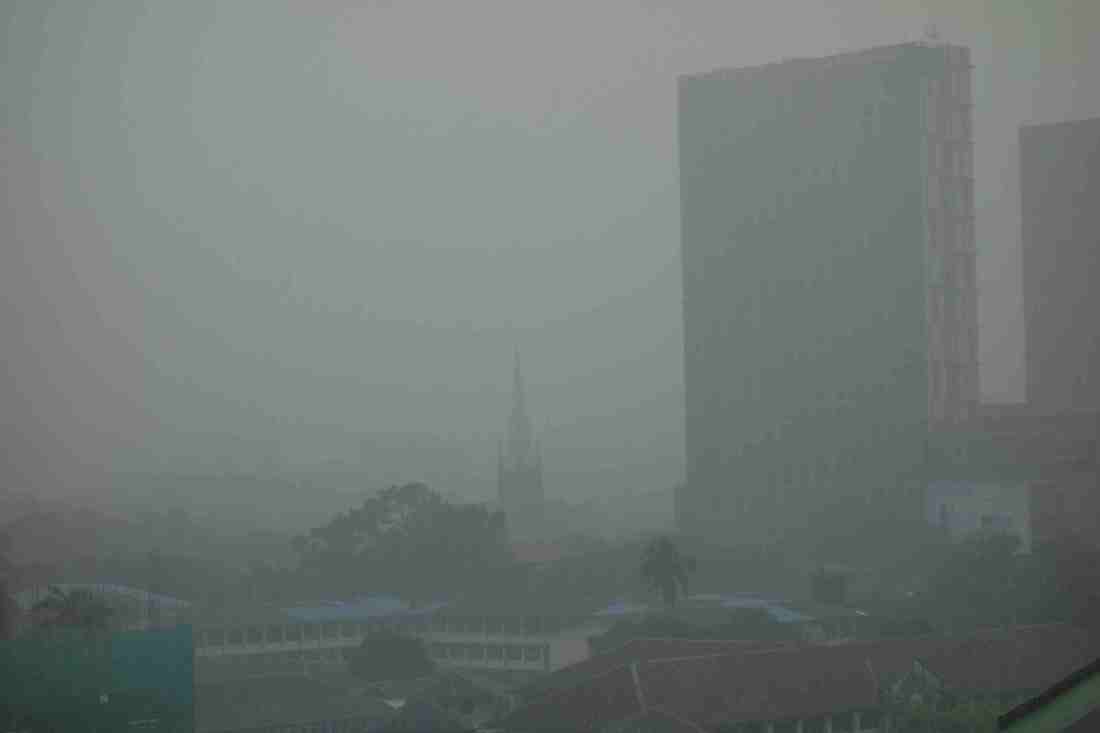
[Above Photo:  A sample mid-day downpour, not smog, at the tail end of the monsoon season.]

8 October 2019

Mangos are gone, passion fruit is in. And durian abides, my luck improving with each gamble. Mangosteen are hanging around but getting more expensive. Supply and demand is a wonderful system and I cannot imagine how leaders of the Soviet Union and China each imagined that centrally-planned food production would work. With a supply-demand system, billions of people adjust and correct daily, an efficient and effective guide for production. I have no training in macroeconomics so the above may be nonsense but it makes sense to me.

The students completed the 3 hour written exam on Friday; they found it difficult, apparently. Everyone stayed for the full 3 hours, except one of the 3 students about whom I’ve worried. But when I graded the exams, she tied for 2nd place! Everyone got a passing mark—60% is passing here. One was in the 90’s and one in the high 60’s but everyone else in the 80’s. Why do I care? I don’t think it correlates well with clinical skills.  In part I care because they do.

The oral was yesterday. It was in the University of Medicine 1 main building, the cornerstone of which was laid by Lord So and So (British) in 1919. Huge, lovely in that solid British way, and well-kept, with a central grassy courtyard bordered with flowers. The exam was in a long, wood-paneled room with 30 foot ceilings, all marble underfoot. A compressed U-shaped table stretched the length of the room. We were supposed to sit at the head, at the bottom of the U, with the student at a little table inside the U, facing us. It seemed unnecessarily formidable and threatening so I put us on the side. Khin Maung “Frank” Zaw, a Burmese who has worked as a child psychiatrist in UK for 40 years, and I interviewed. Professor Tin Oo, the department chair, and his predecessor, Professor Win Aung Myint, sat on our flanks and observed throughout the day.

We were served breakfast and lunch by the staff, elegant, complex meals, and tea and biscuits throughout. One would definitely fatten up if examining a lot here.

I was perhaps as stressed as the students, feeling for them as if they were my children and also feeling like it was an evaluation of my teaching, which in part it was. They all passed, although one with less than flying colors. Their anxiety was astounding to me for such bright people. Perhaps I was that way. When I failed my oral Child Boards, I’m sure I was a wreck, too. The next year I retook the oral section and when I sensed I wasn’t impressing them I started quoting Erik Erikson and other Giants and the Young Turks examining me came awake and passed me. There is a lesson in the experience for me but I’m not entirely sure what it is.  The only examination I have ever failed.  It all seemed arbitrary and expensive. I did visit Detroit to take the re-try, however.

I felt so awful to see my very bright, responsible, and hard-working students in a state of panic induced by me and the process I was leading. Some could hardly speak. Some stuttered. One sort of gave up at the end of the second oral. It was traumatizing for me.  But some shone, surprising me, since they often spoke so little in class. They all passed and will participate in the graduation ceremony in 2 weeks. Before that, I will go through both the exams with them in detail, as I want them to know well the parts they didn’t seem to have mastered.

It didn’t help that in my meticulous preparation I thought, “Frank and I will alternate leading, so he’ll do 5 students each of the two session and I’ll do 5.” We still needed 10 copies of the marking sheet each, but I only printed 5 each. No matter, we improvised and had another 10 copied for the afternoon session.

Overall, I feel unfinished, like they should have all gotten 95% on everything or I’ve done a bad job. They all know a lot more about CAP than they did 7 ½ months ago. I suppose it is my sometime severe conscience/ego ideal just doing its thing to me. I tell you, I’ve learned so much about myself doing this.

I was surprised on the last day of clinic at Yangon Children’s Hospital by a delegation of 4 women and 2 men. They were from MSEA, the Myanmar Special Education Association, which trains special ed teachers. Since there are not nearly enough here and I want to be supportive, I embraced their request to speak at their national conference the day I get off the plane returning from Chiang Mai, next Tuesday. I’ll jump a cab to the conference, gobble lunch, hear Madam Vice President give her talk, and then speak for 1 ½ hours about the principles and practice of behavior management.  I’ve schooled myself in it to some degree, as my students have needed it and used it to great effect.

For example, a 10yo severely intellectually disabled boy from a village was brought to clinic. He spit on strangers including me, hit other children, broke things in the home when he didn’t get his way, could only say, “Mei mei” (mama), and peed on himself regularly.  5 visits later his vocabulary is up to 6 words, he pees in a pot and empties it himself, he no longer spits, he can play with children and not injure them for the first time, and he enjoys helping his mother with cooking and shopping. She and his uncle, who both love him, are overjoyed and the boy looks very happy, as well.  My student, with minimal guidance from me, assisted the family with a behavioral management plan that just fit the bill.  I am still incredulous. Oh, he no longer has to be tied up because his isn’t running into the road. What if we’d gotten to him/them 7 years ago when he was seen and put on antipsychotic medication? It’s why I want to support MSEA.

I haven’t planned my trip to Thailand today, other than to purchase a plane ticket and hotel reservations for a few nights. After 3 days of conference I’ll just sniff around for 4 days. I may go on to Chiang Rai, as I’ve heard it is a lovely town. But people at the conference will have ideas and I’ll have some time to scour the internet.  Two of my students will go to the conference and one will give a 20’ talk about our program. It seems a very nice conclusion to the teaching, to take two of my students to an international child and adolescent psychiatry conference (ASCAPAP).

I must exercise, shower, and hit the road. I’ll try to jump on the airport bus and save $6, but I’m a little unsure as to how often it passes and if it stops to pick up passengers where I hope it will. Worse comes to worse, I’ll take a taxi, as they are everywhere.

Now in bed in a hotel in Chiang Mai, I did take a taxi as it was hot walking to the bus stop. I had a cappuccino at the airport, met my students, and we had a short flight.  Seated next to me was a guy with ear buds in, a baseball cap on, and North Face hiking pants on. I figured him for a late 20’s backpacker doing his SE Asia thing. We started to talk and he was really interesting. He’s worked for 3 years with a Danish NGO—He’s from Long Island.—that helps in refugee camps. They are looking for someone to help direct their efforts on behalf of traumatized children in the camps. How amazing to sit next to him. So he’ll contact me when he is back in Yangon and I’ll meet with his staff to see if we can come up with something useful.

As terrible as some of the world is, some of it is remarkable. However, that statement recalls to me the people saying, “Praise the Lord.” when they were rescued after the New Orleans flood, even though their houses were destroyed and they’d lost a loved one or two.  OK, all-powerful enough to rescue you but not your house, your loved ones, the city? Not much sense there to me. Maybe it just was a kind of sigh of relief, like my students are feeling.

But you know, when the truth is told, that you can get what you want or you can just get old.—Billy Joel in “Vienna”

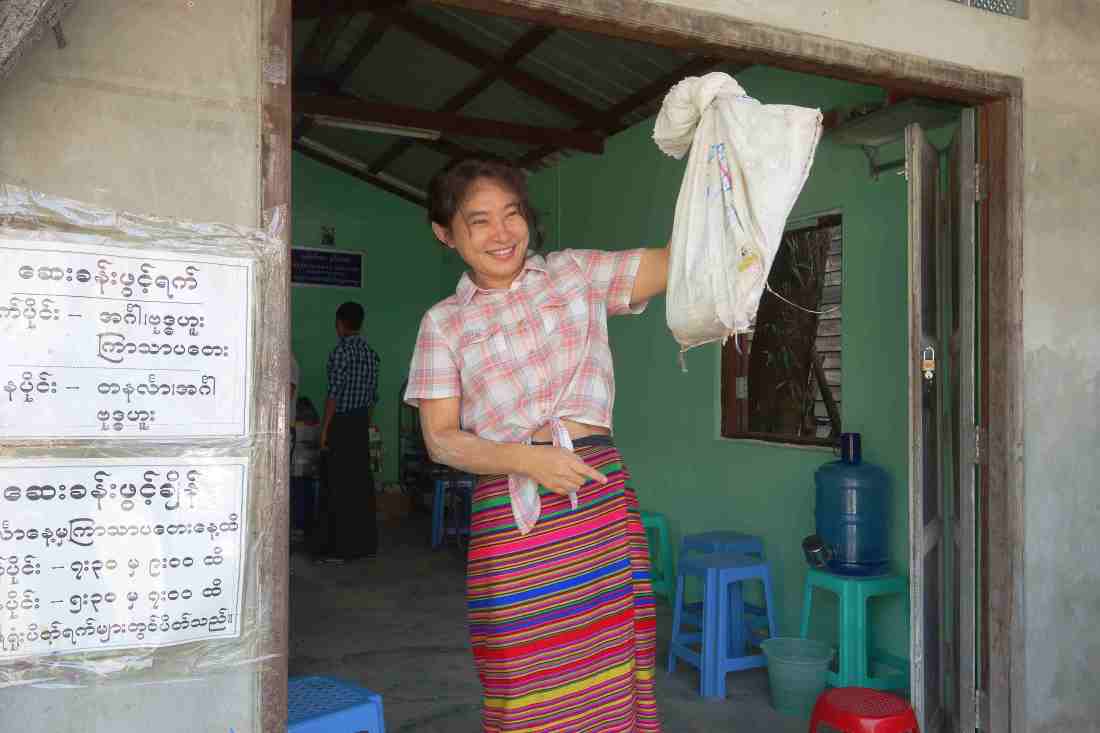
[Above photo: Dr. Hnin Aye after her Friday morning clinic in Maubin, holding up a live chicken. Next they’ll pay us in shells! ]

29 September 2019

The European Film Festival is here for 10 days (3 in Mandalay), showing at the Nay Pyi Taw Cinema across Sule Pagoda Road from the Sule Shangri La Hotel in the downtown area and at the Goethe Institute with its charming café.  I went with one of the Brits—a midwife who is doing antibiotic research, but cannot get the Review Board to approve it. It isn’t that her proposal is unethical, daring, or puts people at risk; people have lived under the gun for so long here that they are fearful of making any decisions, lest the latter return to bite them. So Faye has taken on other work. She’s enterprising, having worked in Latin America and Africa, as well.

There was a huge line for the theatre—admission is free— but happily she’d gotten there early and was almost at the ticket window when I arrived. The two seats in the nosebleed section—“peanut heaven” we used to say, which is probably very un-PC so I apologize, although I like peanuts—were in the last row, in a distant corner: a little couch, of sorts, for two, sheathed in vinyl so it could be wiped off. I’m sure it is just the sort of spot teen couples dream of getting when they go to the movies.

We saw Cold War, a terrific black and white contemporary Polish film set in the years after WW II. The ill-fated lovers, musicians both, were riveting, although I kept diagnosing the woman whose “father mistook me for my mother so I taught him a lesson with a knife”, clearly traumatized and with attachment issues. I’ve been immersed in this stuff a little too much, I think.

A friend of Linda’s family, whom I met in Hawaii, mentioned she had made a film about sex workers in the Myanmar-Thai border area in the 1990’s, smuggling the cameras and the two other personnel in on separate flights to different locations. Her distributor hasn’t been doing much with the film so she liberated it and it is now for free on YouTube. I watched it, as well, this week. The link is: https://www.youtube.com/watch?v=CkYGkZxu3y8  or you can type in Anonymously Yours Myanmar to find it. It’s very much cinema verité, with clandestine interviews with tearful young women. I found it very moving—I mean, these are our mothers, sisters, daughters, wives, friends. Men are such dogs, including the men who hog all the riches and keep the populace starving and desperate. The jade industry alone in this country is $30 billion/year. Then there is all the rest— gold, rubies, oil, and on and on. Opium.  Also the men who start the wars, the men who rape women and children. Oh, I must be in a bad way here, but it is really clear why the world is so fucked up and it isn’t caused by the women. No surprise that educating girls in developing countries stabilizes the country and makes it more prosperous, as well as bringing down the birth rate.

I think I’ll go to bed as this is taking a bad turn, albeit accurate.

I went to another fabulous film at the Festival, Sami Blood. It is a Swedish entry about racism and the persecution of the Same (Lapp) people in the 1930’s.  It was wonderfully done, especially the amazing righteous intensity and courage of the young girl, the focus of the film, who refused to tolerate being treated as less. I do admire survivors. She reminded me a little of Greta Thunberg. Maybe the kids will get us off of our lazy asses to do something about climate change.

Like many, I suspect, I frequently find myself humming a song whose lyrics echo precisely what I am wrestling with—-or just feeling. The title of this post, lines in a song by Billy Joel, really sum up my current dilemma, although Vienna has never been on my radar.  I have a few good years left, hopefully. How do I want to spend them? It’s a battle between doing something good for others here and developing, and consolidating, friendships at home. The latter is currently winning out. I’m sorry to treat you to my obsessional ambivalence in post after post, but this blog is really a diary for me as much as entertainment for others. To that end I want to expose and record some of the currents of my mind, certainly not all of them.

We saw the 13yo boy who drank organophosphate pesticide over the weekend and again, after his discharge, on Thursday. Quite amazing! He was chatty, smiling, very bright and engaging. His parents had talked with his school and all the teachers and the headmaster came by his house to greet him. His father talked with his uncle and other adult males who had teased him, calling him “Gay” because he is tiny and doesn’t want to be injured in rough and tumble play with his male peers, so he plays with girls. The uncle and others apologized. And the child talked openly about being so small and fearful of being hurt. I think that my (our) thought that he may be gay or transsexual was not correct. He’s a smart heterosexual boy surrounding himself with cute girls! If he had been given an antidepressant medication, guess how we’d have understood his recovery.

One of my students, Hnin Aye, and her husband, Kyo Zaw, asked me if I’d like to drive to Maubin and spend the night. She is posted there and has a private clinic she runs on Thursday nights and Friday mornings. They asked another student, Kyi Min Tun, as well. We hopped the ferry to Dalat where Kyo, a merchant seaman home for 2 months between assignments, met us, having taken the less frequent car ferry. We drove for 2 hours through the top of the Ayeyerwady Delta, a vast flat area of innumerable rivers, canals, fish ponds, and rice paddies. And stilt houses. Maubin is a little town, a district center and home, curiously, to two small technical universities.  It has a 200 bed government hospital where Hnin is the only psychiatrist. We had a terrific supper at a local outdoor restaurant and checked into the only hotel that is allowed to accept “foreigners”.

I, of course, was feeling so “of the country” that I forgot to bring my passport. I was going to have to sleep in the car until Kyi whipped out his laptop and produced a copy of my passport and my letter of invitation to Myanmar from the Ministry of Health and Sports. I like that they include Sports; it makes sense.  Two weeks ago he made me a plane reservation for Thailand in October and I’d given him a copy of the passport. Whew!

The next morning we toured the town, especially the jetty and adjacent market. Many small boats from outlying communities had arrived at 5 or 6AM to bring in agricultural products and to take back staples, including petrol for the boat engines. Most fields here are still plowed by water buffalo, fertilizing as they go. The villagers were packing up and heading back by 11AM, beating the mid-day heat. It was a scene of incredible bustle and reminded me how close we are, in behavior, intelligence, and industry, to ants. They are stronger, more disciplined, and less self-indulgent. We dropped by Hnin’s clinic—a tiny single-room stand-alone building with lots of plastic chairs and people waiting. She clearly was very successful, as I’d expect. She is smart as a whip, practical, funny, and kind. Thinking selfishly for the good of Psychiatry in the country, I have repeatedly encouraged her to join the University of Medicine 1 faculty, as have several of the senior faculty. She isn’t interested, even though she knows she’s very clever and is a terrific teacher. “To move up, I’d have to get a PhD (true enough) and I don’t want to go through all that just for advancement.” I tell you, she’s smart! She clearly understands all the arcane politics, plots, and hoops in academia and wants no part of it, loving her work and her little town, Maubin. I so admire her clarity of purpose.

Seeing Maubin was like stepping into a time machine. I am determined to take the 5-6 hour boat or bus ride to Bogalay, at the extreme southern edge of the Delta before I leave. Just on the Andaman Sea is Myanmar’s most populous and varied bird sanctuary. But mostly I want to keep turning the time machine backwards. Not many foreigners go to Bogalay. I hope there is a hotel that will accept me.

Ah, the chickens are coming home to roost. It’s lovely to see. And the Head Chicken is crowing, “Unfair!”, “Fake!”, and “Perfect conversation!”, as the chefs are preparing to pluck and roast him. Hopefully, Ukraine is just the start of a feast. And a new beginning for our lovely country.

Canard a la Cannabis

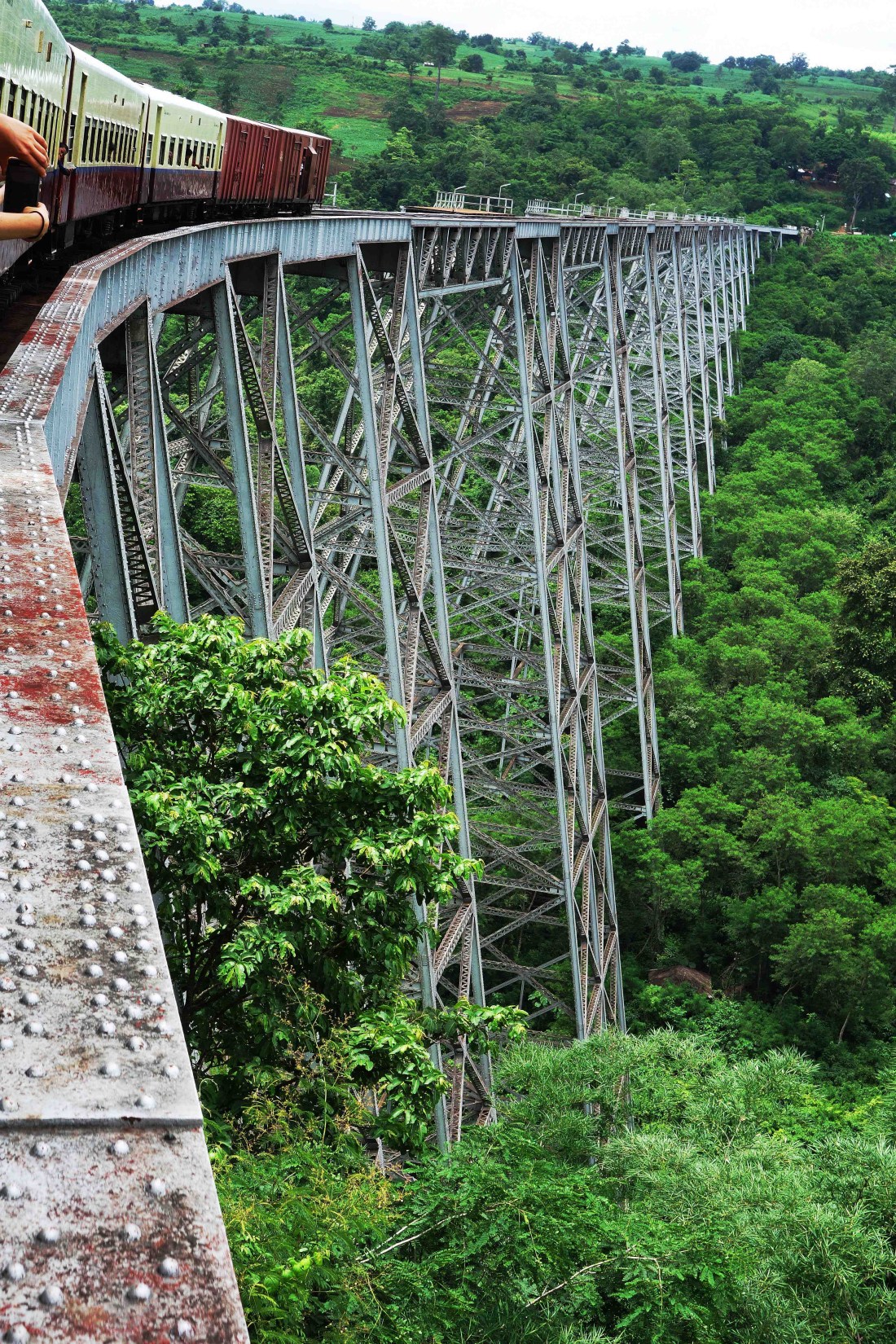
[Above photo: Crossing the Gokteik viaduct, the second highest bridge in the world when constructed by the Brits in 1901. The train crosses it at a slow walking speed, swaying and creaking.]

20 September 2019

For those of you who were concerned that something was wrong when I didn’t post last weekend, I appreciate the sentiment. I was underwater, preparing the final exams and a lecture and exercise on Couples Therapy, for which I had to finish reading a text. This weekend is similar, with breaks for two suppers with friends and catching a film at the Myanmar Film Festival. Plus, I’ll go with one of my students, likely each day, to see a 13yo boy in hospital who attempted to kill himself by drinking organophosphate pesticide. So this entry is it for both weeks.

The lad is from a small farming village and is a tiny boy for his age, preferring to play with girls than in the rough and tumble with his male peers. His uncles and other village adults tease him, calling him “Gay”. He has been getting more and more depressed over the past 2 months, culminating in an early morning attempt. Fortunately, his father found him soon after he ingested it. He is very smart and excels at school, but deviations from cultural norms are no more easily tolerated here than anywhere. I’m thinking of Matthew Shepherd and the powerful play about his death some years ago.

He will hardly talk with us, so we must lure him out of his cave. We don’t know if his suicide attempt was triggered simply by the teasing, by being so petite, if  he is gay, if he is transsexual, or whatever else but he cannot leave the protection, such as it is, of the hospital until we have a better understanding and a sense that he is safer than he is at present. Projection can partially relieve us of painful, unwanted feelings but it also can turn those around us into our seeming critics and enemies.  Part of our job will be to help him accept his conflicted feelings, whatever they are, so that he can then see us as sympathetic to them and identify with that acceptance.

This is all complicated by the fact that he lives 6 hours away and the family is as poor as church mice so travel to our clinic would be prohibitive. There are, of course, no mental health services anywhere near him. I may have to fund their transportation for awhile.  My students regularly pay for their private patients’ medication if the latter cannot afford the cost.

I obviously have decided that I can describe cases from our clinic here, if disguised, without violating principles of confidentiality.

Speaking of which, my last weekend was spent in some agony. Well, something considerably more painful than a quandary. One of my students who struggles with boundaries—timeliness, sharing information—-said she had prepared lunch for us both. The students generally share, with me and each other, whatever is on the table in front of them. It was duck and it was very tasty, especially the gravy which she liberally ladled onto my rice. Walking out of the restaurant where we were eating—As long as you buy some side dishes, they aren’t upset if you bring in food, happy for any business and hopeful for more in the future.—, she said, “Professor, I owe you an apology.” Wonderful, coming to some sense about those inappropriate Facebook posts or drifting into class, regularly, an hour late. Not to be. “I put some cannabis in the lunch.” I was stunned, and hopefully not on my way to stoned, as I had to lead a 1 ½ hour discussion of the Felitti et al ACE (Adverse Childhood Events) study, a landmark in the trauma literature.

I felt no effects from the drug but massive effects from the revelation. I resolved to discuss it with her before talking with Professor Tin Oo. I thought her judgment is so poor that she should be prevented from working with patients. Maybe she can re-train as a pathologist or radiologist. I like her a lot; she is kind and bright but a bit unhinged by critical, persecutory parents. Still, she has a lovely 10yo daughter and is totally in love with her and her younger sister, breaking the generational chains binding her mother and grandmother to their hated parents. I lost sleep and felt awful at what I had to do—-to protect patients in the future and to protect her from self-destructing with them.

Monday I took her aside and asked why she had invited me to lunch and, unbeknownst to me, put cannabis in it. What did she expect would happen? She looked very puzzled. Then she laughed and said, “It was just a little pinch. The Shan and Karen use it to flavor poultry dishes.” I later checked with others and it is true. I could have hugged her but, mindful of my boundaries, I didn’t. My relief was audible, as I sighed and she laughed.  Her judgment isn’t that impaired.

I was asked to meet with the head of Child Protection for UNICEF and after some talk, they want to hire me to do some training of Medical Social Workers in the various conflict zones. I’ll not be in the line of fire, for those who might worry. They have had no mental health training and need to learn how to be helpful to children traumatized by the fighting, by displacement from their homes, by the loss of a family member, and by what they may have witnessed.  Once you put your toe in this water I think there is plenty of opportunity for work, paid work.

We saw a 9 year old girl from rural Rakhine State who has developed panic attacks over the past two weeks. Her village, which sits in a valley, has been underneath a battle being fought between the Arakan Army and Myanmar government forces dug in on opposing hillsides; there has been no damage to the village and no soldiers passing through it but the thunder of constant shelling overhead has terrified her. We adults are so depraved at times.

Speaking of which….No, I’ll restrain myself. I do get a little addicted to rotating through the talking heads on YouTube—Trevor Noah, Seth Meyers, and Stephen Colbert. All of their narcissism is a bit overwhelming but not, to me, as consuming as Rachel Madow’s. Her pace is so slow that I find it off-putting, although her analyses are sometimes excellent. Surprising to me, I like the Daily Show the best. And I read the daily NY Times. It all leaves me feeling a little ill, staring into space, like after eating too much popcorn.

Torrential rains and lightning last night awakened me. It was, hopefully, the last throes of the rainy season before we move into drier and a bit cooler weather. I’m liking The Burma Beat.

And Jetsom

8 September 2019

[Above photo:  One of my students sent me this. I have no illusions about my Bama zaga fluency!]

Hm. The electricity is off, an unusual occurrence. Once or twice a month, at most. Generally, it’s on again in an hour or so. I’ll fire up the tiny propane stove for tea.

I was walking home last night after supper at my new-to-me Japanese restaurant and passed all the fruit and vegetable sellers on the street. The fish, meat, and prawns stop selling at about 4PM—-too perishable, I think, to stay out longer. I passed a guy—it is only guys selling durian and mangosteen, their niche—with a heap of durian. I’d abandoned durian as the last 4 or 5 were not nearly as ripe as the first. Cleverly, they make a clandestine slice in the skin so that when you smell it, it seems ripe. Then I thought, oh ,just once more. I selected a little brown one which wasn’t sliced and smelled very good. I took it home, cut it open, and—-presto, I beheld magnificent, ripe, custardy durian fruit inside.

Two days ago at 8AM, after finishing a wonderful paper by John Bowlby, entitled “The Making and Breaking of Affectional Bonds”, which he presented at the 50th Maudsley Lecture in 1976, I went grocery shopping on 17th and 18th streets. The markets have developed amazingly since I first arrived; they are now very crowded and bustling with all manner of foodstuffs. I bought a kilo of tiger prawns ($6.50), a large pork filet, ½ kilo of onions, fresh broccoli, fresh asparagus, and, wonder of wonders, hmyi chin. This is fermented bamboo which I have had with beef in Chinese restaurants at home. I was assured that it is of Burmese, not Chinese, origin and that it was available in any “wet market”. What is a “wet market”? A street market where everyone and everything gets wet when it rains, I’m told. So I bought a ¼ kg of hmyi chin to saute with my pork.

As I was leaving I saw a man selling incense and burners in the street. His display was smoking and produced a wonderful fragrance. I bought one—-a reconfigured “Swis Milk” can previously holding a “Sweetened Beverage Creamer”—and a supply of incense. When I got home I realized the incense was dried turmeric root, which smells heavenly.

I soak all the vegetables in a light bleach solution for 5 minutes while I trim and slice the pork and portion it and the shrimp in 1-2 meal containers and pop them in the freezer. I then rinse the veges for 10 minutes and I am done for the week. 1 ½ hours, fun and novelty each time, total cost about $11.  Hard to beat.

Speaking of Japanese restaurants, I now have 4 within 3 blocks of my apartment.  Japanese food is my go-to at home but I also appreciate the Japanese intense dislike of dirt, flies, and contamination of all kinds. A safe bet for dining.  Burmese food is generally too oily and overcooked for me. It is much more like Indian food than Thai or Vietnamese.  I prefer the ethnic foods heavy on fresh vegetables like Kachin, Shan, Palaung, and Wa,  of which there is an abundance in Yangon but none in my immediate area.

I took the students out to lunch 3 days ago. There is a very fancy Singaporean hot-pot place, Beauty in a Pot, which recently opened next to the clinic.  It is running a 50%-off special for the first 2 weeks. Of course, many others had the same idea, so we jumped back in our cars and cruised to another hot-pot spot nearby, this one owned by a Burmese super-model who married a rich businessman. It was such a slick operation, Henry Ford would have approved of the assembly-line. Hot pots are quite the thing here. I’m a little surprised they haven’t caught on yet in the US. Perhaps they have and mass-assembled food just won’t fly in Berkeley. We ate our fill, and more, as you can return to the source endlessly. An added delight at lunch was that they requested a photo ID to confirm that I was eligible for the 50% Senior Citizen Discount.  They were uncertain if this old grifter was trying to get away with something at 79yo!

In Berkeley we had a copper Korean hot pot in the bottom of which you’d put glowing briquettes and in the upper circular “pot” there would be broth into which, communally, you’d put things to cook and eat. Much more fun, I think, than fondue. The last time we used it I heard a scratching sound in the heating vent and had to dissemble a duct in the basement to retrieve Ariane’s dusty, absconded hamster, Hammy. Our guests were amused.

On Friday I took a taxi to the Embassy to retrieve an ATM card Linda mailed me, another taxi to my carpenter’s workshop,  and a third, with the dollhouse on-board, to deposit it in the Isolation ward we use on Thursdays to see children. I then walked a few miles home, happy to stretch my legs. Fully 2 1/2 hours of taxiing for about $7.

It is only time before DT’s avarice trips him up. Not to suggest that his path has been anything but a constant stumble.  Lieutenant Zero staying 180 miles from his meetings in Dublin at Trump’s luxury golf resort. Air Force personnel staying at another luxury golf resort and keeping an airport in western Scotland from closing by paying exorbitant refueling costs. All the Middle-Easterners staying at his luxury hotel in DC. Proposing his luxury Florida golf resort for the next G-7 meeting. As if it is the American way, to use the highest office in the land to enrich yourself.

Perhaps it is, you suggest, but it shouldn’t be.  He has reduced us to just another, if large, banana republic and he’s the tin pot dictator. As a nation we have always exploited others for profit but in a wobbly way, regularly scandalized by publicity of the same. It’s the angel on one shoulder and devil on another.  Periodically we try to state, and follow, more noble principles. DT seems less than capable of any principles, let alone human feelings, posing in a hospital photo-op with his smiling mannequin for a grin and thumbs-up photo with the parents and infant of a couple who were just killed in a mass shooting. Watch the silent, castrated Republicans scurrying off the sinking ship to hide under a rock as 2020 approaches. It gives eunuchs a bad name!  I’ll be a year older next election and never thought I’d live to see 80, never imagined I’d witness this sham of a mockery of a travesty, let alone the rebirth of our Democracy..

I’ve decided to stay and teach from January through March, if the year-long diploma course is approved by the Ministry of Health and Sports (?and Education) in time. Three months goes by in a trice and my investment in Child and Adolescent Psychiatry here compels me to want to launch the next class carefully. If I do stay, I may visit the US in December.