To Hawaii

14 April 2019

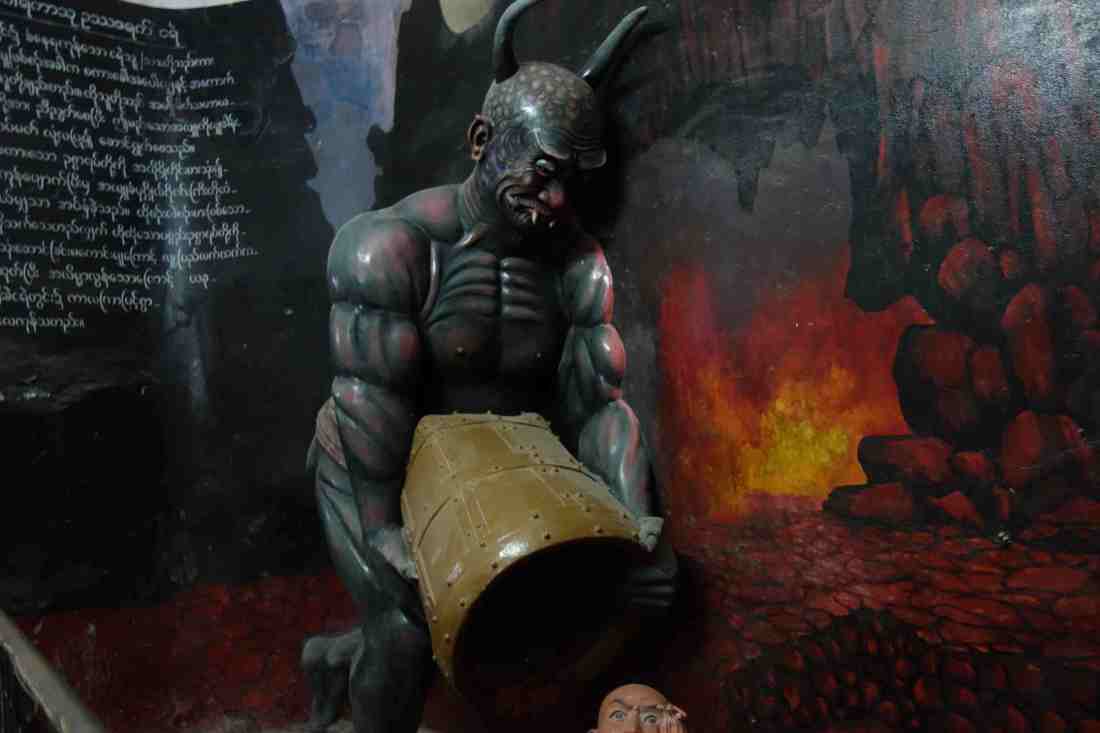
[Above photo:  Satan himself dumping hot coals, in case people were chilly, onto a group of naked women. Hard to miss the censure of sexuality.]

Looking over the balcony of our beachfront condo in Napili toward the sea is like viewing a massive TV screen.  The natural sound system reproduces perfectly the waves breaking over the reef, 75 feet from shore. This morning the sea is peaceful with a light breeze ruffling the surface.

The first three days of the week were passed in teaching in the heat and moving slowly. Lunches, as always, are spent at the medical student cafeteria with my students. As I sit with my meal, purchased for $1 and including soup and condiments, many pairs of chopsticks dropped choice bits of fish or meat and tasty vegetable dishes like lemon or watercress salad and rosalie on my plate. The latter is a leafy plant with purple stems. It is steamed or sautéed with onions, fish paste, and several other ingredients into a wonderful, pungent dish. The students’ generosity appears so natural and effortless.

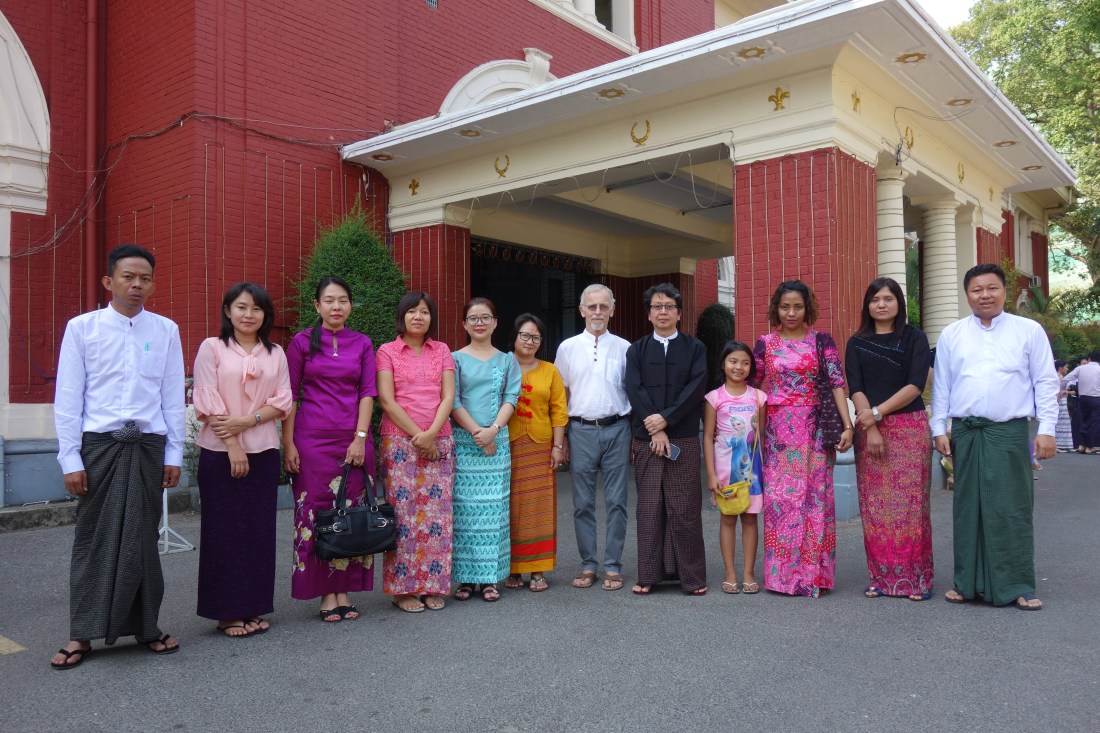
We had a supper with the Mental Health Society of Yangon, most of whose senior members I’ve met before. This time they invited all the students. The women dressed to the nines and it was such fun to watch them interact with their former professors. The food at the Golden Duck was memorable and plentiful; the duck didn’t disappoint.

The upshot of the meal was I decided to wear a longyi for teaching every day. It is cooler than trousers and increases my sense of assimilation, as well as my anxiety of a wardrobe malfunction. It was funny as I was lecturing and one of the women in class pointed out that my longyi was coming unwrapped. I turned my back to the class and one of the male students raced to the front, hands on, showing me how tightly I must tie it. A bit like those ladies of yore being laced into their whalebone corsets. A female student also came forward to give advice at a distance. Laughter and good humor all around.

I cannot adequately express how much I love them all. Each one has, in his or her way, been through hell in this country of dictatorship, repression, informants, economic hardship, frequent job tansfers, and poor health care, not to mention all the ordinary trials of life. Each student is so distinct from the other, yet all are kind and thoughtful. Even “Rambo”, as she was nicknamed earlier in her worklife, is a savvy, thoughtful, lovely woman. I worried how well she’d get on with children, having earned that moniker. She is direct but able to listen and observe. I keep pinching myself, it is so perfect. I’ll give them a mid-term in three weeks and we’ll see how much they are assimilating.

I see tests as a method of learning more than as an assessment of knowledge, except for the rare ones who either don’t or cannot do the work. It is strange, as Linda and I were talking, how many book-smart people have social skills limited by their need to control others or who lack any common sense. There are so many types of intelligence, it seems to me. There is emotional, of course, and SAT abilities, but many others. Some people have a capacity to recall many details with no application or relation to their life yet cannot risk expressing their emotions. Or don’t know how to comfort someone who is hurting. So this test is more for them to see how much they are getting of the basics of Child and Adolescent Psychiatry. And for me to see how effective a teacher I am. They can use it toward their final grade—Pass/Fail—or not, as they wish, as I can use it to adjust course if needed.

I’ll miss Burmese New Year or Thingyan celebrations this week. It is known as the Water Festival, and water is thrown by everyone at passersby for several days. Coming as it does during the hottest, driest month of the year, it seems like levity and relief. I was assured that after a day of getting soaked walking down the street, it gets old. Still, I doubt I’ll intentionally return in the hottest season so I’ll likely never experience Thingyan.

My flight(s), all 4 of them, went off without a hitch. CheapoAir provided the least expensive fare from Yangon to Maui, by far. It did, however, mean a different carrier at each stop (Hanoi, Seoul, Honolulu), which meant that I had to get my boarding passes at each airport. The layovers weren’t excessive yet I didn’t have to sprint for any planes. I talked with each of my seatmates and they were all interesting, on holiday, travelling for work, etc.  Vietnam is a huge tourist destination now. Trying to imagine that in 1968 when I refused military service during the war would have been a stretch. How stupidly reactive and fickle we are as humans, mortal enemies then, friendly allies and partners now. I always wondered how our government repeatedly made the mistake of siding with tyrants; it isn’t a mistake.  We support those who will do our bidding. To hell with the citizens of the country.

How easily good people can be recruited into supporting bad people. One bright PhD on the plane is doing research for a vaping company; she is a kind, decent mother and yet didn’t seem to grasp the evil of addicting high school kids to nicotine. I’d met a young Chinese engineer in a restaurant in Yangon who was working for a large and multifaceted Chinese government company that is building a liquified natural gas port near Yangon, one small part of the Chinese takeover  of the globe that appears to be very successful in SE Asia and Africa.  Our blustering foreign policy, excepting the Peace Corps which is probably our most effective, seems impulsive and childish compared with the long-horizon strategy of the Chinese.

As I emerged into the bright Hawaiian sun from the Kahului airport on Maui, Linda slipped to the curb in a blue VW convertible. This was not the capable but primitive blue VW we bought new for $1700 in 1958 to carry Chas and I to college and back 3x/year, 36 horsepower, 1192 cc displacement.  This is a sleek, fast, comfortable little car with a spoiler on the trunk and a single button that lowers the windows and the top.

We chose to meet in Maui because her nephew, Alex, is marrying here. We spent the first night with friends of Linda from Samoa, when she and her husband and children spent two years there in 1990-92. Linda delivered their last child. Tom arranges trainings for linemen at power companies all over the Pacific islands so they don’t fry themselves. Nancy is the administrator of a group of National Marine Sanctuaries, especially for humpback whales, around the islands here. We’ll do a hike with them later in the week.

The next day we met Richard, her brother, and his wife, Laurie and another nephew, Nathan, and hiked up the Lahaina Pali trail, used in ancient days by missionaries and farmers. The views of the coastline were lovely and it is so glorious to see clouds again, after seeing none since my arrival in Yangon. Sitting for long periods (24 hours getting here) on planes and in airports makes me want to hike and climb endlessly.

We’ll walk and swim and eat and get to know each other again. And go to the wedding celebrations. Linda made me an amazing little book of her miniature paintings on tea bags documenting each day of our Namibia/Botswana/Zambia trip last summer. I’d already forgotten some of the less-memorable place names. Pretty charmed lives we’ve created.

Small World Coincidences

7 April 2019

[Above photo: From the bed of the giant reclining Buddha outside Moulmein, the Devil and his pet, Spot, just doing their jobs.]

Last week I mentioned meeting a Burmese man at the International School Yangon Gala. He and I were the only ones dressed in formal Burmese garb. We had dim sum yesterday at a lovely restaurant, Signature, overlooking Kandawgyi Lake. He told me had married a Korean woman he met in the US, divorcing her after 23 years. Her adoptive father built a sailboat, sailing through the Great Lakes, out the St. Lawrence Seaway, and down the coast, berthing her in Bar Harbor, Maine. He used to sail with him in Penobscot Bay. He now has a Burmese partner who works as a preschool teacher with my friend, Ruth.  It is a tiny world filled with coincidences and the same miseries and joys felt by most.

When I walk to the bus each morning, I pass the Baptist Church and School at the end of my street. At 8:45AM I am treated to a children’s chorus, their voices raised in unison (almost). I’d recommend it as a way to start the day. Also, on that corner there is usually a man selling strings of jasmine flowers which people use in their cars as air fresheners.  The scent is so much nicer than that from the green chemical mix with a picture of a balsam fir on the label which some people have on their dash.

Preparing for Maui, I imagined I needed another pair of shorts. After working for several hours on my class presentations yesterday, I dropped by Sein Gay Har 3 blocks away to see what I might find. It is a narrow, 4 level store with a tiny escalator going up and stairs to descend.  I found two sections with shorts in the Menswear Department and tried on 4 pairs. Could I fit a 30 waist? Nope. Here’s a 32 but when I try it on it clearly is mislabeled and should be a 28, as I cannot button them. Then a 31 that kind of fits but there is no buttonhole for the main button. Finally a pair that looks ample enough but hasn’t a fly, even though it has a flap suggesting there is one. None of them were really my style, as well. I decided the Fashion Gods did not want me to buy shorts; beside which, I already have two pair. Whyever did I think I needed another? I likely wanted a reason to walk around a little. So I bought 5 mangosteens at an inflated price (27cents apiece) and a red bean smoothie with black tapioca pearls from Bubble Tea and returned to work out “Talking With Teens Who Are Dying” for Monday.

I’m in the middle of a 10 day 100-102 degree peak temperature spell. April is indeed the cruelest month, here at least. As I left class Thursday, two of my female students approached me. “We are worried about you, Professor. It is too hot for you.” I assured them I was indestructible. “Yes, you are incredible.” No, not incredible, indestructible, a very different word. Yet hearing their concern both warms me (not necessary in this heat) and revives my own life-long concerns about dying, having identified all too well with my father who died at 55yo of an m.i. when I was 9yo. And his father who died of one in his 40’s. I seem to be from a different gene pool, plugging along at 78. I’m doing pretty much what I want to do so if it all ends now that won’t be a regret.  Still, I have most of my marbles and am productive and have big (unrealistic, no doubt) plans for Child and Adolescent Mental Health in Myanmar, so I’d rather not go soon. Not to mention all of my relationships.

I’m going to try to learn a bit of Myanmar script, so I can read signs. My progress is flagging with spoken Myanmar and perhaps this will help to stimulate me a bit. The script is fascinating, seemingly arbitrary, and totally incomprehensible to me now. Not even recognizable little pictures, like with Chinese characters. As Pwint Phue Wei, my language teacher, was describing how the characters are combined to make sounds and words, I asked, “Do people ever go crazy trying to learn this?”. Seriously, truly the Mysterious East.

I went to the swearing-in ceremony for the 4th group of Peace Corps volunteers in Myanmar on Friday, 37 young fresh faces preparing to teach in the secondary schools in Mon State and in Maguay and Bago regions. It was so sweet. One from Berkeley, two from LA, and a bunch from Ohio. They were all dressed in traditional Myanmar clothing. The girls did a traditional Myanmar dance number. A boy and girl alternated giving The Speech, interpreting for each other. And several ministers and governors were there. And the US Ambassador. The Peace Corps Country Director gave a good send-off talk. And dozens of their Myanmar counterparts, dressed in the traditional white tops and dark green longyi of teachers, sat in the front rows and clapped with enthusiasm.

I met a fellow who has been doing NGO work for 30 years, until recently with Save The Children. He’s former Peace Corps. He has recently been a part of a group trying to address sexually abused children in private schools. We hit it off and it turns out he spent 5 years living in Malawi, working with an NGO at a refugee (from the Mozambique civil war) camp in Liwonde. The latter is now one of two premier game parks in Malawi. And the Peace Corps Country Director was Country Director in Malawi in the 90’s. I think we’ll have a PC reunion sometime soon. It is a large family. I feel a bit of an imposter since I wasn’t in a village in my 20’s but I’d guess I worked as hard, learned as much, and was exposed to as much grit working in psychiatry in Blantyre as they did in the boonies. I wish I’d done it at an early age, though. So life-changing.

Back to child abuse, there is no national policy or reporting, investigating, treating,  or prosecuting system here, despite that Myanmar was an early signatory of the UN Convention on the Rights of the Child. This week we saw a girl we suspected of being sexually abused in her pre-school. The school has been put on notice, the perpetrator doesn’t seem to be a member of the faculty or staff, and our patient will change schools. But since it is “suspected” only, I don’t want to tell the police who aren’t trained to investigate it properly and may simply close the school, ruining some lives in the process. So I’ll supervise one of my students seeing the little girl in therapy and we’ll all learn from her.  Perhaps we can convene a working group to develop a plan for a Child Protection System for the country, or at least the region. It is so easy to see a glaring need, think of a comprehensive fix, and then get stalled trying to educate and convince the powers that be to develop it.

Joe Biden is too old to be president. If he runs, he’ll get whacked, hard and repeatedly, about Iraq, Glass-Stegal, and Anita Hill, as well as the nuzzling. Time to be a sage and a counsellor, an ambassador, something where his good heart, wisdom, and experience can make a difference. I just cannot bear it if the Dems chew each other up before the primary and, exhausted and bloody, are fresh meat for The Donald. Coincidentally, he who voted for Iraq, cheats on his wife, grabs women’s genitals without permission, and has been playing fast and loose with financial laws for years will try to savage Joe where he can. Remind me, O Reader, if my ambition o’erleaps my potential.

Sharing

31 March 2019

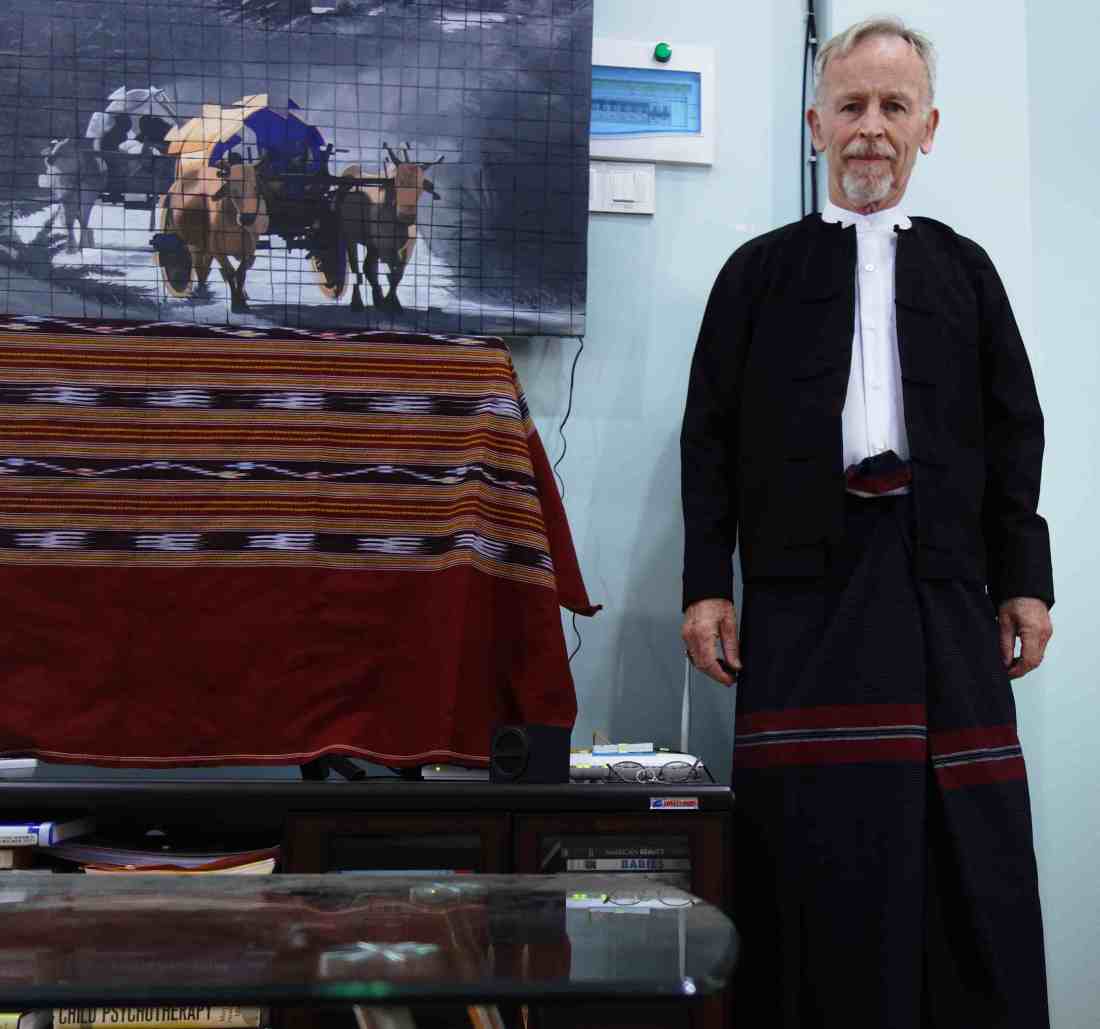
[Above photo: In traditional Myanmar formal dress.]

Burmese people share. Constantly and without expectation of return, I think. Little gifts of tamarind candy, or spicy, crunchy rice cakes.  Tea. At lunch on Mon-Thursday I sit with my students. Some bring food from home in those stainless steel containers that nest so nicely. Some buy lunch in the cafeteria. All of them put a bite onto my plate and onto other’s plates. Or if they want a bite, they ask for it. It is so sweet.

The students are all curious but non-competitive. They ask great questions, dispelling my worry that ain deh (Don’t ask. You may cause someone to lose face.) would reign. After I tried to explain projective identification for the third time, I said, “Let me see if I can find something to clarify this complex concept”. I’ve been on the receiving end of it many times, feeling corrupt, exploitive, useless, enraged, etc. with a couple of Borderline Personalities I saw for a number of years. I’m not sure how well I always managed those; I want to prepare the students for what they may experience. I think how far they all might have gone in their training and in their careers if they’d only been born elsewhere.

When I have looked for shampoo I keep seeing “White” and “Ultra White” on labels of lotion in the adjacent shelves. Tell me it isn’t so. But it is. And broadly so.  Asian women think that light skin is much more beautiful that brown skin. I expressed my surprise and dismay. The stuff has some sort of bleach in it. I mean, all lotions. It made me think of the Chris Rock film “Good Hair”. When I think of how poorly adapted my white Anglo-Saxon skin is to tropical Asia and Africa, I blanche. Brown is so healthy looking to me. And if people will keep intermarrying we’ll all eventually be a lovely café au lait.

Shifting topics, I have noted rusty red splotches on the sidewalks and streets. At first I thought, cavitary tuberculosis must be rampant, with people hawking up blood and expectorating it. Fortunately, it is “just” betel nut juice. Looking into someone’s mouth the first time when they are chewing is breathtaking, like discovering a vampire or a cannibal. Their teeth and gums are stained dark red. Now I see the betel nut sellers with their leaves, lime and flavor solutions, and bits of nut. They have an organized operation, like many drug dealers do. I’m not sure if I’ll try it.  Too many unwashed hands involved without any cooking, I think. The major booze competition here seems to be between High Class and Glan Master whiskies. That’s not a typo. For medical types, the glans is the head of the penis. Or perhaps it is from “Glen”, the Scottish term for a valley.  Or, likely, “Grand”. There may be a little subliminal advertising there. Remember Vance Packard and The Hidden Persuaders?  I have a bottle of High Class—-it must be so or they wouldn’t name it such, right? I’ll bring it and some Glan Master back when I return next year.

Another interesting bit is Chinese Stainless Steel, which appears to be an oxymoron. My sink and dish drainer were brand new, supposedly Stainless Steel. Both are rusting out rapidly. As I was doing some exercises the other night a large cockroach crept from my bedroom into the living room. I think it was headed for the kitchen, the source of all things tasty for roaches. When I say large, I mean 1 ½ inches long, not the massive central American or Hawaiian variety. You can step on those and they’ll simple keep walking, carrying your foot away. I don’t think it lives here. Probably came in from the deck through an open window. I gave it a solid thwacking with a fly swatter I bought. And deposited it in the garbage, which is where it was headed. Dead, though.

I went to the International School of Yangon annual gala fundraiser on Friday. My secret was to wear a black belt around my waist. With my taikpon buttoned, it wasn’t visible, and I never worried once about my pa so falling off. Only one other person was dressed in Burmese traditional. He introduced himself to me and we hit it off. I’ll meet him for lunch next week. He moved from Yangon to the US at 14yo, was a consulting engineer, and recently retired, moving back to Myanmar with his stunning wife. He was a scout leader in the US and both his sons are Eagle Scouts. He volunteers a lot here in schools. A really good guy with an interesting tale.

The gala was fun, with raffles and auctions and performances, and, eventually, dancing. Of the 250 people attending, only about 40 stayed for the dancing. My feet hurt in my awful pha net (I think they are 2 sizes too small.) so I kicked them off and danced in my bare feet. I won two nights at the Sule Shangri La with a raffle ticket. (Not for my dancing!).   The Sule is the very fancy hotel where the gala was being held. I gave them to Ruth, the teacher who asked me to the gala, since she has a studio apartment and has friends who visit. I’ll never use them, having an extra bedroom in my penthouse. [Addendum: It turns out it was brunch for two at the Sule Shangri La. My auditory discrimination issue.]

This morning I went out early to get a papaya for breakfast and some vegetables for supper and discovered two busy dim sum operations at the end of the block. So I bought a number of them and brought them back for breakfast. Gale, a Fulbright math professor who has been teaching in Mandalay, has been staying here for 3 nights and now is off to Columbo, Sri Lanka for a vacation with her partner who flies in from the US this evening. She is really fun and full of energy for ideas and travel and standing up for her students, especially the females who are discriminated against by dress code (must wear longyi) and curfew (girls in by 6, boys may be out until 10). She’s spunky, like Linda, and I admire it. Trying to nudge this society ahead, inch by inch.

I went to the clinic on Thursday and there was a “drug fair”.  It was approved by the Neurology Department so included booths touting a variety of anticonvulsants (sodium valproate, lamotrigine, etc) but also some old-fashioned snake oil, complete with extravagant claims on gaudy posters. For example, Kalysmon, a multivitamin “essential for prevention of infections by increasing Body Resistance” and “gives your child a good appetite and keeps them smart”.  Then Daneuron (Vit B1, B6, and B12) which is used to “Get rid of chronic pain” including “Inflammation of the optic nerve”, “Intense facial pain”, “Pins and needles”, “Sciatica”, and “Numbness”. And, Preven C Soft Caps (Vit E and refined fish oil) whose claims include “Strengthening Brain Function”, “Improving and Strengthening Visual Acuity”, “Prevention of atherosclerosis and cardiovascular disease in patients with high risk”, and “To improve brain function and growing up of the infant in the last period of pregnancy”.  From Indonesia in the purple trunks.

And weighing in for this heavyweight bout from the US in the red, white, and blue, a variety of SSRI’s with similarly doubtful results. Fluoxetine (Prozac) decreased the score on a depression scale by 30% in 53% of children and adolescents diagnosed as having Major Depressive Disorder. Placebo decreased it in 28% of the control group of depressed kids. The conclusion, which seems like boiler-plate for these studies, was “Prozac is, thus, safe, effective, and well-tolerated” for major depression in children and adolescents. Not strikingly effective, it seems. This is a many, many billion dollar industry built, I think, on sand.

I have thought that, yes, antidepressants aren’t so effective (in adults) for mild or moderate depression but they really do work well for severe depression where there is a large difference between active drug effect and placebo effect. On a close reading, it turns out the latter is due to a decreased placebo effect in severely depressed adults, not from increased efficacy of the drugs.

It is important to talk about these issues of drug money driving (corrupting) the marketing of drugs with my students but I must do it carefully since they are taught medication management of psychiatric illness only—with a bit of motivational interviewing tossed in—and no psychotherapy. I’ll arm them with psychotherapy skills.

I started this with sharing. I guess I end it with sharing my disappointment in the drug industry, in the health insurance/HMO industry that promotes the drugs as a cheap alternative to therapy, and in those of my US colleagues who, incuriously, peddle pills for a living, fooling themselves as to what is helping, or might help, their patients.

Turn Down the Thermostat, Please

24 March 2019

[Above photo:  A massive reclining Buddha near Moulmein.]

It was 101F yesterday. I got sleepy in the heat so made a cup of coffee. Then I was unpleasantly wired and actually felt ill, so I skipped supper and went to bed early. It will only be 98F today but I still may break out the air-con. My apartment is such that I can shut doors and cool just one room. It has been a matter of [stupid, I think] pride not to use it so far but these temperatures are more than this Seattle/Berkeley/Maine native can manage. My productivity just slopes off.

On Wednesday I awoke at 3:18AM.  The phone alarm was set for 3:30AM but my inner alarm, which I’ve used since childhood, gently roused me. A quick shower—I’ll often shower 3x/day—, a cup of tea, and I walked up the block where I met Drs. Tin Oo and Kyi Min Tun waiting in Tin Oo’s very fast and fancy Toyota Mark X Premium. I’ve never seen a car like this before but it is comparable to a 500 series BMW, I think. We drove, or perhaps we flew, 4 ½ hours east to Moulmein (Mawlamyine) for the day. It was a holiday, the Full Moon of Tabaung. Indeed, the moon was full as we left Yangon.

The idea of driving 9 hours in one day to spend a few hours sightseeing seemed like a lot of work but these two guys are so sweet and so much fun I decided to try it. Tin Oo grew up in Moulmein and lived there until he left for university. He drove like a maniac but he knows the roads and the car is very capable.  Despite patches of thick fog, we arrived intact in short order. We saw his home, his brother, his high school, and the “old Moulmein Pagoda” of Rudyard Kipling. Talk about poetic license! It looks southwestward towards the sea, not “eastward”. And the “road to Mandalay where the flying fishes play and the dawn comes up like thunder out of China ‘cross the bay” is a complete fantasy. Mandalay is hundreds of miles inland, there are no fresh-water flying fishes, and there is no bay. China is far to the east, so the sun would rise in that direction. Apparently Kipling saw the mighty Shwedagon Pagoda in Yangon but never visited the other towns.  How myth becomes truth! Of course, DT is a skillful negotiator who cares deeply about the Working Man.

Moulmein is on the Thanlywin River, downstream from Hpa An where I spent a few days earlier in the year. There is a lovely promenade along the river and we lunched in a restaurant there with the senior psychiatrist at the Moulmein Hospital. The food was a delicious mix of curries and seafood dishes. Salted, deep-fried lemongrass is tasty and crunchy,  a fastidious person’s grasshopper, I think. Part of the day we spent cruising around the countryside, visiting rather extravagant images of the Buddha. The one in the above photo reclines on a many-story building which is honeycombed with rooms. Each room contains one or more dioramas, complete with life-size statues, from the teachings of Buddha, including his life, his enlightenment, and many grisly depictions of Hell. The entire production is rather overwhelming. Looking across the valley, there is a mirror image, partly completed, of the same Buddha reclining on a building but the funds for it have run out. It looks like your neighbor’s 50’ ferrocement yacht which he gave up building half-way along. Since you take off your flipflops—That is all I wear anymore and what a treat not to mess with socks!—whenever you enter a temple (or a house and many shops), we doffed them at the bottom of the hill and sprinted up the many flights of stairs, trying to stay just above the flamingly hot concrete. We realized that most people wore their flipflops up the stairs until they actually entered the building. It would have been smarter.

I met a guy, a retired academic photography teacher, in the Berkeley Marina 6 years ago. He was aboard a huge (65’), and beautiful, classic schooner he was restoring to sail to the S. Pacific. The amount of work required was legendary and he recently was discovered to have metastatic prostate cancer. No Polynesian cruise for him, I fear. Be careful which dreams you commit to.  He did beautiful cabinet work so presumably the process of getting it together was much of the fun. I know I once built a kiln and enjoyed the building much more than I enjoyed subsequently throwing or firing the pottery.

These road trips regularly begin early in the morning so a breakfast stop is mandatory. Amazing to me, the food is generally remarkably good. There are great soups, like mohinga and pho gai, which are simple and quick to assemble but lack the artificiality of American fast-food. I think an entrepreneur could do well in the US with a chain of Thai/Vietnamese/Burmese fast-food joints. Probably they exist already.

One of my students asked me to see her 4yo austistic son. She, the boy, and her father, a retired anesthesiologist, came in. This woman is a star in the class and a lovely person. The little guy is clearly on the spectrum with no functional language, rare eye contact, difficulty with change, social deficits, and a lot of repetitive “play”. They have done a good job with him, given what’s available here.  I took a Systems of Care day-long workshop on Autism at the Child Psychiatry meetings in Seattle in October. In reviewing my notes and the handout, so much of the physician’s work is to make sure the family makes the right connections with the relevant professionals. Speech Therapy, Special Education, Sensory Integration, etc. Of which, very few exist here. The emotional and financial burden of having an autistic child is unending. And we still know so very, very little about it’s cause or effective treatment.

I’ve tried to share with my students the necessity in our work of feeling the patient’s, and parents’, pain in order to be maximally helpful to them. It certainly is possible to feel swamped with patients’ misery, which isn’t useful. It’s kind of a fine line, I suppose, between feeling their pain and living their pain.  It is such a treat for me not to have direct clinical care as one of my responsibilities here. The need and the work hours in Malawi seemed endless, even as seeing patients was one of the most interesting and rewarding parts of my work there.

And speaking of Malawi, there is no end to the misery. Mozambique, Malawi, and Zimbabwe have had floods with over 500 dead and counting. Thousands of houses have collapsed; crops have been washed away. There will be famine come October/November. Not easy for most, this life.

Getting My Rhythm

17 March 2019

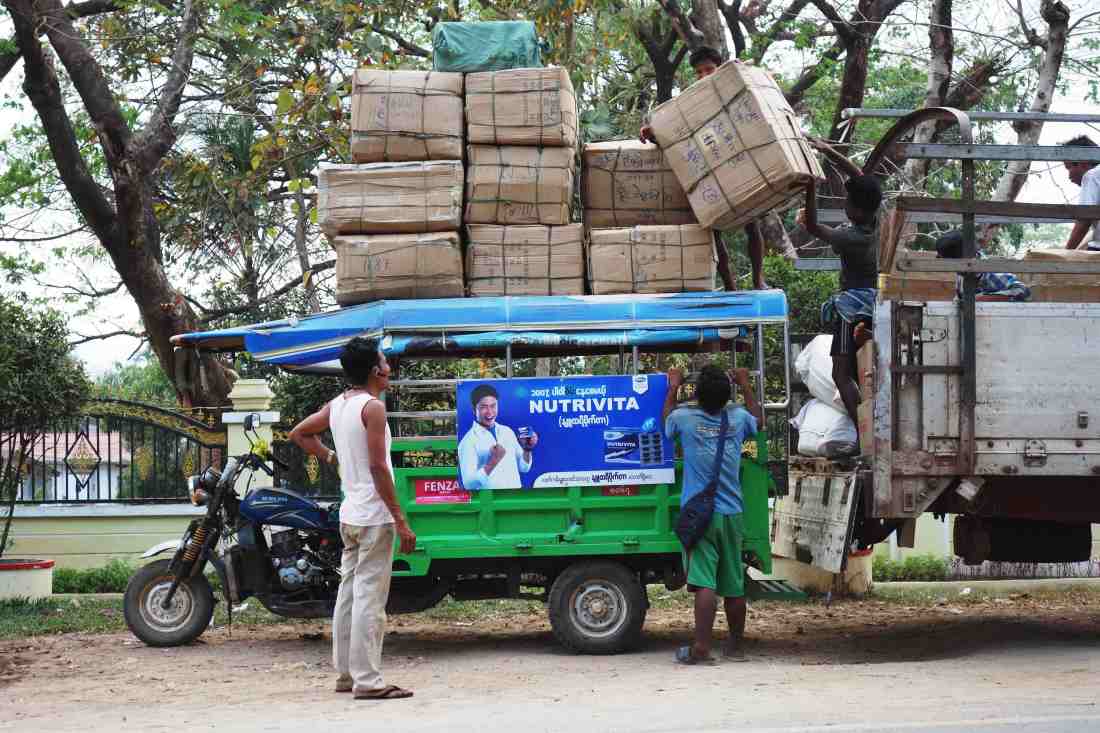
[Above photo: A good ad for Nutrivita! And Myanmar can-do! I always love to watch the “helpers” gawking.]

I awoke this morning with the expectation of calling my nephews and sister-in-law in Williamsburg, Virginia. We’ve tried to connect a couple of times but it can be difficult with busy schedules and my fumbling the time change. I slept 9+ hours and awoke 20’ after the time I said I would call. I tried with Skype but they were off-line. Hmm. Then I had the thought that perhaps, like Linda, they are on Daylight Savings time now, which adds an hour (or does it subtract an hour?) to our 12 ½ hour time difference. Anyway, it is unsettling as I want to talk with them. I’ve sent a text and an email. Somehow the 6 hours difference from Blantyre was more easily considered.

We saw a number of children this week. One on Monday, 4 on Tuesday. Some were very hyperactive, whizzing and flipping all over the large play area in the Development Center where we work. Two stumped me: a huge 17yo mentally retarded (Intellectually Disabled) autistic boy without language who has been hospitalized many times for violent behavior. He became very anxious having to wait while we saw and discussed the three children who came before him. His mother, a physician-become-Chinese-businesswoman has started her own private mental hospital and the boy lives there with two strong men 24 hours/day. He is on a boatload of medications, including three antipsychotics, a benzodiazepine, a mood stabilizer, an SSRI antidepressant, and an antihypertensive. We are slowly trimming those down, since we have no idea of what they may be doing to his brain (and other) chemistry, what with cytochrome P450 inhibition and enhancement affecting the drug levels, and on and on. Another child, 11yo, had communicating hydrocephalus, mental retardation, a seizure disorder, left hemiplegia from a stroke at 3yo, no language, and aggressive behaviors. His parents, weighing the risks, refuse to have surgery and the placement of a shunt.

I did seize on those two patients as a teaching moment on the following day. Starting with Primum non nocere (Do no harm), we looked at our collective and individually-determined responses to feeling helpless and not having much to offer.  A large proportion of health care expenditures in the US occur in the last 6 weeks of life with the futile efforts to prolong it.  This can serve as a useful example. It is so hard in the “helping professions”, especially as a physician, not to feel you can help the primary problem. We can always, however, attempt to make the patient safe and comfortable, look for antecedents of problem behavior, and support the caregivers. How is it in “Hamlet”? “Diseases desperate grown are by desperate appliance relieved, or not at all.” The above are two desperate cases.  Acting desperately, but futilely, will not improve things at all. It may allow us to feel we are “doing everything in our power” which is a perversion, since it potentially violates “Do no harm”. It certainly will do no good to throw more medications at their poor, damaged, struggling brains.

After that discussion, the class opened up and we talked a lot about Myanmar culture, how emotions are rarely discussed, how girls are usually left to understand their menarche on their own, how “family business” remains unspoken, how sex education is ignored in the schools, and so forth. It is very familiar and similar to Malawi—or Kansas! The rise in teen pregnancy in the US with Bush-era abstinence programs, including no [effective] sex education, is not too hard to understand. I suppose what angers me are those leaders who oppose sex ed in public, as well as family planning, contraception, abortion, and homosexuality, but practice it clandestinely themselves. The lives damaged, if not ruined, by their cynical ambition—it seems to be men, again, often politicians or televangelists. Those who need an approving flock to ensure their power and livelihood.

Then one of the women in the class said, “We have never been taught psychotherapy in our training. We have been taught diagnosis and how to use medications only. You are giving us something new.” Kvell—is that the appropriate Yiddish term? I mean, pleased that I can do this but mostly so proud of the students for grasping—-nay, embracing what I am about here.  It is so wonderful to be able to teach Child and Adolescent Psychiatry in accordance with my experience, my understanding, and my convictions.

I saw photocopies of some of the chapters of the electronic Child and Adolescent Psychiatry textbook I am using being passed among the students. Realizing what was happening I volunteered to copy the rest of the articles. So much for saving paper and costs with flash drives! It is much easier to read dense material on paper, rather than on a computer. When I went to pick up the print job, about 75 papers, 11 copies of each, there were three large boxes full of them. This will dent my Fulbright salary, I thought. Nope, $64.16. Live and learn. “We don’t take copywrite laws seriously here.” It does, again, suggest the brilliance of Harold’s idea in starting the online journal(s) PLOS, the Public Library of Science. Why should medical information, crucial to people’s well-being and often funded by tax dollars, be sold at exorbitant prices by journal publishers? No one in the developing world, specifically the physicians for the majority of the world population, can afford the multiple journal subscription fees, let alone the fees simply to read a single article in a journal. Business is important but health care research and information shouldn’t be for sale—and should be easily, publicly available.

At any rate, I had brought my large backpack to the printer and, after filling it, staggered home carrying two filled boxes in my arms. I could have taken a taxi for $1 but it was only a few blocks and pride wouldn’t allow. And I didn’t fall.

Yesterday at 12N my chief, Professor Tin Oo, called to ask if I had finished lunch. Nei le sa sa pyi byi lar? I hadn’t started.  He swung by and took me to lunch at a lovely lakeside restaurant. He told me some about his many years as a General Practitioner, being the only doctor in rural hospitals. He regularly did major surgery illuminated by a flashlight. They sterilized their own gloves. He was in 10 different hospitals, two in high conflict areas. When he was transferred away from one after 3 years, he had to walk for a day with armed guards because there was no transportation. He only lost one patient with surgery, a woman who presented with a ruptured uterus from prolonged obstructed labor. She died 3 days later of sepsis. This man is so sweet, quiet, and modest you would never imagine what a powerhouse of a mind he has.

I proposed that I take two of the students and we will present on our course, the Child and Adolescent Psychiatry Initiative in Myanmar, from opposite sides of the fence. The venue will be the Asian Society of Child and Adolescent Psychiatry and Allied Professions (ASCAPAP) conference, to be held in Chiang Mai, Thailand in October. That gives us time to pay attention to and collect information from the course. Strengths, weaknesses, omissions, highly valued parts, challenges, etc. It will be fun and informative to assemble the talks.

At the end of our lunch, Tin Oo gave me a bag in which were two pa so (traditional tube skirts worn by men), a white collarless eingyi (shirt), and a black taikpon (formal jacket). I must just find a pair of black, velvet pha ne (slippers) and I’ll be set for the black tie International School Yangon Gala at the end of the month. If I can finally master how to tie, and keep tied, my pa so.

A brief survey of signs on my street include: Eyebrow Tatoo, Eliza Skin Republic, Ruby Reflexology and Lounge, Fuxing (not sure but I don’t think it is risqué), and Aung’s College Phonetics.  Bubble Tea is across the street. Ju Fu Juan is the go-to Chinese place adjacent to my building. With street food tables and fruit/vegetable vendors at each end of the block, I want for nothing edible. Oh, there is a bulk drinking water dealer and a Chinese bakery with the best sweet yellow bean curd buns. I recall how irritating I found Melville’s lists in Moby Dick so I’ll stop here.

Life is good and I’ll see Linda in Kahului, Maui in 25 days at 5:30PM!  Life will get even better!!

Headline: GIN AIDS LECTURER

[Above photo: Boats on the Thanlwin River  at Hpa An. ]

10 March 2019

30 minutes into the first day of teaching my class, I paused to drink from a bottle of water I brought. I had topped-up a partially-full one, using a chilled bottle from the fridge. I had forgotten that Cecily, before she left Myanmar, gave me the remainder of her gin in two of these. Well, the first few deep draughts went down easily. Then I slowed and tasted a strong chemical flavor. At first I thought the water had been in the plastic bottle too long. Then I realized what I’d done. We all had a good laugh as I described it to my class. The day went by pleasantly and without a hitch. Should I try it again? I mean, one of our topics was Ethics, as in the Ethics of teachers’ conduct.

I remember Perry Miller, an irascible, brilliant Early American scholar at Harvard, drunkenly slurring his words as he told the lecture hall full of undergraduates at 10AM that we would/could never understand Jonathon Edwards, the fiery Connecticut River Valley preacher and his unforgiving doctrine. We were all walking on rotten boards beneath which the flames of hell licked and all of our good deeds made no difference whether we would plunge through or ascend to enjoy eternal celestial glory. He also was overheard complaining at “tea” to the housemaster of Leverett House how much he hated his office hours, that undergraduates would “suck you dry”.  I think I did better than Perry Miller today, not insulting the students, and I didn’t slur. Happily, I was introduced to the Rector of the University in the classroom prior to my impromptu cocktail.  I can hear it now. “He had gin on his breath at 10 in the morning.”

Thinking of college, I recall a lewd story, likely apocryphal, about Howard Mumford Jones, who was an accomplished poet and cultural scholar, when they tried to remove him from his quarters in Eliot House. I will not repeat the story, not knowing its veracity and not wanting to falsely sully our memory of him.  Two quotes I saw when looking him up caught my eye: “Ours is the age which is proud of machines that think and suspicious of men who try to.” Also, “While it is true in this nation that we remain free to be idiotic, it does not necessarily follow that we must be idiotic to remain free.”

As an aside, I’ve wondered why when I ask for tea to drink in a restaurant they look at me quizzically. Tea—lepay yay—is pronounced a bit differently than fish paste—lepee yee. Their kindness in not taking me at my words surpasses understanding!

I asked the students on Tuesday, in an exercise to increase their skills of observation, to write for 10 minutes about something they noticed, inside themselves or in the environment, on their way to class. They generally did well, with a good bit of self-revelation. I was stunned to learn that some arise at 5:30AM for our 9:30 class, having to prepare food for children and ride a bus 2 ½ hours to class. And the same going home in the evening. As faculty psychiatrists, they are paid $200/month by the government and at any time may be posted to a different part of the country, dragging, or not, their families along. One woman from a small hill town was recently posted to Mandalay. She moved there just before moving again, with her 10yo daughter, to Yangon for the course. Her husband is career military and lives in a totally different area. How they manage to keep going I don’t know.

I always participate in the writing exercises; then we read them aloud. I took this idea from Linda, who did it regularly with her midwifery students in Malawi. Here is my bit, capturing some of my walk to work.

I threaded my way among all the fish, pork, poultry, fruit, and vegetable sellers lining the sidewalks. And the women with various cooked foods in stainless steel trays setting up for the day. I saw some children, little ones. One was being bathed by his mother on the sidewalk. Three were playing a game, tossing their sandals to land on a chosen spot. One little girl was with a man who I assumed to be her father. She was wearing a pretty, clean flowered dress and had thanaka paste on her cheeks. She was crying. I wondered about her mother. Was she working somewhere else? Was she ill? Were they separated? Was she dead? Would the little girl eventually go to school? Was she doomed to become a street vendor? I felt sad for her as it appears to be an extremely hard life.

In addition, on my walk to work, I cross at the corner of Bogyoke and Lanmidaw Streets. Both are 6 lanes. Both are two-way streets. It is like Pamplona and the running of the bulls. I walk halfway across Bogyoke and wait patiently for a break in the two lines turning left from Lanmidaw. I see an opening and move briskly but there is a cabby who has also seen light ahead and accelerated so fast that I completely underestimate his speed. I startle, jump, skip, run, and dash out of his way. Crossing is always a risk. Then I stroll through the main gate at the entrance to University of Medicine 1, passing the central fountain which is capped with a caduceus and 4 plaques on which are written: Morality, Perseverence, Concentration, and Wisdom before I enter the immense 90 year old building. It is very lovely with marble floors and a large formal garden in the center. I head for Amphitheater 6 to set up. My day begins.

One day this week I was 20 minutes early to class, as were 7 of the students, so I showed them a slide show of our trip to Namibia, Botswana, and Zambia last summer. They were enthralled.

I became exhausted by the end of each day. Thursday I ran a few errands, ate a piece of papaya, and went to bed without supper at 7PM, sleeping soundly for 12 hours. Part of it is nervous exhaustion, with correspondingly light sleep, from the uncertainty of the first week. Part is having to prepare, de novo, 5 hours of lecture or exercises for each day, since the bulk of my teaching in Malawi was in Adult Psychiatry.  But a large part is constantly straining to understand what they are saying through the filters and distortions of my lessened auditory acuity, their poor British English with a heavy Myanmar accent, and my life-long auditory discrimination difficulties. The latter prevented me from grasping many popular song lyrics when I was a kid. For years I could not understand “The night they tore old Dixie down” and a host of other songs. I’m hopeless with rap but probably have many age-mate companions with that disability.

The students are sweet and funny and generous. They make sure someone herds me to the cafeteria and helps me to buy lunch, which assistance I don’t need. Someone regularly walks me most of the way home because “I am going that way.” I love the company but, in truth, I have been happily cruising all over Yangon on my own, unsupervised, for 2+ months.  In Malawi I was go-go, grandpa. Here I am “Professor” rather than apo (grandpa). They are very respectful. They often buy me a coffee or buy an extra dish to share, putting it right next to me at the table so I’ll eat some.

One of my errands after class Thursday was to get some business cards made. I went to a printing shop nearby and was directed upstairs. The ceiling was so low that all the beams were wrapped in foam because even I at 5′ 7″ would bang my head. It was wild and chaotic but after 3 people attempted with my flash drive Word document, they were able to make 100 sweet little cards with my info and flags of both Myanmar and the US on it. “You want color?”, the woman asked gravely. Casting caution aside, I replied, “Sure”. $4 for 100 on good stock (“British card”) with rounded corners in a little plastic box. It is such fun doing these things!

I’ll have some young (30’s) friends over for beer and guacamole (I know I’ve seen cilantro somewhere.) on my deck this evening. When we get hungry, we can drop down to Ju Fu Yuan 25 steps from my building entrance and order Chinese take-out. I wasn’t going to prepare an entire meal. Even though I have only a hot plate and a rice steamer, I could whip up something tasty but I’m busy enough as is. It’s my way of getting together with them. Being young, they like to go to bars and noisy restaurants. I hate the cigarette smoke and have to strain over all the racket to catch 10% of what they are saying in rapid-fire, witty British English. I anticipate it will be fun. I need more limes, avocados, and chips.

Tomorrow we’ll interview our first child, an outpatient referral carrying a diagnosis of ADHD. We’ll see about the diagnosis. I’m an ADHD skeptic; it exists, I believe, but in the US it is so over-diagnosed and -treated with medication to the exclusion of really understanding what is making the child impulsive, distractible, and hyperactive. It’ll be a chance for the students to see a child evaluated. They’ll be doing it themselves the remainder of the week.

Class Is In Session!

3 March 2019

[Above photo: ]

My class, the first Certificate class (7 months full-time) in Child and Adolescent Psychiatry in Myanmar, begins in earnest on Monday. I met 9 of the 10 students, Adult Psychiatrists and Faculty all, on Friday at the University of Medicine 1 where the non-clinical learning will take place. I hesitate to say lectures, as we all know how boring those are. I’m currently turning Child Development into a Quiz Show, complete with timer and music (a recording of a guitar track). Oh, we’ll have a good time and learn a lot, me included. The plan is to use those certificated students to develop a Diploma-level class in order to train more Child Psychiatrists. They will form the leadership core of Child and Adolescent Mental Health Services in Myanmar going forward, training Psychiatry Residents (MMeds), Psychiatric Nurses, Medical Students, Social workers, and Lay Counsellors. I’ll get someone to teach a research module for them, since I’m not fluent enough to do that myself. They all look highly motivated, smart, and seasoned. Many of them are sacrificing considerably to do the course, moving here from other parts of the country, leaving or bringing their families. Their ages are between 30 and 50yo. I think I’ve never felt so motivated, professionally, to do a very thorough, responsive, and creative job. What an amazing chance I have here!

I keep forgetting to write about random observations that, in sum, add up to a glimpse of Myanmar culture. Like the cords hanging to the sidewalk from apartments many floors above with clips, bags, or baskets on the end to retrieve food from the local market without descending 5 flights of stairs . You shout down to a street vendor, bargaining for what you want, send the kyat down in the bag, and bring the fruits or veges back up. Or the strawberries neatly packed and secured with plastic wrap for sale at curbside which always look wonderful but sometimes the underside of each berry is rotten and must be pared away. The last bunch I bought was nearly perfect. It is the luck of the draw as examining them doesn’t help me. I think buying them in the early morning is the trick, before they sit in the heat of day for hours. I wash all fruits and vegetables in a basin of water with a bit of chlorox, soaking them for 5’. Then a 10’ rinse. Then pop them into the fridge. Fresh foods taste wonderful and seem to last remarkably well.  My Myanmar language is improving and people begin to understand when I ask, “Please bring the bill.” or “Drop me off at the corner of Sint O Dan Lan and Anawaratha Streets, please.” Anawaratha is pronounced something like “Annoyata”, lest you think this is simple. And me often not being able to decipher song lyrics in English!

I see women everywhere with stainless steel steam trays on the sidewalks. Often there are 12 or 20 varieties of cooked foods, with little plastic tables and stools nearby for the customers. They are set up before I arise in the morning and are there after I retire at night. What a life!! How do they do it, day after day? I’d jump off a bridge! The mid-day temperatures are in the high 90’s and they are out there, serving and selling.  What a strong people. And there appears to be no theft. People are remarkably polite and kind. It is so different than the dominant culture in America, where no one feels they have enough, everyone feels they are working too hard, and tempers blossom into murderous rages frequently.  The Myanmar people have suffered repression and austerity under a military dictatorship for at least 56 years, which has undoubtedly caused many parents to teach their children and grandchildren how to stifle their needs and, perhaps, ideas. But it also must reflect their internalization of the principles of Buddhism.

In anticipation of the monsoon, there is a lot of work clearing and rebuilding the wide and deep drainage system alongside all the roads. It promises to be an experience, trudging to work through swirling brown water while its source gushes from the sky.  I must purchase a more substantial umbrella!

My new favorite vegetable is, I think, garlic scapes. They are wonderfully crisp and fresh, add well to any dish, have a mild flavor and all the nutrients you would want (I’m totally guessing by the dark green of their stalks!). I boiled some fresh wheat noodles yesterday, sautéed some garlic and chopped scapes, added sliced chicken breast, black bean sauce and some sesame oil—–it makes me hungry to write it! I’m no chef but I often cook better than I can buy out. I do like sushi and have that once a week. It is dull to eat out alone and I often bring my phone to read the NY Times or the New Yorker for the latest screed on Hizhonor. He has learned to garner attention, that boy. Lord, I hate to think of what his childhood was like and how his parents related (or didn’t) to him. We’re not supposed to diagnose, as psychiatrists, without directly examining a person but if he isn’t a malignant narcissist, I’ll eat my hat. Which is saying a lot, since I must have dropped my good one and had to scour Lion World Market for another, lesser, cap. Even with SP 56 titanium dioxide/zinc oxide sunscreen, it is foolish with my skin to saunter about at mid-day with no hat. My scalp got burned.

Back to eating alone, I entered my local (25 steps from my door) Chinese restaurant to find all the tables full. A young man was finished and stood up to give me his table. One thing led to another, so he stayed and we talked. He was reading Shakespeare in Chinese. He’s here with a big Chinese government conglomerate. Very pleasant and worldly for 31yo. He’s off to Japan in two weeks to visit Hiroshima and Tokyo. Then on to China to see his parents.  The Chinese government has a huge treasury and spends it in very strategic ways, like starting these multiple businesses in Myanmar under one roof. So much more planful than our DT, rushing around and grandstanding with dictators while alienating all our friends (See Foreign Affairs this week, if you need to.) and allies.

I supped with a friend, a pre-school teacher at the Yangon International School, last night and bought a ticket to their annual fund-raising gala at the fancy Sule Shangri-La Hotel. Black tie. I didn’t bring my tuxedo. I don’t own one.  Apparently the Burmese really get dressed to the nines (OED “to a great or elaborate extent”) for this event. One reason to come to the tropics, it seems to me, is so you don’t have to dress formally. Perhaps I have lived in Berkeley too long. I don’t even have black shoes here. I may dress in traditional Burmese formal style: a black taikpon eingyi (jacket), white shirt, dark longyhi (wrapped skirt, basically), and velvet slippers.  The longyi recalls my Scot origins. The outfit on me is probably no more eccentric or uncomfortable than a tuxedo with cummerbund! I’ll seek a cultural and sartorial consultation.

I have a certain level of anxiety about the teaching, feeling like I need to be an expert authority in every aspect of Child and Adolescent Psychiatry. I’m not. And it would be nice if I were but I can read and I do know enough from time and hard lessons (“One kind of wisdom”, sing Alison Kraus and Union Station on one track) to orient them to it all. Linda said, “I think you have a wounded child in you.”, referring to my passion for this. Yep, certainly true. Don’t we all?

I cannot say my guitar skills are advancing much but it is so nice to be able to sit and pick a tune when I want. I never want to perform for others. Even if it gives them pleasure, which it might, that sort of directly revealing my desire for applause is anathema. Of course I have the desire, as we all do, but I seem able to seek it through other avenues.  Playing a musical instrument in front of others is too bald an appeal for me. My dear sister thinks I reveal too much of myself in this blog. I don’t. None of what I say about myself is deeply shameful to me, just human. I think we’d all be better off, and feel closer to one another, if we didn’t try to hide ourselves.

Hpa An

[Above photo: A sand-dredging boat on the Thanlwin River near Hpa An. It is not sinking.]

19 February 2019

I didn’t take my laptop to Hpa An last weekend and although I made some notes by hand, I never managed to churn out my blog post during the subsequent week. Lesson learned: bring the laptop.

I took a 6:45AM cab for the Aung Mingalar Highway Bus Station, Yangon’s major bus hub, which is located far from where I live. I asked the driver if it took about 45’, my bus leaving at 8AM. He nodded and drove like a maniac, fully floored on city streets when he could. I cowered in the back seat, firmly fastened by a lap belt. I couldn’t liberate the chest strap. We arrived at 7:20AM. I assumed he misunderstood me and thought the bus left in 45 minutes. On reflection I don’t think so, as the taxi driver when I returned 4 days later drove equally wildly. The faster you go over a long distance, the more fares you get, I suppose.

The bus, a fuscia-colored San Par Oo Purified Drinking Water travelling billboard, was named “Miraculous”. A bit down at the heels and with windows painted black—cheaper than curtains? A former military decree?—it nevertheless got us to Hpa An in 6 hours. My only view was a 3 degree wedge up the aisle through the windshield. The interior was an intriguing study in interior design, with many pink tassels framing the windshield and non-functional TV screen and large posters of the Buddha and the Golden Rock temple at Mt. Kyaiktkyo plastered around. We heard a monk chanting for about two hours. Many of the lines ended “de bizi, nah bizio”, leading me to wonder if it was a gratis MBA lecture. Then the driver’s assistant played a very plaintive series of songs by a young woman who had obviously lost a lover, a pet, or a job. At our halfway stop in Kway Larb I noticed the name of other buses: Busy Bee, City of Glory, Beach Club, Tranquil, and Aviator.  I like it, a kind of ascribing motivation, personalizing, and anthropomorphizing the inanimates.

As I descended in Hpa An by the clock tower in the center of town, a pleasant young man offered me a motorbike “taxi” ride to my hotel which I took, mindful of my flip flops and lack of head protection. The next 3 days were spent sightseeing and seeking food.

I hired a driver, since many of the sights were scattered around the countryside and I figured I’d just get lost trying to ride to them on a rented motorbike. The temperatures and distances made a mountain bike impractical, if more fun. We started at 8 and ended at 8. I hiked into, and through, a number of wonderful caves. If one Buddha image is good, several thousand are better. The lush, mountainous countryside was dotted with glinting (gold) stupa spires. One large and long cave led out to a gem-like lake. Enter a poled canoe and the boatman took me into a cave on the far side of the lake which eventually led to another small lake. And so forth.

My driver spoke no English and my Bamar za ga doesn’t include “cave” so when he dropped me off at noon at the base of a mountain in 89 degree heat (and rising) I assumed it was yet another. After walking a while up an incline the pitch became nearly vertical. I realized I was climbing Mt. Zwegabin, the 2372 foot highest peak around, to visit the monastery on top. In my flip flops. Of course, all the Burmese going up were in flip flops, as well. It’s just that all the westerners were in substantial foot gear. I made it up and got one gouged shin, dripping blood, and one black and blue toe for my troubles. There were glorious views from the top, especially of the young man, standing on a girder and a loose 2×4 over a 2000+ foot sheer drop, welding a new viewing platform.

After several more amazing sights, I sat with 50 others at dusk by the river and watched a literal torrent of fruit bats exit a cave to feed nearby and to be eaten by the 8 or so raptors circling above the cave for their nightly snack. The torrent continued to flow for 20 minutes, by which time it was so dark we left because we could only hear, not see, them. It is estimated that more than a million inhabit the cave, which seems about right, +/- a few hundred thousand.

That night I ordered “Thai-style” tom yum soup that was very tasty yet flamingly spicy. I’m not a timid eater and love spicy food but that was nearly inedible (by me).  I let it cool and simultaneously drank a good Myanmar beer and was able to fill myself.

The following day I spent walking about the town, hiring someone to take me in their boat across the river where I walked through the village and partway up a hill to another perched monastery—“nearer my Lord to thee?”  They had a shaded rest area and no one else was around so I sat and read and wrote and hydrated and just took it easy. On my way back to the river I saw my first angry person in Myanmar—a late teenage boy with his friends. He threw a heavy rock off into the bushes and stalked away. I don’t know what was his beef. His friends looked a little askance. It isn’t that the Burmese are incapable of anger or aggression; behind a wheel they are fearsome and merciless. They either suppress or conceal it well, however, most of the time.

The bus ride home, on a brand new very fancy and comfortable bus with clear windows, was a breeze.

I was informed that the exam has been given to the 15 applicants for my course, from whom 9 will be selected. These have already completed Adult Psychiatry training, so the only two relevant criteria I can imagine to examine would be English proficiency and their motivation for the training. I’ll begin the course on 4 March, a week from tomorrow. Finally!

Linda came up with the brilliant idea of meeting in Maui during the Water Festival holiday here. Sign me up! And an extra benefit is her nephew, Alex, will get married there so we’ll have a combination of some family, some friends, and, mostly, time to see and enjoy each other. I’ve always wanted to hike in Haleakala and swimming in the warm Pacific…. well.  [DT has given a bad name to ….. I like to use them, occasionally.] Tuesday often being the best prices on air fares, I’ll buy my ticket then.

It felt strange to announce a vacation before I had even started my course but then I expected to start it in early January. And 9 members of the Dept. of Mental Health, including the Chief, are currently in Sydney for a conference for a week, so it’ll be fine. I can get too scrupulous sometimes.

Nay Pyi Taw

10 February 2019

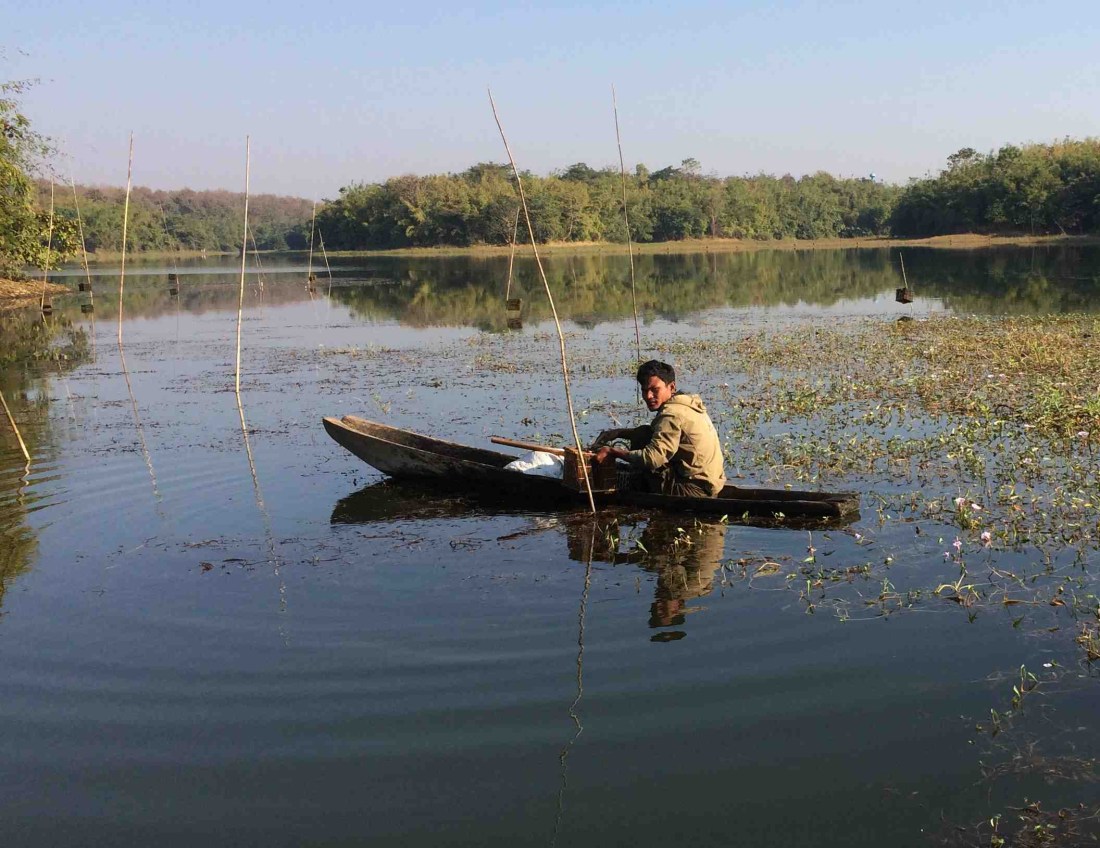
[Above photo: A fresh-water shrimp fisherman emptying and baiting his trap. I don’t know why WordPress flipped the image but I think it looks pretty neat so I’ll leave it that way.]

I arose at 2:45AM, shaved, ate half a mango, drank a cup of tea, and walked 75 steps to the end of my block. Then I awaited my ride, Dr. Kyi, to drive me to the capitol 4 hours north. A steady stream of taxi’s honked their question so insistently that I was forced to repeatedly wave, “No.”. At 3:35 AM Dr. Kyi pulled up. After some driving around Yangon’s suburbs, already quite busy with street merchants transporting their wares, we changed cars and 4 of us headed up the pike. The wholesale flower market was bustling at that hour.

We drove at 140Km up the safe but bumpy divided highway, stopping once for tea and once for breakfast (good mohinga!), finally arriving at Nay Pyi Taw’s hotel zone. My kind of road trip, plenty of refreshment stops. The conference, a country-wide meeting on substance abuse surveillance and treatment programs, was in a very modern, attractive hotel and functioned identically to any of ours, except it was conducterd largely in Myanmar. Often slides and handouts were in English. It was astonishing to learn that, as of last year, being a drug addict was no longer illegal in Myanmar.  Addicts are to be treated, not punished. I’m not quite sure how it works because it is still illegal if you are caught in possession. Hm.

The US has more people in jail than any country in the world and our incarceration rate is the highest, as well. And we think about China as being a police state and the US as “the land of the free”!  Almost a quarter of our inmates are drug offenders, excluding dealers. If someone feels hopeless about their ability to improve their lot in life, or is stupid enough to try an addictive substance a few times for fun, or has gotten hooked as a result of treatment for chronic pain, punishment doesn’t seem like the right approach. Perhaps they need to be in a treatment facility where they don’t have access to drugs but do to yoga, vocational training, education, and supportive psychotherapy services, as well as exercise and healthy eating. Looking at our recidivism rates, it’s clear that punitive approaches don’t work.  We know the “War on Drugs” has made some people very rich and drugs are cheaper, more potent, and more plentiful on our streets than they have ever been. Certainly, a Wall will make the builders a profit but do nothing to slow the flow.

I’m lying in bed at a resort outside of town now, in a very pretty room. It was an elegant teak stilt house, moved here and refurbished with a gorgeous teak interior.  It is set on a lake created by a dam 30 years ago so the vegetation around it is mature. It is so perfect and pretty, it feels at moments like the Truman Show, illusory. Yet it is genuinely lovely.

After an elegant mohinga for breakfast—There is a competition between the soup base and the garnishes to be the best!—and a cup of Myanmar tea, we jumped in a boat and headed up the lake to Elephant Camp. The motor was a 4 cycle gas affair, 13 hp, with a long-tail shaft and propeller, mounted on a swivel on a short deck at the rear of the boat, costs about $350 new and moves the boat, with 4 people, nicely.  Compared to our new $9000 outboard on the Island—well, they aren’t comparable but this arrangement is very clever and very inexpensive. Couldn’t tow a water skier, though.  We passed a very slender man in a small dugout canoe emptying fresh water shrimp from tiny reed traps. The traps were ingenious, similar in principle to lobster and crab pots.  The shrimp are salted and dried and used for garnish in, for example, tea leaf salad.

We arrived at Elephant Camp and walked up a hill through clumps of bamboo and trees  scattered with picnic tables. Since it was Chinese New Year, families were coming to enjoy the forest and the elephants. For a small sum we got a couple of plates of corn cobs and sugar cane and fed the elephants by hand.  There are allegedly 50,000 muscles (a suspect number) in an elephant’s trunk and it takes them a few years to learn to use it well.  They are remarkably delicate with them (It’s tempting to say, “Dextrous”, but that’s not quite right). Then we climbed a platform and settled into a padded pack saddle (howdah) on the back of an elephant and the mahout, sitting on the elephant’s head, took us for a ride on jungle paths. It was amazingly fun. The mahout jiggles his left foot constantly, gently scratching the elephant’s ear.  If he stops, the elephants stops instantly. I’ve been reading Elephant Bill by Lt.-Col. J. H. Williams, OBE. He worked for the British Forestry Department for many years, extracting teak from the forests of Upper Burma, before, during, and after WW2. He became an expert on the care, training, and use of elephants. It’s a very colonial-era book, unsurprisingly, but a fascinating look into that time in Myanmar. It’s on Kindle. He talks at length about the intelligence and memory of elephants, which is prodigious. It always is conflictual, domesticating animals, like elephants, for our ends. At least we aren’t eating them!  And, really, it shouldn’t matter that they are intelligent. Would we want out developmentally delayed child to be treated badly by virtue of low cognition? Mother Nature is impassive and lets us do what we want without moralizing, which can allow us some pretty depraved practices. I remember in the old film, Mondo Cane (A Dog’s World), seeing geese in Alsace confined to crates where they were force-fed corn via a grinder and funnel to fatten their livers for pate de fois gras.

Nay Pyi Taw is described as “soulless” in the Lonely Planet Guide and “a bizarre monument to the megalomania and bombast of the country’s ruling generals” in the Insight Guides. I found it otherwise, perhaps not a PC position. In fact, if the government were still occupying the Secretariat, the massively elegant seat of the British government here in Yangon, I’d find that sad. The Secretariat was built by the British with forced Burmese labor. And as Myanmar becomes more democratic, as it is gradually, and the lovely plantings around Nay Pyi Taw mature, I think it will be a stunning place, if lacking that colonial twist we seem to love to see in former colonies. Again, it is complicated, like everything everywhere. But I think the Myanmar people can be proud of their grand capitol without snide travel writers—dare I say with a post-colonial mentality—dismissing it. There!

The meetings were lively and informative, even if a lot of the information slipped through my language filter. They have many methadone treatment programs around the country and methamphetamine is making a big entry into the heroin scene. We had a wonderful dinner at our lakeside resort with about 20 of the senior psychiatrists and lots of good talk. I sat next to a man who has been flying to Bangkok for several years to take an EMDR course. He’s now completing supervisor training so he’ll be able to teach it here. Nine of the academic psychiatrists are going to an international conference in Sidney soon. I am very impressed with the commitment and leadership of psychiatry here.  And the openness and generosity of everyone. The psychiatrists I’ve met seem to lack the competitive, in- or out-group mentality, so common to middle schools in the US, that infests American academia.  They are smart and informed without that.

Which leads me to another topic that depresses me. Strong and pushy seem to prevail in many, if not most, arenas, a form of natural selection. Sociopaths have an advantage since they can easily do things the rest of us cannot.  It means that kindness, attention to feelings and to process, not achievement, often lose.  General happiness and community well-being rarely are the outcome. More likely, the strong and greedy succeed in domination, control, and accumulation. As I see, and hear, how much China is acquiring all over SE Asia and recalling how they have done the same in Africa, I am impressed with their long-term planning, not so impressed with ours, and appalled by both. It is a repeat, on a mightier scale, of the colonial takeover of the “third world”, as it used to be called.

Might makes right and, if wedded to long-term goals, is going to leave our country, and our democratic institutions and ideals, however imperfect they are, in the dust, especially if we support an illiterate, racist, misogynist chief who impulsively leads from his “gut”, not from any reasoned thought process that recognizes historical precedent and human needs.  2020 is increasingly looking like a watershed election, as were the mid-terms. It feels like the future holds a rapidly increasing number of “watershed” moments.

Unfortunately or not, the Virginia 3 must exit, since appearance is so crucial in politics. I do believe in redemption, but not inside of public office. Public office should be reserved for those who don’t carry the burden of past racist behaviors (certainly as adults) or are not credibly accused of sexual assault, like Justice Kavanaugh. Why is it always men?!! Always.

Days in a Life

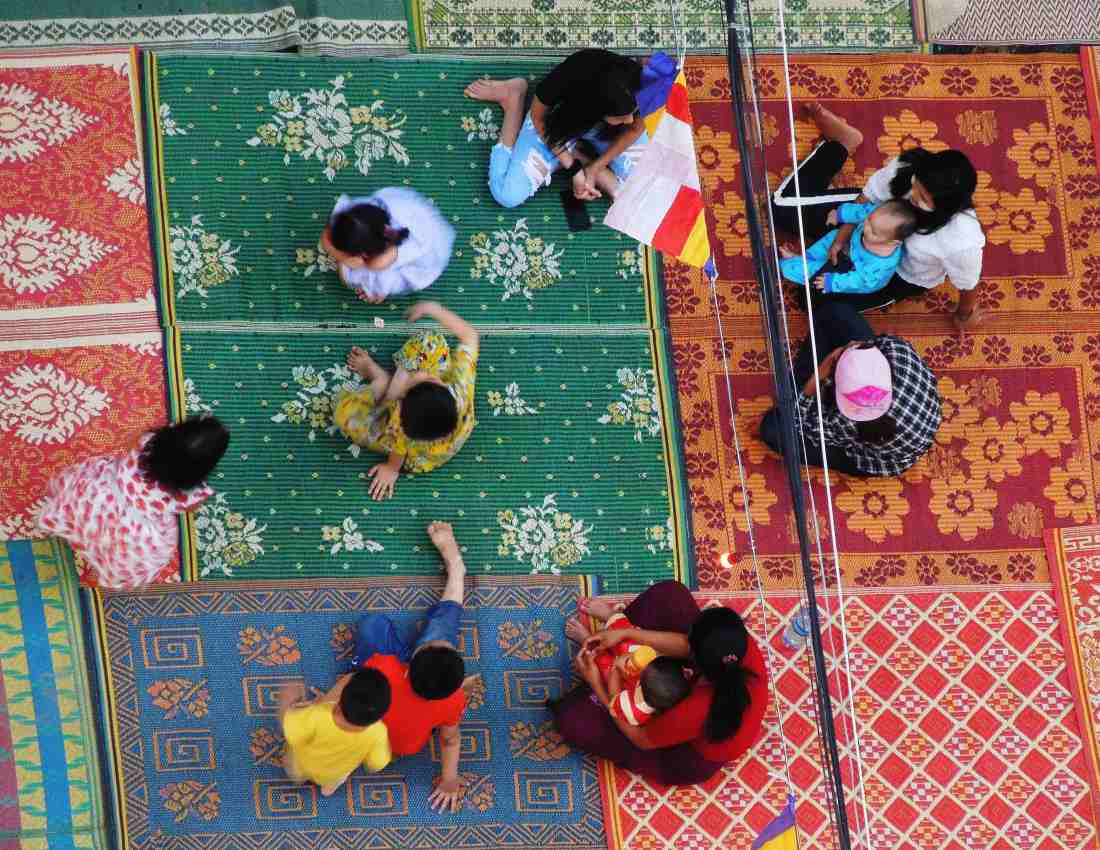
[Above photo: Children playing in the street below my deck before the monk speaks.]

3 February, 2019

I was talking with a cabbie who asked for my age. 78yo. He said, “My father is 70yo. Men that age in our country are—“and he demonstrated, shrunken, crumpled over. I’ve been very fortunate and not needed to abuse my body seriously with food, drink, or tobacco. I’ve always liked physical exercise and currently try to get my steps in, as well as 25 minutes of stretching and small-weight lifting each day. I have now abandoned the lift in the building and regularly walk up the 9 floors. And I take all the pedestrian overpasses here, both for the stairs and to avoid getting killed by aggressive cabbies. Death has, since I was a child, hung round my door.  Outwardly it is from identifying with my father who died at 55yo when I was 9. Less consciously it is because I always anticipated a fatal punishment for my Oedipal victories. Now I’ve outlived my father (d at 55yo), my mother (d at 78yrs 3 months), my grandfather (d. in his mid-40’s) and my brother (d. at 42yo). They all had full lives, even if nipped in their respective buds. If mine ends on this distant shore, I’ll have seen my share of splendors and tragedies. Perhaps my turn of mind is prompted by the fact that we’ll leave at 3:30AM tomorrow morning for Nay Pyi Taw, a 5 hour drive. We would never do this in Malawi, where we might encounter 18 wheelers parked in the middle of the highway showing no taillights or a pile of rocks set across the road by a group of men who would rob you when you stopped. No second thought about it in the US and apparently not here, either.

This week I’ll note here the days of life in my week, as much to confirm for myself how inconsequential they are right now as to give you a flavor. I want my class to begin!

Monday 28 January I wrote my blog and had my language lesson. There is too much new vocabulary with no familiar cognates and my brain is exhausted after 1 ½ hours. I can now count to ten: tit, nit, thone, lei, nga, chauk, khun hnit, shit, koe, ta seh. I can also count into the millions and billions but I’ll never need those numbers, given my Fulbright salary.

Tuesday 29 January  I was fleshing out my presentation for Grand Rounds tomorrow when—of course—my first electricity blackout descended. In the middle of the day. I had no computer charge or internet to search for articles. 5 hours. Oh, well, I’ve learned to roll with these little inconveniences. I know enough off the top of my head to talk for 1 ½ hours about Safety and Quality in Child and Adolescent Mental Health. So I didn’t stress unduly and wrote up what I could.

I also trudged in the heat to City Mall St. John and bought a huge pop-up mosquito net for my bed. One “bugged” me all night. I finally cornered and exterminated her in the bathroom. There isn’t malaria to worry about here, as in Malawi, but there is dengue, which is no fun at all and for which there is no treatment other than fluids, antipyretics, and rest. The net, with springy plastic poles, was so cleverly folded that I had trouble restoring its desired, “popped up”, shape. Now it is a massive 6 foot high dome over my entire king-sized bed. And I sleep like an infant. An infant’s only worry is, “Will the breast be there when I want it?”. I’ve given up on that for now, so I just rest without anticipation.

Wednesday 30 January I met Dr. Tin Oo at the head of my street and he drove (flew?) me—-He is a true road warrior!—to the Yangon Mental Hospital. We had snacks and he taught a class in his office about psychiatric assessment to a group of 4 Emergency Medicine Residents, while I read through The Child Law: Rules related to the child from the Ministry of Social Welfare, Relief, and Resettlement. It is a good document, although it deals too generally, in my opinion, with the abuse of children. Basically, it derives from the 1990 United Nations Convention on the Rights of the Child (UNCRC), the first internationally ratified document of its kind. All but 2 of the UN members have signed and ratified it. Myanmar was one of the first to do so, in 1991. Somalia hasn’t because it doesn’t have a recognized government. And, you guessed it, neither has the US of A. Both 42 (Bill Clinton) and 44 (Barack Obama) vowed to ratify it but never did. What is with our cooperative spirit here? Many of the rights were drawn from our Constitution; others we’ve contributed to the Articles. All I can imagine is that the UN is too politically unpopular in the US. We lack the long view in the US and are such a parochial nation sometimes, despite the vast well of individual generosity to be found. I think we are just too far from other countries so most people don’t travel or even have passports. I imagine Zeno* would have felt right at home, excepting his toga would have gotten him shunned, perhaps jailed. [Actually, it’s xeno (foreign or strange)-phobia.]

Dr. Tin Oo and I walked through many buildings and covered walkways in the 1200 bed mental hospital to get to the auditorium.  We sat at the head table, Dr. Tin Oo being the Chief, and 80 psychiatrists and psychiatric residents from the 3 local medical schools (University of Medicine 1 & 2 and Military University of Medicine) sat at tables arranged in a U while we were served tea leaf salad, coffee, tea, grapes, sunflower seeds, and mandarin orange slices. Then Dr. Kyi Min Tun summarized a 5 day conference he’d attended on communicable disease prevention in hospital settings.  Time for lunch.  I’m thinking, I like this pace! Then back for my little talk.

It was fun, passing from the history of the concept of childhood to the history of protections for children in different countries. Among the “Factory Laws” passed in England, in 1833 one asserted that only children over 9yo could work in woolen and cotton mills and they couldn’t work more than 60 hours/week! I think it was similar in the coal mines. Then, eventually, along came compulsory education and the UNCRC.  I talked about what was needed for Safety and Quality in Child and Adolescent Mental Health including: a strong, developmentally-attuned, incorruptible judiciary and smart, understanding laws;  robust medical and social service systems of care for children; and a comprehensive system of mental health care services adequately staffed by well-trained, up to date professionals of a variety of stripes. Then I gave a couple of clinical examples from Malawi and asked for questions. I couldn’t get the audience to be very interactive, as I had expected, and we all laughed together at that. It was fun and I hope imparted some useful ideas.

Afterward, Dr. Tin Oo asked if I would like to accompany him for two days at a meeting in Nay Pyi Taw, the new and deserted-looking capitol. Of course. At this juncture I’ll accept any invitation, not knowing what doors it might open. Well, no “girly massages” as I am always solicited by young men when I walk through the Sule Pagoda area which tourists frequent. I feel I’m being allowed to get a little closer to things with this invitation and I am most eager to be of assistance.

In the evening, as people are warming up for Chinese New Year on 5 Febuary a group of revelers in red costumes with drums and cymbals made a huge noise walking the length of my block of Sint O Dan Lan. I hope to return from Nay Pyi Taw on the 5th in time to see the Dragon Parade.

Thursday 31 January The water system has two reservoir tanks tucked in the ceilings of the bathrooms. I must turn on a pump occasionally to fill them. But I use very little water. There is a small booster pump that activates when I turn on the faucet or shower so there is better pressure than simple gravity feed. The booster pump was running continuously when I got up this morning and yet there was no water pressure. Hm. After sleuthing around, I noticed that the outside walkway was flooded and a faucet was open and flowing freely. It is on a side of the apartment where I never go. There is, however, a fire escape. I think there must have been a prowler in the night who caught his clothing on the faucet in passing. I cannot explain it otherwise, unless someone is just messing with me. ( On further reflection, I’ll bet it was the 14yo girls who live in the building doing a prank.  I once ushered them off my deck. They had come up the fire escape, being bored teens. No self-respecting cat burglar would leave a faucet gushing away.) There has also been a chronic leak in the kitchen sink drain, so I called the owner’s representative and he sent someone. I explained it all to him and he fixed the leak. He didn’t have much English and used a translation app that worked really well so I installed and tried it: I said, “A thief”. The app wrote, “Oil”. I said, “The drain leaks.” The app wrote, “Toast”. I have great hopes for it but clearly haven’t mastered it yet! Now to study my Myanmar so I can wow! my instructor tomorrow. And communicate with plumbers. I’ve added “Help!”, “Get away!”, and “Thief!” to my vocabulary.

After talking with his boss, the handyman is going to put a locked cover over the fire escape to prevent intruders. Maybe I’ll get a long rope so I can repel from my deck railing to a nearby roof if a fire starts. Ah, the joys of city living!

Then beers [sitting] on the deck at 5PM with Cecily and her friend, who are hopping a bus for parts unknown (to me) tonight. They are leaving their kathundu for me to keep. Kathundu only eat dust and mosquitos, so I may be reluctant to part with them when she returns. ( I later learned that kathundu means “stuff” in Chichewa.)

Friday 1 February I discovered that in the morning there is the most amazing fruit, vegetable, and meat/fish market on 18th street, one short block from my digs on Sint O Tan Lan.  Later in the day it has all folded up so I have never seen it previously. The early bird, and all that.

Speaking of birds, crows predominate here; they are small and have a varied call. There are pigeons, as well. And house sparrows. An occasional hawk wheeling overhead. But virtually nothing else. We had such a wide variety of birds moving through our garden in Blantyre that this feels pretty impoverished, as clever as crows are.

Saturday 2 February I walked early, before the noonday sun, to Bogyoke Market and bought some Shan shorts—-traditional hand-woven, naturally-dyed fabric.  One size fits all and you must fold over the extra waistline and secure it with a tie which is attached behind.  Less than $5, with two flap pockets. And three white shirts for teaching. And a small suitcase since I don’t want to carry a backpack to Nay Pyi Taw. .

Pleased with my purchases—the shirts are a light weight cotton and cost about $5.50 each—-I arranged to meet an acquaintance of a good friend from the Bay Area. She is a primary school teacher, 60yo, 4 kids grown and off, and has lived and worked in Caracas, Mumbai, and, now, Yangon. I got wind of a little restaurant serving Kachin food and we met nearby, across from the huge Hledan Center. My god, and I thought Chinatown was busy! A fantastic street food scene with yummy grilled fish. Have to return and take a chance sometime. Anyway, Mu Ai Kachin is a tiny hole-in-the-wall up a narrow alley that serves the most exquisite food, presented with an artist’s touch. I let Ruth order and I skipped around the corner to buy some beer. We tucked into a wonderful and beautiful meal, leaving after several hours, stuffed.

Sunday 3 February I’ll write my blog, pack for the early departure, study Myanmar, and, possibly, mop the floor today. I wash and dry my feet every night before bed, they get so dirty padding around. I could wear sock or slippers, I suppose, but everyone seems to accept that feet get dirty and can be cleaned. With all the unstructured time I now have, I realize how work has kept me from having to be very disciplined. Three areas present themselves daily: my stretching-exercise routine, my language study, and, when a craving is upon me, limiting my intake of something sweet in the house. Usually I just have nothing around except fruit and that makes it easy. But I bought a box of raw palm sugar balls which are so good. But I almost threw them out rather than have to limit myself to one or two a day. Then I thought, that is so weak and stupid. So I’ll exercise that discipline muscle, as well.

There are acrobats performing on my street on a series of pedestals of varying heights (4 feet-8 feet) to cymbal/drum music every night now as Spring Festival approaches. And percussion accompanies the “little” dragons, 2 or 3 people, as they go into each shop on the street, presumably for donations. As I sit on my deck writing, the congregation in the old Baptist Church on the corner—75 yards away as the crow flies, as they often do—is singing something with many verses to the tune of “Happy Birthday”. Since Christmas is past, I’ll guess it’s a hymn in Myanmar to that tune. The girls at the school in the same church during the week really belt out songs; it thrills a little, to hear the energy in all those unified voices.

What great works of benefit to all we could do if we just had thoughtful and enlightened leadership!

*I include this for fun. Zeno of Elea, a 5th c. B.C.E. thinker, is known primarily for propounding a number of ingenious paradoxes. The following reconstruction attempts to capture something of how Zeno may have argued. For anyone (S) to traverse the finite distance across a stadium from p0 to p1 within a limited amount of time, S must first reach the point half way between p0 and p1, namely p2.

Before S reaches p2S must first reach the point half way between p0 and p2, namely p3. Again, before S reaches p3S must first reach the point half way between p0 and p3, namely p4. There is a half way point again to be reached between p0 and p4. In fact, there is always another half way point that must be reached before reaching any given half way point, so that the number of half way points that must be reached between any pn and any pn-1 is unlimited. But it is impossible for S to reach an unlimited number of half way points within a limited amount of time. Therefore, it is impossible for S to traverse the stadium or, indeed, for S to move at all.

Too clever by far!