Distractions

29 August 2021

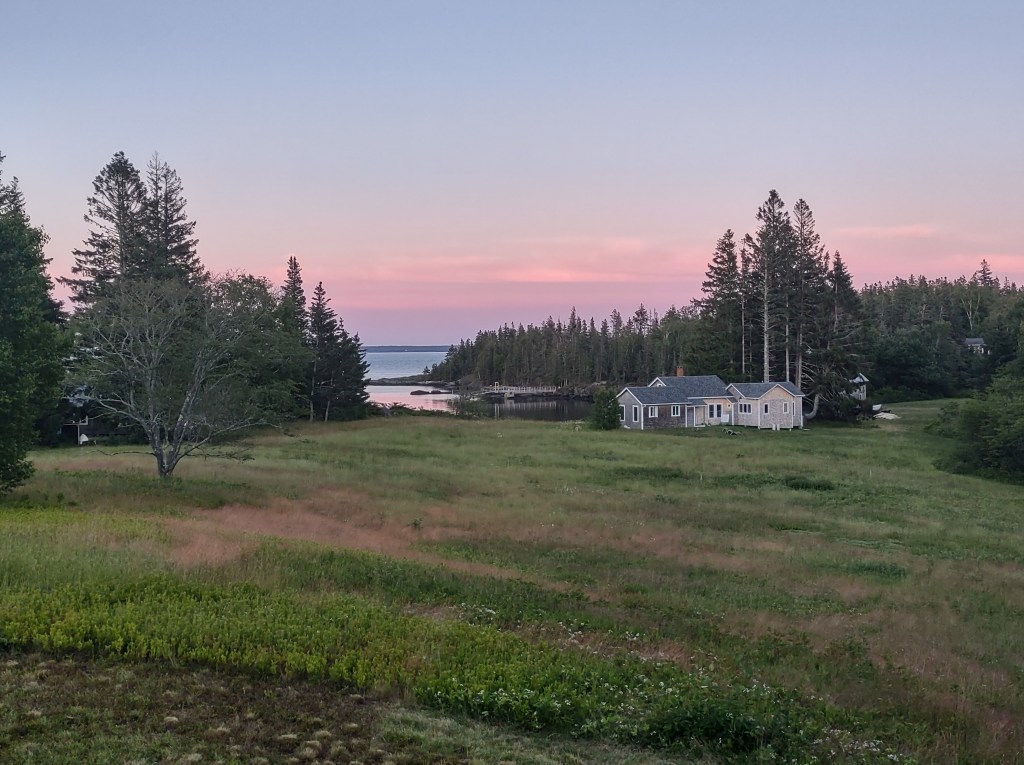
[Above photo:  ]Sunrise on Beach Island. 5AM?]

Most everyone has departed the island for the summer. Michael, the caretaker, Chris, an old friend of the island, and I are left. It is remarkably quiet, especially today which is one of Michael’s days off. I pumped this morning, after bailing last night’s downpour out of the rowboats. I suspect the only engine I’ll hear for the rest of the day will be the occasional lobsterman who is making the most of the season.  

Chuck Dodge, aboard “Wounded Coot”, supplies lobsters to our float for a reasonable (for this season, which began at $17/pound!) price.  The harvest is not great but Mr. Dodge seems unfazed. “Just the usual fluctuation.” He drives the Brooksville school bus during the rest of the year. It’s the rare lobsterman who keeps fishing, generally for crab but occasionally for scallops, after lobster season concludes. It is cold and dangerous, with rough seas, and crab doesn’t command the price of lobster.

It is certainly true that we can, intentionally or not, distract ourselves from painful or difficult thoughts/feelings.  “Do you miss your husband/wife (recently deceased) a lot?” “Not really, I’ve been so busy.” Now that I am not in a consuming relationship or job, I think much more about my son and my marriage, obsessively reviewing my perceived shortcomings in each, as well as trying with distance to better understand the context surrounding them. Neither are satisfying to review, since I can come to no comprehensive or restorative conclusions about either. Yet it feels important to me to strive for understanding; relationship is pretty much where I think our meaningful existence begins and ends. Professional or artistic accomplishments are the garnish, the fresh parsley, basil, and garlic I sauteed in butter last night with which to drench the boiled new potatoes. It is strange to me, since the majority of my time and effort has focused on my work. Accomplishments can be dazzling but feel hollow to me without close relationship.

As an example, I see my recent 2+ years in Myanmar as very focused the instrumental: on my teaching and in other ways conveying my knowledge to junior colleagues.  But the punch, the intensity, the flavor of my life was a result of the relationships I formed with others, especially my students. And, toward the end, with an additional set of friends. It isn’t the one or the other, of course.

Thinking about our entry into conflicts in the developing world, our idea that might can make right seems to be self-evident. And so wrong.  Time after time our money and power and blood is squandered for a lack of acknowledging and accepting the fine points of culture. What is the character of the person we prop up in a leadership position? Fundamentally kind, honest, well-intentioned? That is not usually the case. More like pieces on a chessboard—-a certain apparent power and a willingness to do our bidding meets our criteria. This is not the fault of the military; it is our civilian leaders who want a “clean” victory, free of the complexity and mess of another culture. The military serves at their pleasure.

Circling the island yesterday in a rowboat, I looked for additional lobster buoys. These break free from their lines, often inadvertently cut by a passing motorboat, and wash up on our shore in multitudes. In cleaning up around my house recently I decided that the large pile I had collected needed a use and, if so, an augmentation.. I was planning to make a sculpture 5 years ago when I gathered the first large bunch. What to do now?

I settled on building a railing 2/3 the length of the porch, using a hardwood log I had salvaged and a couple of sturdy posts from the barn loft. The posts sunk and the railing now affixed to the top, I’ll hang buoys in sequences, covering the ugly (to me) underside of the house when viewed from the Farmhouse lawn. The house has always looked a little disproportionate to me, towering above the sloping meadow to a 1 ½ story peak.  This will ease my discomfort and provide a bit of local coloring, a fringe. Maybe I can work out a musical theme, high notes in lighter colors than the low, major chords in primary colors and the minor in off-colors. Da da da DAH. Da da da DAH. Bethoven’s 5th symphony.

My nephew and his brother are in the process of buying an old building in a small university town in northern Portugal. The first floor will be a coffee shop and they will live above. Perhaps their mother will join them.  They both have had varied careers, one with the Federal Reserve, then as an executive with the Bank of Thailand, and, currently as a novelist. The other has done IT, having started a small software company in Bangkok, then worked for the National Park Service and, finally, for the Department of Defense. Both are very bright and kind people. The older, hitting 60 this year, has learned to roast coffee and wants a change of occupation as well as lifestyle. They have spent time in Portugal and have friends there. I applaud their spirits of adventure and change. And I’ll go visit!

Draught and subsequent fires consume California, threatening the wine industry mightily from the smokey taste imparted to the grapes.  There are hurricanes in Rhode Island, Louisiana, and Mexico.  A suicide bomber in Kabul, killing 183 people and wounding many more. The Colorado River, so crucial to so many, is drying up. Journalists and environmental crusaders are being murdered. And covid-19 is either in our face or lurking menacingly in the background. We’re in for a rough ride and responsible for much of the poor road maintenance. Meanwhile, back at the ranch, Republicans continue to try to interfere with public health advice, restrict the vote, interfere with the January 6 investigation, continue to insist DT was actually the winner, and spend their time criticizing Joe Biden, who is doing as good a job, and transparently, as could be done in a terrible situation, the creation of which falls on both parties. And he accepts responsibility. Through all the current and past disease, smoke, and destruction, as well as anger and dishonesty, Joe feels to me like a breath of fresh air.
Time Flies Like An Arrow. Fruit Flies Like A Banana.

22 August 2021

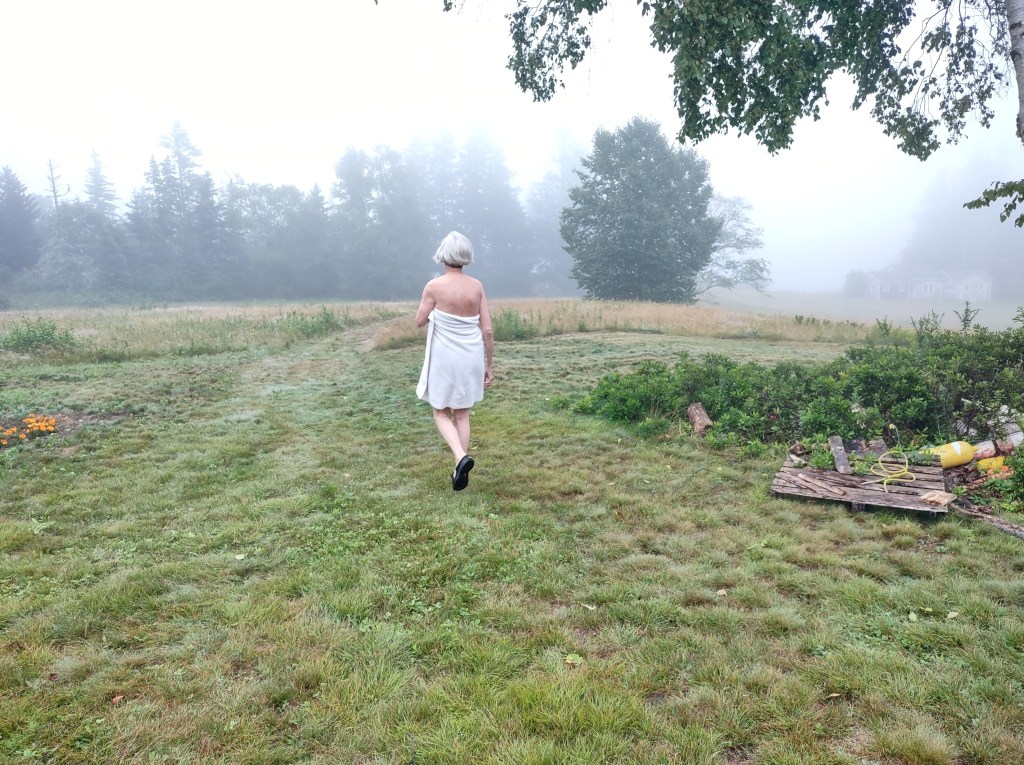
[Above photo:  Connie heading for a swim at Kinkwater Cove in the fog. “Don’t swim out too far, Connie!”]

Awaiting the arrival of our French visitor, Henri, I want as few boats on moorings as possible. I assume that the winds will eventually blow straight into the harbor, since tropical storms circulate counterclockwise in the Northern Hemisphere and Henri will be heading out to sea when he gets here. The barn doors are closed and all doors and windows in the empty houses, as well. Other than bringing in my hammock chairs, chain saw, and string trimmer from the covered porch, which I assume will be drenched what with rain and wind, I may remove the large screens from the porch, since strong winds could damage them or blow them off their seats. I have enough food, water, and wood and can monitor the float with my telescope.

I’ll check the beach today for loose or low-lying boats/kayaks, since we may get a very high tide or storm surge. Oh, and I’ll bring the Velociraptor (pontoon-mounted bicycle) off its mooring and up the beach. Other than that, I’ll enjoy the show on Monday and Tuesday. It certainly is calm now and I may even go for a kayak paddle after writing this.

The end of our involvement in Afghanistan is a relief, very sad, and a testament to the importance of understanding how a culture works before rushing to superimpose our values. Our military and diplomatic ignorance about Iraqi and Afghani cultures—Tom Friedman encouraged the Iraq invasion as an opportunity to bring “Democracy” to replace Iraq’s feudal governance.—has contributed to our undoing. And, as in Vietnam, the wishful, or deceitful, optimism of our leaders has contributed to the mess. I find Condoleeza Rice’s thoughts predictable but misleading. Basically, she thinks we didn’t give it enough time. But we weren’t making any headway with honest governance or military will after 20 years. We now, at least, can try to protect and welcome to the US Afghanis and their families who helped us and want to immigrate.  

People have rushed to attack the President. He may have erred, following the disastrous “agreement” between DT and the Taliban, which excluded the Afghani government. I see the nips as either attempts to sell papers—“Get it now! Hot off the press! Biden really messes up!”—or score political points. More sober voices will analyze the situation with a little distance. Like Obama, Biden inherited a mess. Our naivete in expecting to be greeted by millions with garlands, shouting “Mission accomplished!”, is well-matched by our short memories and quick reaction times.

What an impulsive, short-term-profit culture we have become, especially given our origins. People came to this wilderness from hardship and persecution, expecting to work hard indefinitely to carve out their existence. First, car models changed every year. Then bands were “so over” after a 12 month run. Now we seem to have the staying power of an overripe nectarine—yes, we have our DNA but conscious thought and resolve decays in a minute, it seems.  This sounds like I think we should have stayed longer in Afghanistan. I think we should have stuck to our mission, preventing threats to the US, and not tried to drag, to paraphrase Ms. Rice, a 7th century culture into the 21st century. We cannot be successful at that, no matter how many schools we built. How about fixing our own marginal education system, enabling all of our children to get a first-rate education?

I think the Canadian immigration experiment in which provinces are allowed to set their own immigration quotas, depending on the provincial labor needs and ability to accommodate, is something we should consider, given our shrinking birth rate.  As much as we think of them as quaint, our northern neighbors are well ahead of us in this, health care, and, generally, civility.

Being alone on the island for the entire summer has allowed me to get to know my family members at a deeper level than previously. We are all a pretty odd bunch but decent, hard-working, and smart enough.  We all love the island and I am glad to have had the opportunity.

Harold and Connie visited for 5 days. We had lobster and played Scrabble, as well as other island activities. They brought 3 bottles of quite fancy wine. The white, a French Burgundy “Goisot”, was especially lovely. There is something about old friends that is so automatic and easy.

I met my new Goan friends and we got crab rolls at the Bagaduce Lunch, overlooking the old stone wharf and the rushing tidal bore. How stupid some of us are to resist immigrants. These are the nicest, smartest people you could ever wish to meet. We used to think of the amazing overachievers we’d interview for Harvard admission as having “immigrant hunger”. Such wonderful energy to harness for our country.

A new friend will visit for 5 days in September. More civilized than I am, I think, so we’ll see if it agrees. A little lobster with a good white wine can go a long way toward easing the itch of a mosquito bite or trepidation at approaching an outhouse.

The chanterelles have been amazing this year. Is it climate disruption? We have all picked quarts and quarts, sharing them around. I was circling the island on the path one day and came upon a clearing with a large golden patch in its middle. Chanterelles 4-6 inches in diameter were growing cheek-by-jowl. I harvested them and gave them to visitors I liked. Abundance can encourage generosity, although I have found the poor to be more ready to share what they have than the very wealthy. Which makes sense, as clearly the latter have a strong desire for their gains.  Oh, the rule doesn’t hold true, I think.

I am excited to start a new chapter in Portland, ME. It seems the small colleges I’ve contacted—Bates, Bowdoin, Colby—are not receptive to adjunct faculty. I’ll try a state school next and suspect I’ll be lucky. It’s paradoxical how a thinner budget may encourage them to take risks, be less insular, and enrich their students’ experience.

I have carried a lot of luggage and food this summer as visitors come and go but not so much lumber or building supplies. It has restored muscles, which I enjoy using. With a good diet, island life is healthy. But the summer has flown.

Housing Insecurity

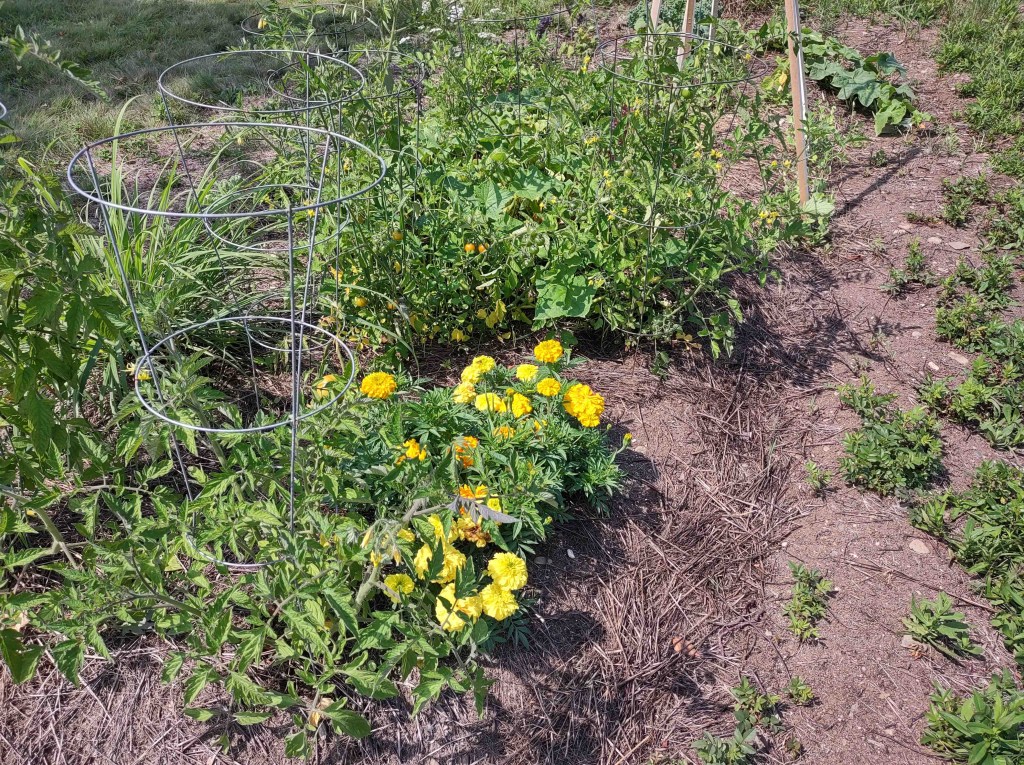
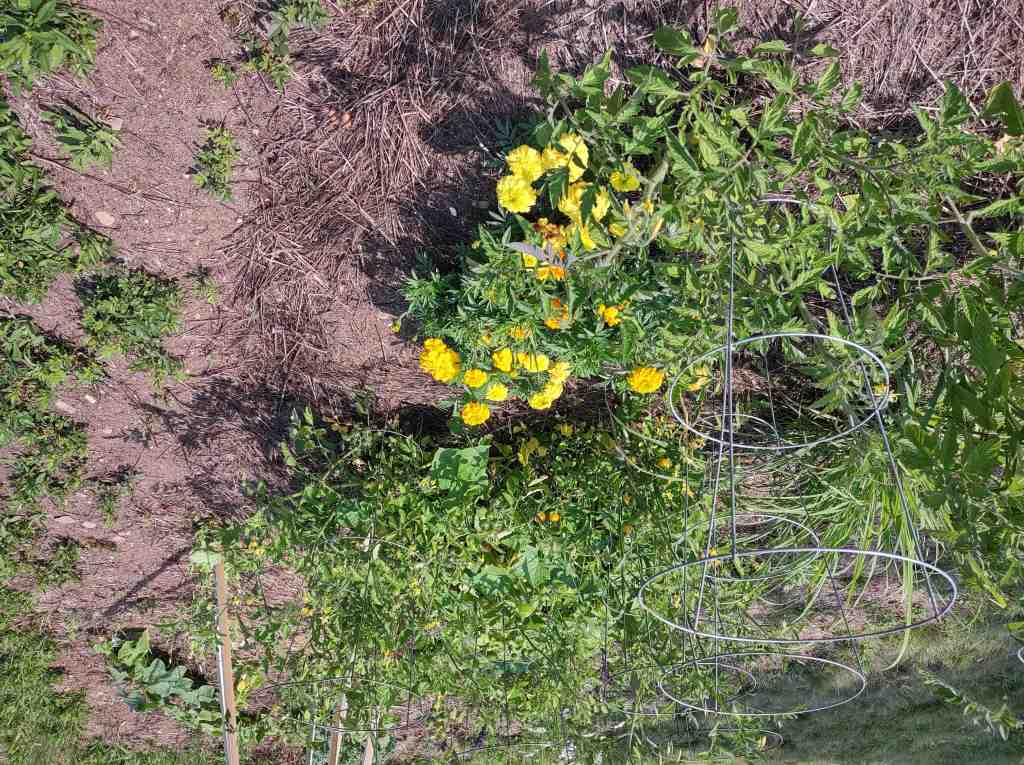
8 August 2021 [Above photo: My meagre island garden now provides kale, tomatoes, cucumbers, green beans, basil, cilantro, lemon grass, and marigolds. The peas are just starting up their trellis, but my soil needs serious work.]

I have discovered that writing a blog is not a habit I can easily break. 5 years posting every week is enough time to experience withdrawal symptoms when stopping. And on the positive side, there is the immediate satisfaction of organizing, recording, and refining one’s thoughts and activities. It helps me to pay close attention to my life, how I spend my time. Putting it down improves my writing ability and gives me a purpose on Sunday.  However, I mostly miss the sense it provides of connection with my family members and friends, all of whom are at some distance and who I can see only irregularly.  Even if it lacks a certain direct plunge into my deeper, more conflicted, and complicated feelings, I have learned to say things without saying them. That is, if a reader wants to look deeper, they can expand on what I write in a similar direction to my own thoughts from the tenor of what I do reveal. So, it needn’t be simply white bread, filling but lacking in nuance and nutrition, as I suggested in my last post.

I’m watching the sun burn off a thin layer of fog, listening to the Brahms Clarinet Sonata Opus 120 No. 1. I’ve always loved the Brahms Clarinet Quintet but have never, I believe, listened to the sonatas. He knew the potential of the clarinet and shows it off to good effect. Part of my love for these is, I’m sure, from listening to my brother, Chas, play clarinet as a high schooler. He was good and our teacher, Johnny Jessen, appreciated Chas’ talent. After our respective back-to-back lessons (me on flute) in downtown Seattle, we’d go to a market nearby and buy something “exotic” to us, like a coconut, a pomegranate, or chestnuts. In the late ‘40s and early ‘50s there, coconuts weren’t common. Even under the gray Seattle skies and the cloud of my father’s sudden death in 1950, we managed to find fun.

Having decided that I’d feel too isolated living on the Blue Hill Peninsula in the Maine winter, I selected Portland as a good place to set down new roots. Funny, new roots at 81yo (in 3 weeks)!  Visiting there for a couple of days in June, I tried to scope out the apartment scene and came away discouraged. Very few listings were available and they cost more than I had hoped. I also didn’t understand the system, where they were listed, and how to be in competition for a desirable place. I returned this past week to look in earnest. Over three days I learned how: they are listed on Zillow, Trulia, and Craigslist. As soon as a listing appears, I’d send an email and at a decent hour I’d call to arrange a viewing.  Also, I filled out the Zillow application for $29 and which I could then submit as quickly as listings appeared.  The service also provides the landlord with a credit rating score.

I met some lovely people and some not so lovely. The first place I saw was in a wreck of a building; at the end of the viewing, the owner said, “I hate to tell you this but I pretty much promised the apartment to a young woman who saw it yesterday.” When I wrote her the next day, noting that it “wasn’t very nice” and that she could have saved us both a trip, she defensively went off on me, confirming to me that she knew she was covering her bases at my expense. I saw a wonderful townhouse in S. Portland on a quiet cull de sac next to open space with a nature path along a stream.  It was pretty and owned by a sweet young couple who’d recently left San Francisco because of housing prices. Spacious, room for a workshop, hardwood floors, airy and light, it was, however, the suburbs and I knew then I wanted to live in the city. [It is funny to talk about Portland as a city. The population is around 66,000 [half of Berkeley which I think of as a town.]. I emailed and called one broker at 8:30AM; he’d posted on Craigslist at 8PM the night before and had 75 applicants! After several other tries, I decided to stay another night for two last viewings.

I did not want to spend much on a hotel and couldn’t stay with my unvaccinated brother in Brunswick because of the new surge of the Delta variant, so I booked the cheapest nearby motel I could find online: the Rodeway “Inn” in Saco. Well, it did have soap and shampoo and was reasonably clean. The following night I signed into the Sun Rise Motel in Saco. Again, it was clean but very, very modest. A tiny bar of soap, no shampoo, no bath gel, no lotion, no conditioner. I am spoiled, having had elegant accommodations for 1/3 the price in Thailand and Myanmar.

Friday started off poorly.  A woman who had stood me up and lied about it on Thursday but rescheduled for Friday cancelled our appointment, wondering if I could see the place Saturday. I then saw an ad for a rather upscale complex, managed to get Monica in the leasing office on the line, and she showed me around, although I couldn’t actually go into the apartment. It would be safe, clean, light, quiet, good parking, spacious, a good value for the money. But no character.

I then drove to Tandem coffee, a service station re-purposed into a bakery and restaurant, with picnic tables outside where the gas pumps formerly sat. The cappucino and cheddar/jalapeno muffin were delicious and I began a conversation with a vacationing couple sitting next to me. He’s Dean of the Business School at Georgetown U. and passionate about prison reform and rehabilitation. She is equally enthusiastic about teaching math to immigrant middle-schoolers. They are from Goa, having come here for graduate school. Just interesting, accomplished, and friendly people. [I’d guess Donald would lump Goa into those “shithole countries”, if he knew where Goa was.]  I’ve invited them to take 4 or 5 hours and come to the island for lunch. They are driving to Acadia and back down the coast, so they may. They are people with whom I could be friends.

I was beginning to think this might be a good day.  Breakfast can often do that for me. My appointment with Kim was at 11. I saw the first floor flat in her 1800’s Victorian house and loved it. She then surprised me, saying that the upper flat was available, too. She’d just heard that the tenants were moving out by October. I saw it and felt it would suit me perfectly.  It is a light, spacious 2 bedroom with 16 inch wide  pine flooring. There is a nice back yard. It is a few short blocks from two good Japanese and an excellent Thai restaurant, as well as coffee houses, sitting as it does on the edge of the “Arts” district. Brackett is a quiet street. Kim, who lives in the cottage next door, is probably in her mid-30’s and works for the UN as an economic development consultant. She lived in Yunnan Province for 6 years and 4 years in Thailand, so she and I have common interests. I’ve signed the lease and given her a security deposit. A sigh of relief!

I have been so lucky finding places to live in Blantyre, in Yangon, and, now, in Portland. It actually felt pretty bad facing an insane rental market and having no place to alight after we wrap up the island at the end of September. I could stay briefly with Ariane or with numerous friends in New York or California but not to be able to secure my own spot amplified my feeling of rootlessness. After settling it with Kim, I went to the Portland Museum of Art and bought a year membership, which allowed me to see a terrific retrospective of David Driskell. And to top it off, going and returning I listened to David McCullough’s reading of his book, The Wright Brothers. He exposes their character and tenacity, their courage and science, gloriously. My understanding of them was two dimensional: two bike mechanics who managed to develop a powered glider to leave the ground and advance 800 feet or so in the air. They were so much more, as he describes.

I am now reading a collection of Alice Munro stories, Dear Life.  She can say, and imply, more in a sentence or short paragraph than mere mortals can in pages or chapters. She carries a depth of honesty that, while not particularly cheerful, is definitely illuminating. Reading her builds character, which is certainly not her intent at all. I feel a mix of awe, admiration, appreciation, and intense envy when I read her stories.

I am on top of the world to have settled my living site. On Friday as I returned from Portland, my nephew drove to Maine from Cambridge, where he had installed an air conditioner in his daughter’s apartment (Good Dad!). She’ll start Harvard Law this month.  We met at his home in Blue Hill and had a very nice supper at the only restaurant in Brooksville Friday evening.

Now I am back in Paradise.

Moving Mountains, Concluding Thoughts

[Above photo: My brother, the paddle-maker, with a sampling of his creations from his
attic. Sorry the photo is sideways and at the bottom.. My new phone is behaving strangely. A software incompatibility, I suspect.]

9 July 2021 It has been a relatively quiet few weeks here. I have moved,
with Jonathon Raban and George Vancouver, to the top of Vancouver Island and
through the Queen Charlotte Sound to Ketchikan. The journey includes a series
of harrowing passages. Large volumes of water are funneled through deep, narrow
channels  between islands and the mainland in many spots when traveling the Inside Passage. Water cascades at up to 18 knots through some of these, creating falls, whirlpools, and
unmanageable turbulence for a boat, even a large one.. They can only be traversed
during slack high water—ie, when the tide is at its maximum,
before it has begun to rapidly ebb.

Raban talks a lot about the anthropology and cosmology of the First People.
They have lived on the shores, having an abundance of food but also great
threats and frights from storms, grizzly bears [the deep woods], orcas [even
though they don’t attack humans in the wild], and, especially, from the wild
waters [the deep water] on the edges of which they travel, fish, and hunt.
Despite the ease of nourishment, their world was a frightening, chaotic, and
scarcely predictable one. In an attempt to feel less anxious, they imposed
strict rules of behavior upon themselves, with serious punishments for
transgressing them, assuming that their behaviors influenced the malign powers which they feared. Raban has read widely and contrasts his experiences on the
journey with the history and context of both the early explorers and the First
Nations. It is a very gripping read for me.

The character of our island is changing. Much was initiated, repaired, and
concluded in the past using ingenuity and experimentation, along with a measure
of grit and push ‘em up, Tony. There wasn’t much money. Now, as most Islanders
have become too busy, they want the island for a holiday, not for a work party.
Others are hired to do much of the labor. It is understandable but something is
lost, especially for the younger generation for whom contributing in the past
was rewarded with a sense of ownership and skill acquisition. Time marches on.

My brother came for 4 days to clear out his cabin. Wearying of the constant
maintenance and expense, he sold it to the Beach Island Corporation, basically
my sister’s 3 children. He can visit and stay whenever he wants; he just won’t
have automatic priority of use. We spent two mornings in the attic, sorting
through 45 years of our mother’s and his accumulated stuff. While I suspect it
was bittersweet for him to end a chapter of his life, we had many laughs and
activated so many ghosts. We discovered 2 pairs of new lovely white spruce
oars, forgotten for years. We also uncovered many kayak paddles and another
pair of oars, all of which he had constructed. A trove of perhaps 25 empty
cardboard boxes. Many and excellent tools. A Porta-Potty. No, two
Porta-Potties. A bassinet. Old clothing. Fathoms of rope and chain. A large box
of books. Eight fishing rods and reels. Chairs, tables, bed frames, probably 15
kerosene lamps, lumber, boxes of nails and screws, and more. We did a first
pass, from one end to the other, removing those that he wanted to take home and
those to give to the Island. There also were loads of clothing for Goodwill,
lumber for the barn, and much that no one would want. The work continued
over the next few days. We decided over the course of the mornings that we’d
both feel better if we did a bang-up job, rather than leaving it for the new
owners to wrestle with.

I am simultaneously using my time here to simplify and
purge unwanted/unused items from my own house. There are too many chairs for
comfort here. We’ve transitioned from kerosene to solar, so lamps and
containers of kero are going. I painted the interior of the outhouse white.
There are tales of “wolf spiders” here and Ari has a certain fear of spiders so
the white will give her some relief. I want to go on record that I emptied it
and swept the ceiling, walls, and floors before painting and saw only two very
tiny spiders in toto.

I am impressed with the beauty of the birch trees this summer. I have small
groves of paper (aka white or canoe) birch visible in front, behind, and on
each side of the house, as well as across the meadow. They are such magnificent
trees and are of great utility for syrup, bark, furniture, crafts, and firewood.
Watching skilled craftsmen build a 36 foot long voyager birchbark canoe, using
spruce roots to lace it and a mixture of bear tallow and pitch to seal the
seams, was a revelation. I recommend the Canadian National Canoe and Kayak
Museum in Peterborough, Ontario to anyone interested in the aesthetics,
construction, or history of those small watercraft. Their collection is
unequalled. The hours I spent there passed in a trice. I expect I’ll fell a
birch tree and split it, leaving it to dry under a tarp for
firewood and furniture construction material next year.

It has gotten dark. My lids are heavy. I awaken with the sun at 4:30AM each
day. It is nice to have my brother here. Despite our different views of the
world, we shared the life of our family and have loved Nature equally. He is
now retired and an impassioned painter of landscapes.

The blueberries are ripening enough to start picking them.

9 July 2021

I have been delinquent in my weekly posting and in writing the next edition,
which is unlike me. I wondered why and the more I thought about it, the more I
realized that I am done with it. Part of that is a result of my resuming life
in the US, so I don’t have exotica to report that might be of interest to
readers, generally family and friends. I think the larger reason has to do with
the form. Writing in this way is constraining. I must avoid total disclosure
which I feel would be inappropriate for a blog. So it comes out as sort of
cheerful white bread, some nutrition but ultimately lacking in the more
interesting, if problematic, aspects of my thoughts.  I’ll keep writing
but not publishing. It is a time in my life that I want to do a deeper look at
myself and those around me in writing and I don’t want to do it publicly.

It feels a little like I am abandoning my family and friends, as I can never
write each of you a weekly letter. You know who you are and I’ll visit or
otherwise be in touch as time goes on. Perhaps when my plans develop, I’ll use
the blog-site to let people know. As of now I am in a snug and warm house on
Beach Island looking out at rain and a very thick fog. I’ll have a cocktail
party this evening for the adults, which includes 8 beside myself. Then I’ll
have supper with my niece, great nephew, and sister. Last night was lobsters at
my nephew’s. Not suffering too much.

My dropleaf table came out well. I built a second bookcase of driftwood
yesterday and It looks great. And I hung my father’s ancient 2 man saw, his
broadaxe, and a piece of rusted barbed wire from [at the most recent] 103 years
ago in a sort of homage tryptic, recalling earlier, less mechanized times on
the island. Next, I’ll hang up a mobile I made of seal or porpoise bones I
found on the beach. They are so solid and smooth and beautiful.  How amazing is
our construction!

I’ve loved having this conversation with you.

R.I.P. Carrington

“No, Toto. This is not Kansas and it also isn’t the Ozarks. It’s an old and functional outdoor shower in Maine. And, no, you don’t have to try it.

20 June 2021

We held a memorial gathering in recognition of the death at 60yo from pancreatic cancer of my second cousin, Carrington Rhodes. It was a fine experience, summoning two boatloads of those who loved him from Camden and S. Brooksville. People came from Indiana and S. Carolina. In order, we chatted, feasted, shared memories of him, and placed a stone in the Rhodes’ cemetery here. It is a ritual we do every summer if a family member has died during the preceding year. Carrington died March 2020, but covid restrictions prevented a memorial last summer. All 40+ attending adults were fully vaccinated, as were some of the teens, so when we sang it wasn’t a super-spreader event.

Carrington was, like most of us, complicated.  However, he expressed a love of life in his friendships, his music, his travel, his generosity and good deeds, his stewardship of a tough length of the Appalachian Trail in Maine, and his daily attitude. He was a gifted musician, playing a variety of string instruments in numerous groups, often performing songs he’d written. He traveled widely and simply, hiking the world and building schools, churches, and, even, an outhouse in Kenya. He “adopted” a 13yo Ethiopian girl while he was working there and brought her to the US several times for camp, as well as paying for her to resume and complete school. He hiked the length of the Appalachian Trail twice, once as a through-hiker. He had his father’s gift for curt truisms: “Civilized people don’t chew gum.”  He could always be depended upon and he had an admirable work ethic, moving throughout his life to the beat of his own drum. He will be greatly missed.

I had a wonderful visit to my friends, Jeff and Bonnie, on Martha’s Vineyard. They moved from Boston, after many summer vacations in the Vineyard, and are settled in a lovely home on 8 acres of woods. Bonnie is an energetic and intelligent gardener and the trees, shrubs, and flowering plants are stunning. Jeff, despite significant physical limitations from a chronic back injury and multiple surgeries, is of great good humor and has engaged in intellectual pursuits, connecting with others in the community. His shift is all the more remarkable to me, since he ran for 30 years, including the Boston Marathon twice. They are always warm and welcoming to me.

We had a squall yesterday; the wind was so strong that many young birch were temporarily bent double. Sheets of rain were followed by a remarkable hail storm. Chunks of ice up to 1 ¼” in diameter pelted down in great profusion, bouncing off the porches and grass like popcorn. As the storm approached, I began to make popcorn and just as it began to explode, so did the hail. My garden suffered some broken leaves off the kale and tomato plants, but not much more. A good reminder of Nature’s potential.

I’m reading a book Poki gave me 15 years ago. I started it then but gave up early. This time I find it gripping, stimulating my fantasies of having a serious cruising sailboat to explore the coast of British Columbia, Vancouver Island, and northward. The book, Passage To Juneau by Jonathan Raban, is beautifully written. He begins with a detailed accounting of George Vancouver’s West Coast explorations and he promises to look closely at the Native American cultures—Haida, Kwakiutl, Salish, and so forth—on the way. It’s perfect for me right now.  

I did not like Where the Crawdads Sing by Delia Owens, despite testimony from Reese Witherspoon: “I can’t even express how much I love this book! I didn’t want this story to end.” Please. The issue for me is that I really, really liked her first book, Cry of the Kalahari, a non-fiction page-turner. This was simplistic about human nature:  too predictable, too sentimental (ie, unrealistic, even shallow), and the protagonist was too smart, resourceful, and beautiful. It didn’t help that the heroine was quite transparently the author.  Oh, well. It strikes me that it was not all peaches and cream with her hubby studying spotted hyenas’ social behavior in the Kalahari. Fortunately, there were significant distractions, like black mambas approaching their camp, a cobra in the dish cabinet, a resident leopard in their little grove of trees, hungry lions stalking around, and the threat of their funding being cut.

The air is very clean and the vegetation rich and fragrant as I walk through the meadow or into the forest. The balsam fir in sunlight, especially, is irresistible.  I breathe deeply, as if next to a lover who is sleeping and I cannot get enough of her air. The breath of healthy plants is also intoxicating.

I ran an Island friend and his 4 kids into Bucks Harbor today. The kids are going to summer camp in a few days and need to present negative PCR covid tests. The Bay was glassy calm and our runabout, Tern, planes over the water at half-throttle, turning a 45 minute trip into 15 minutes. I enjoyed recalling mother’s tale of Captain Carver, who farmed on Hog Island, delivering a young heifer to the mainland. He’d stand in his flatbottomed skiff, facing forward and row the several miles while the heifer, tied to the boat with a rope, swam behind. How times have changed! What have we lost? The gain of ease is readily apparent. I think we shall get dumber as we depend more on smart, powerful machines, or simply money, to solve our problems. Plus, it isn’t as much fun, if less work.

Pea-Soup

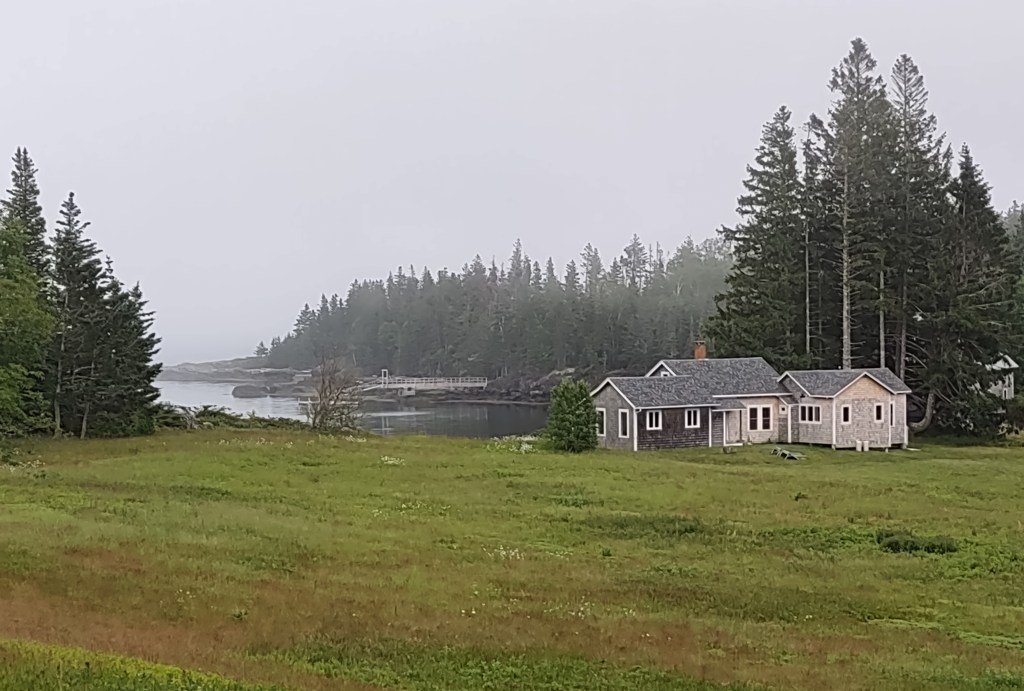
Farmhouse and the harbor in a bit of fog. Earlier in the day, neither were visible from the same viewpoint, hence the opacity of “pea-soup”.

13 June 2021 [Inadvertently I posted this last week on my Malawi blog site in error.]

The Island, and the Bay, are snugly wrapped in a gray fog-blanket. I love days like this—damp, cool, and quiet with only the occasional thump of a lobsterman’s diesel as he is pulling traps or the caw of a crow. My Pullman-car-size Jotul warms the house quickly. Endless cups of tea. Perfect for a writing project or, if others are around, to chat, gossip, and argue, our equivalent of cawing. I put my kayak in the barn last night in hopes I could apply a coat or two of bottom paint on it but the air is so moist I’ll hold off. The garden, by all appearances, loves this weather.

While I am missing durian, mango, and mangosteen season, I’m gorging on cherries and early blueberries (from California). Anadine, my 2nd or 3rd cousin, once or twice removed, is the only other soul overnight on the island. Carpenters are putting a new roof on one of the cottages, arriving at 8AM and leaving at 2:30PM. I thought they might not come in the fog today, but their ride, Karl, has been delivering the mail to the islands of Penobscot Bay for years and sniffs his way unerringly through the fog.

I have 8 small kale seedlings which I’ll put in after lunch. If Ariane’s garden is representative, I’ll be eating kale in a week and bathing in it by two. I bought lumber to build a 6’ dropleaf table, which will go together quickly, I imagine. I’ve decided to paint the top the same turquoise blue I’m putting on the bottom of the kayak; the legs I’ll stain and varnish, like the topsides of the kayak. It isn’t really a theme I’m aiming at; I just want a bright color for the table, not simply oiled wood, of which there is plenty here. The lumber was unbelievably expensive—for pine, mind you. I could have bought a finished table in an antique shop for less, but mine will look, and function, better.

I discussed cases via Skype and WhatsApp yesterday and today with former students in Myanmar. “I don’t know what I’m doing!” but she really did and was doing a good job. The other wrote me an email, “I need your help to manage these two cases.”, giving me thorough case descriptions with good management plans. She was doing fine, also. I think it is just the anxiety of doing something new and wanting to do it well. I’m happy to be regularly on their sidelines as they both seem to be getting lots of referrals. Both are smart and conscientious and want to learn. And it is great for me, lending some continuity to my substantial investment there.  

Good grief! Just like that, the sun is appearing and the fog is receding. I was going to photograph the meadow and harbor in the fog to use with this post; no longer. I cannot say I am unhappy. Perhaps it will dry enough I can put a coat on the boat.

I was in a poetry workshop at Stanford for a couple of years and simultaneously met with a separate group of poets to discuss our current work. I haven’t written a poem in 3 years and feel no need to. “Coat on the boat” is as close as I’ll get. Better I learn to make a good bagel and a good croissant; both seem challenging, since most examples are mediocre. All I need is one very good one of each to discount all the so-so attempts preceding that. It’s like heat or cold, how we are able to adapt to imperfect circumstances. Or a difficult relationship. Or all manner of discomfort.

A pair of osprey have a nest 100 feet from the shore near our dock. I haven’t looked carefully with  binoculars to see if chicks have hatched. That’s the whole point, isn’t it?  Thankfully, it seems to me, we have other important tasks to address after childbearing is done. I love to watch osprey fish, hovering in one spot while they lock onto their prey. Then it’s a vertical dive, wings folded, and they emerge, often with a mackerel, held like a bomb underneath an WWII prop plane. When an eagle, our national symbol of courage and fidelity, spots them, the larger bird steals the fish. A good example of a Proud American!

Now we learn that DT was using the Dept. of Justice to investigate “leaks”, not of highly classified information but of politically-sensitive material. Investigating Congressmen, including Adam Schiff, and their families. Also, pressuring the Attorney General to corrupt the election with phony fraud charges, as he continues to do. It is a customary practice in dictatorships, using the “non-partisan” institutions of government to stay in office illegally. Before the election, he publicly stated “The only way I won’t win is if there is fraud.”, a wishful logical twist or preparing us for his lies to come? He is as dangerous as his niece has suggested, and it is not surprising that those he admires are all tyrants and above the law: Putin, Bolsonaro, Duterte, Kim Jung-Un, and the like.

What I cannot fathom is why or how people are so blind to his corrupt ways. Before the election he bragged that he made money during his bankruptcies: now we know he stiffed his contractors and left his investors holding the bag.  The Sleaze-O-Meter throbs when he passes nearby. I fail to see how he appeals to anyone.  He is also, for the macho men among us, a physical coward, despite sending others into the breach. I must stop here. John Adams and his son—all our Founding Fathers—would have thrown up their hands and stared in disbelief!

Ghosts In Paradise

[Above photo: Ari’s lovely 1890’s farmhouse/home. ]

6 June 2021

Taking after Selma Fraiberg’s seminal paper, “Ghosts in the Nursery”, which should be a center of discussion for any psychology/psychiatry/clinical social work/therapist training program, Beach Island is thoroughly haunted.

It is stunningly beautiful here on the Island, despite being crowded with ghosts. My mother first came here in 1913, at 9yo, with her mother and 4 siblings. My grandmother was looking for an escape from the summer heat and foul public water (in summer) of Boston and saw an ad offering a former church camp for rent in Maine. That it was on an island 6 ½ miles offshore and had for accommodation only a small cookhouse didn’t dissuade her. They came, somehow, with a large tent and a cook and fell in love, returning every summer thereafter.

Grandma was a spoiled beauty with no experience “camping”, joining all in those days who weren’t soldiers, prospecters, or surveyers. Grandfather, a rather timid and unambitious attorney, likewise was a naif.  He worked in Boston at the New England Mutual Life Insurance Company, visiting his family at intervals, while my grandmother managed the kids, three girls and two boys. All fell totally in love with the beauty and freedom, the lack of rules or hygiene. The boys and my mother all became proficient sailors over time. The kids would pile into their first boat, a Swampscot Dory decked over for racing on the open ocean, and sail off, returning after a few days. It had no engine or navigation aids and fog or lack of wind would thwart their return. Gram apparently would put a kerosene lamp in an obvious place and go to sleep, trusting in Providence.

As time passed, Grandfather bought a motor yacht, Egeria. The kids found a perfect Herreshoff sloop sitting unused in a barn, bought her for a song, and sailed her in Penobscot Bay for years until a storm tore her from her mooring and crashed her onto the rocks. The island was rented to two farmers during WW I. Their attempts to grow potatoes in this rocky land failed but they built a beautiful barn and a perfect small farmhouse with a root cellar. Both are used today. My grandfather also built a lovely house with a view of the harbor, although he didn’t own the land.  

My mother brought my father here after they became a number while in medical school at Columbia. My dad had some money before the Depression (none after) and had a 40 foot yawl, Playmate. He kept her at the Rye NY Yacht Club and in the spring my parents would spend weekends sanding and painting. When school let out for summer—Columbia didn’t let out for summer when I attended, he said with bitterness.— they’d sail to Maine and the island. Dad bought an undivided half of the island for his bride in 1926 for the value of half the spruce (as lumber).  Island life was too rough for “rusticators”, it seems, and Maine islands were for the taking then.  In a few years our second cousins bought the other undivided half.

I first came here at 2yo from Seattle, where my family had moved from Boston. I returned the next year but thereafter the great distance (train travel only), WW II, my mother’s depressions, my father’s surgeries, financial stresses, and more prevented our return until I was 16yo or so.

We “summer people” left the island before Labor Day to get their kids back for school. My wife loved it here and before children we stayed through September on two occasions. On the first, when we arose the day after everyone else had left, a blue heron was marching around the front lawn, assuming the invaders had decamped.  He was surprised to see us with morning tea on the front porch! We survived a couple of worrisome September storms.  I’d row out to the motor boat, which was heaving and pitching in the northerly blow, and somehow get aboard to check the mooring pennant.

Once we saw the Northern Lights. They weren’t the Norwegian greenish streaks seen in National Geographic photos, more fog-like wisps and flashes. Having never seen them before and it being the midst of the Cold War, we wondered if there had been a nuclear attack. My wife suggested we get in bed under the covers; I thought it was a swell idea.

Eventually, my mother gave the barn, the farmhouse and our half of the island to my sister, causing considerable unhappiness for my brother and I. Talking about ghosts, be careful how you dispose of your stuff!  Mom built a small cottage for herself, which she deeded to my brother and I. Our older brother and his family were happily ensconced near the Chesapeake Bay and didn’t want to be a part of the Island community. Eventually, my wife, kids, and I built a lovely cottage at the top of the meadow for ourselves.

Wild strawberries, raspberries, blackberries, and blueberries come in succession. Each adult islander has their own secret location for chanterelle mushrooms. When children are here, we take them and all the empty bottles out on a rocky promontory and sink them with bb guns. In a few years the sea glass washes up, smooth and opaque, as “pirates’ treasure”. Sailing, rowing, kayaking, swimming for the hardy, and “projects” in the daytime, with reading, talking, or intense games of pounce (called nertz-West Coast or racing demons-UK) in the the evenings, especially for the teenagers. The champion was always a 14-15yo girl; she’d wear the crown for a year or two until a quick and ambitious youngster would supplant her.

The stories go on and on. Never an accidental death or serious injury; no drownings. My mother once fell down the cellar stairs. I carried her up, put her to bed, and gave her a shot of whiskey, a shot of maple syrup, and a good book. Beach Island is the repository of many of my happiest young and older adult experiences, especially with my own family. It feels familiar and odd, divorced and estranged from my son, to be in this wonderful spot with so many memories.

I wrestled Ari’s rototiller over a patch of the meadow where I’ve had a garden previously.  I greatly respect New England farmers’ toughness, especially in the days before electric or gasoline-powered aids. The length, number, and toughness of the roots! The endless rocks left from glacial scraping! My garden is tilled and planted.   The lovely sea kayak I built 23 years ago has two fresh coats of varnish on it.  I’m settling into a routine of reading, birdwatching, hiking, some maintenance, chatting with my great niece, Gwyn (off to Harvard Law in September) and Michael (the son of a friend of the island who has now become the caretaker), and smelling the balsam fir.  I’ll leave tomorrow for 5 days to visit my brother and his wife, scout Portland for an apartment for October, and visit friends on Martha’s Vineyard.  I’m in touch with some former students and colleagues in Myanmar and will resume virtual case supervision soon.

Looking back, talking to my ghosts here, I feel pleasure and regret. I wish I knew then what I imagine I know now. But I have had wonderful times here with all manner of family and friends. I could see continuing to do so for many years into the future, but apoptosis is likely to increasingly be a problem.  Eventually, I’ll shift to another, less substantial existence: others’ memory.  I’ll be a ghost.

The American Spirit

30 May 2021

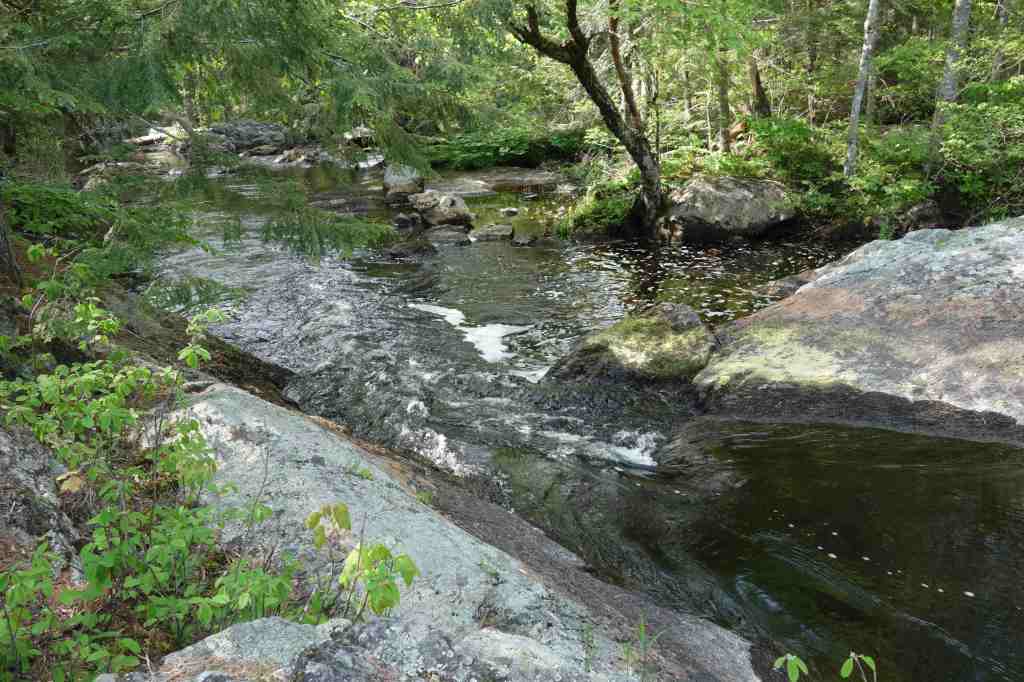
[Above photo: On a walk along Pearson Stream outside of Blue Hill, ME. ]

It is chilly (50 F) and drizzly outside. A fire in the Jotul has warmed the first floor of the farmhouse to a toasty 66 F. My amazing portable Bluetooth speaker (onn.—$14.99) sends me Bach’s cantatas BWV 48, 82, and 199. I’ve just finished breakfast. A perfect situation in which to write the blog I totally forgot yesterday.

The distances here in rural Maine are for driving, not walking. I’ve had CD’s of David McCullough’s “The American Spirit: Who we are and what we stand for” sitting in the car for several years and never listened to them. My sister, also a Pittsburger, admires his writings and conveyed that to me in the past. Since she is the oldest and, naturally, given to being a bit bossy, as the youngest my first reaction is often “No”.  Was I wrong!

It is a collection of his speeches from commencements, receiving honorary degrees, to Congress, to a celebration of the Bicentennial of our national capitol, and so forth. His gift is large and he brings his subjects to a lively, complex state of animation, warts and all. My god, were our Founding Fathers brilliant, visionary, hard-working, and courageous. My daughter pointed out that most were slave-holders; yes, evil in that regard. But that criticism, available for our current edition of awakening, is a bit irrelevant to McCullough’s storyline, as if we were to criticize him for not addressing the appalling medical and dental care of the age, They were culpable, of course, often personally benefitting from unjust practices and at the same time McCullough is not excusing them, merely focussing elsewhere. And among that group, John Adams and his son, John Quincy Adams, were vocal opponents of slavery.

The tale of John Adams sailing the Atlantic in winter, with English warships sniffing around for American prey and the foul weather not matched by the seaworthiness of the vessel, to plead for help from the French during the Revolution is legendary. And taking his beloved 11yo son, because father and mother wanted to further his education, including learning French, by travel to France, was brave.

McCullough has wonderful insights. Acquisition of information, he tells us, is not learning; learning requires thinking, apart from memorization, which generally requires dialogue with another. Facts are not a story, as in “The king died. Two weeks later, his queen died.” However, “The king died. Two weeks later, his queen died of grief.” is a story.

The Founders sought to do what had likely never been done in the history of the world—to establish, with written and ratified documents, a country on the principle of popular, not royal or military, rule—a breathtaking concept, like the discovery of fire. That it was imperfect, that the country was founded on slavery, genocide, treachery, and land theft, doesn’t detract from the novel idea of people ruling themselves in concert. They, horribly, didn’t consider Native Americans and African-Americans people, or at least equal people. We continue to try to correct that, an amazingly stubborn idea that lives all too vitally in some.

Just to think of the shrunken character and the low level of discourse among many of our current politicians, with fantasy, corruption, vengeance, anti-science and anti-intellectualism, loyalty to person over country, probable sex with minors, conspiracists, and flagrant liars rampant, is nauseating. How have we fallen so incredibly far from the standards exemplified by our Founders?  I realize that all were flawed but….good grief! Fortunately, our current government is seeking to redress many ills of the nation and science, policy, and idealism are back in the DC saddle. Anyway, McCullough’s John Adams is on my Kindle and will be my next read. Listen to your sister on occasion, George!

After suffering through some unimaginative and wretched streaming videos, I found two that were fascinating. “Unintended Memoir” is a documentary of and by Amy Tan. I’m finishing The Bonesetter’s Daughter and found the video inspiring, a demonstration of spinning straw into gold. She was the literary angel for the Northern California Regional Organization of Child and Adolescent Psychiatry annual meeting for many years. Each Sunday morning of that gathering, in Carmel, Yosemite, or Sonoma, she would facilitate the attendance by and discussion with creative luminaries: Maxine Hong Kingston, Dave Eggers, Matt Groening, and many, many others over the years.

The other video is a documentary entitled “What Happened, Miss Simone?” of Nina Simone by her daughter. It is beautiful, raw, and gripping, the kind of life tale that shakes your fundament in so many ways.

The forsythia have given way to lilacs, huge exuberant bushes exploding with flower and scent in violet, white, and lavender. Horse chestnut trees are in bloom with their large creamy cones. Tiny bunchberry flowers are in the woods and there are many trillium. I saw fireflies the other night in Ari’s front yard. Deer ticks abound, as well, unfortunately.

I’m expecting the weather to clear for a couple of days on Tuesday or Wednesday. I postponed my move to the island by 5 days, not fancying being wet and cold with no dry firewood as I opened up the house and planted the garden. I have two flats of vegetables, plus packets of seeds, as well as a bale of straw to hold in the water and Ari’s electric rototiller loaded in my car. It’ll be lovely to farm and read and drink tea with whichever islanders are present.

Re-set

23 May 2021

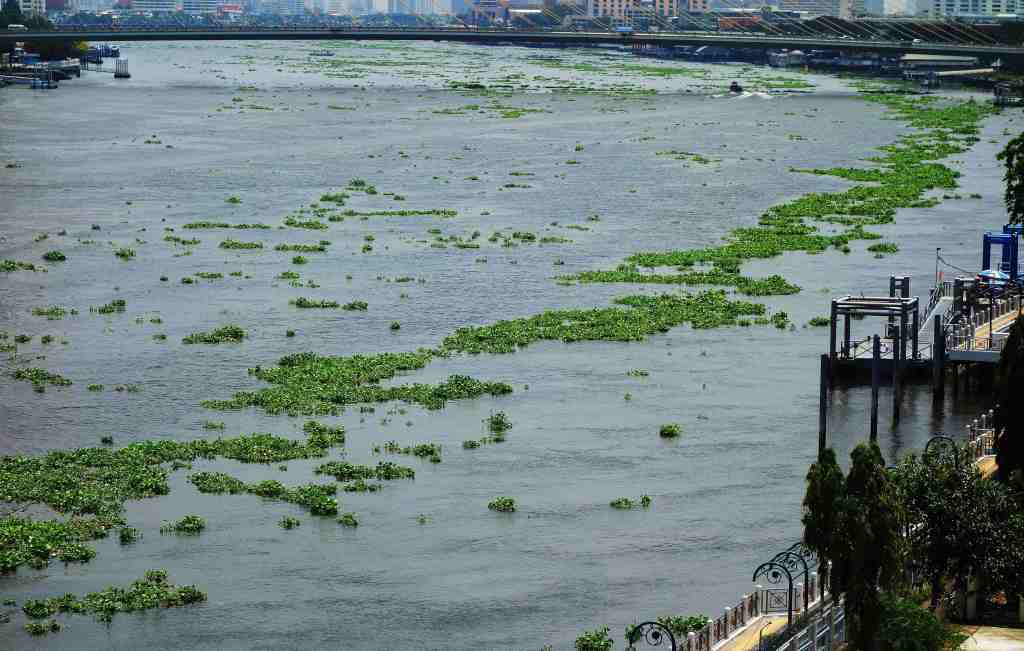
[Above photo: I’m not fully back from Thailand. Water hyacinth thrives in the Chao Phraya in Bangkok. I hope our kale does as well.]

I awaken each day at 4 or 4:30 as the sky lightens to a cool rose hue. Ike, Ari’s small dog (“Bred for hors d’ouvres.”), is alert as I roll over to ease my sore left shoulder. He slowly arises from the foot of the bed, comes closer for a pat, and crawls under the covers to stretch alongside me for a quick nap, his pack instinct kicking in. It feels wonderful to have a living animal next to me. I loved it as a child when my cat had kittens and all the babies would crawl around under the covers. Touch, even animal touch, activates a lot of systems.

As I get up, he jumps to the floor, fully alert. I put on my slippers and descend the steep farmhouse stairs into the nippy living room. I put on his leash and take him out the front door to pee. I return into the kitchen where I light a burner under the kettle. Retrieving his bowl, I break 2 biscuits into it, and pour a bit of the warm water over. He is spinning like a top now, fully activated with anticipation of the same meal he’s had twice a day for who knows how many years. But who am I to judge? I can eat oatmeal with walnuts, prunes, and bananas on it morning after morning with a similar relish. I don’t spin around, though.

Then I crumple up paper and lay logs in the Jotul. It often takes me two tries to get it going but quickly the cool edge of morning melts. Then back upstairs to shave and the rest before I fix my breakfast and tea.

I’d thought it would be difficult to write about the familiar. The exotic presents so many stark contrasts and easy surprises, almost cheap scenery.  The advantage of the familiar, I think, is that it encourages me to focus otherwise. We’ll see.

We’ve taken three lovely hikes. Two to Harriman Point, a beautiful woodland leading to long pebble beaches and rock shelves, donated to the Maine Coast Heritage Trust. Then we bounced up Blue Hill, which is a smaller version of the many hills in Acadia NP, topped by a granite cap from which Eastern Penobscot Bay can be viewed. Ari could see Beach Island; my unaided eyes weren’t up to the task.

Ari’s home is lovely. She has worked like a beast of burden to make it so. As with old homes and extensive outbuildings, it presents one damned thing after another, which is one view of life, I guess. This is planting time for flowers and vegetables and she has extensive beds for both. Since it has been dry here, daily watering is necessary.

While the watering is a repetitive chore, I notice that I quickly become acquainted with each plant and how it is faring. It’s a bit like having many, many children and watching them all grow. I transplanted some kale that were too tightly spaced. One bunch was actually two varieties, Siamese if you will, but trying to separate them would have killed both, so intertwined were their roots. The latter attempt, plus moving them at high noon, induced a swoon. Transplant shock. Each lay on the ground as if giving up, the kind of event that can occur after a traffic accident with minor injury. They didn’t look much better the next day. Ariane seemed non-plussed so I put on a good face but inside myself worried about them. I guess I just needed a worry, since I’ve been eating kale from the market without compunction. Yesterday they were pertly vertical; Ari was right. We all, plants included, are more resilient than I sometimes imagine. I think I can sort out my transition back successfully. 

It was leeches in Khao Sok. Here it is dog ticks. My god, they are thriving. I’ve awakened twice at night to feel one crawling up my body, looking for the right combination of warmth and moisture, I’d guess, before tucking in for supper. It is a banner year for them and the population won’t peak for another month. I cannot imagine more; we’ll be overrun.

Speaking of reproduction, the global population boom has levelled off, excepting in Africa.  Asia—Japan, S. Korea, and China, notably—all are contracting. China is predicted to have half its current population of 1.4 billion people by the turn of the century, whereas Nigeria’s population is expected to exceed that of China by then.  2.1 children per family is the replacement number, the UN-listed birthrates for Bangladesh and Myanmar. I suspect Myanmar’s birth rate will contract more with the coup, although in a draught some plants produce insane numbers of seeds. Southern African countries average 4-5 children per family. S. Korea is at .9, and that must be a special child! The factors causing the shrinkage are many, as are the implications of less consumed and a much older population. Change is the only constant.

I’m hoping Ari and I may take her boat out for a spin today. I’d love to get on the water and she needs a break after three intense days of work. However, the warm day has just turned chilly as dark clouds have moved across the sun. It may rain.

A Return To Maine

[Above photo: Kharst pillars in Chiaw Lan, Khao Sok National Park, Thailand ]

16 May 2021

May 10

I awoke at 5:30AM yesterday, packed and ready to leave for the journey to Bangkok. It’s not unlike leaving Beach Island—pack, a boat ride, a car ride, an airplane ride, another car ride, and home. It was laced with a bit of anxiety, since the boat was ½ hour late, the taxi driver hadn’t responded to my emails moving the time back, my flight was cancelled and I had to reschedule one an hour earlier, etc. But it all worked out and I am in the lap of luxury at a sweet boutique hotel, the Riva Surya, in Bangkok with a 10’x12’ covered deck overlooking the Chao Praya, what I have thought of as the Bangkok River.

The river is, again, full of tugs pulling strings of immense barges, orange flag ferry boats, and masses of water hyacinth. Since I am in an older part of town which I have only cursorily explored, after I retrieved my stored luggage from the Siam Heritage Hotel, I wandered about. I bought a new razor from the 7-11. I unwittingly interrupted a woman having her lunch in a barber shop and got a haircut. She’ll be 81 on March 15 but looks 60. We commiserated about ageing.

I thought I really should take a peek at Khao San Road, the center of footloose young backpackers in SE Asia since the late 1970’s. As I was walking towards it, I passed a bakery with croissants in the window. After two more blocks I turned back, entered, and bought a pain chocolat and a cappuccino. There is no eating inside now—-all restaurants, museums, temples, palaces, etc. are locked up tight—so I stood outside and ate and drank. My! I re-entered and bought a croissant. Amazing! Crispy, flaky, buttery outside and damp and chewy inside. As good a croissant as I’ve ever had, and La Farine in Berkeley does them well. For the past four years, “croissant” has meant bread dough baked in the shape of a croissant.

I learned that the owner and head baker was Japanese and was taught by a French baker. “Precision”, said the Thai shopgirl as she swept up. The place is called “Konnichipan”—“Same day bread”.  Worth a stop if you are ever in Bangkok. It made my day.

11 May

As I walked back to my hotel after my pre-flight covid test at the Hospital for Tropical Diseases, the sunny day turned dark gray, thunder and lightening grew louder, and soon I was battling a tropical downpour. I could have grabbed a cab, but I wasn’t cold and I had a small umbrella. I put my phone, camera, and wallet into a plastic bag inside my daypack, which I then held on my shoulder under the umbrella.

The distance was a few miles. It was a new area to me, so I consulted Google Maps a couple of times and followed the klongs (canals) that earned Bangkok the nickname, “the Venice of Asia”. I got soaked but it was a good walk and a warm shower in my hotel followed by tea revived me.

Before getting my covid test, I met with the SE Asian bureau chief for the NY Times, Hannah Beech. Harold knew a friend of her husband and assisted with the connection. She has been writing eloquently about the Myanmar conflict, nee civil war/revolution. She is a smart, fun, warm person who, with her husband and two children, has bought waterfront acreage in Maine for summer holidays. She went to Colby College and her children’s only experience with the US, although they are citizens, has been at summer camp in Maine. They have lived in Beijing and Bangkok all their lives. I don’t think I added much to her fund of knowledge re. the coup; she has numerous sources, staying incognito, within Myanmar.  In an effort to share a good thing, I took her a bag of croissants from Konnichipan. We each had one with our coffee and had lots to talk about.

12 May

I went by the patisserie, again, today before meeting with Matthew Schojan, a Johns Hopkins researcher who left Myanmar in early May with his wife and daughter. He, and a colleague, Cate Lee, have been developing and studying psychosocial interventions for people in ID (Internally Displaced) camps along the Thai-Myanmar border. They have been training a cohort of villagers to deliver basic counselling services, exactly what I was beginning to explore doing. He, also, echoed my enthusiasm for croissants. Ironically, he said that his Filipino-American wife is crazy for good croissants. The things on which you fixate when you cannot get them!

After visiting with him and collecting my negative covid test result, I took a cab (I got smart!) to my neighborhood and dived into the markets around Khao San Road. I was seeking Thai fishermen’s pants and found only one shop that sells them. They are now fashionable for women, I think, as I could only get them in purple and coral colors, which I did. I’ll try to get my 91yo sister to wear them on Beach Island, even though they might test the limits of her comfort zone. They are so comfy.

13 May

I packed meticulously, for me, the evening before flying out. Arising at 3:20AM for an 8:05AM flight, I showered and assembled my 5 pieces of luggage—two heavy suitcases, a large backpack, a day pack, and the long pvc pipe carrying my painting—got them to the lobby and into the taxi I’d arranged to take me to Souvarnabumi International.  It took longer than 3 hours to get through everything when I departed Myanmar, so I left plenty of time.

Since there were virtually no cars, we arrived at the airport by 4:30AM. Check-in for Japan Airlines didn’t even open until 5:30 and I was cleared through everything, waiting to board by 6:45. 6 hours to Tokyo, a lengthy transfer and another 13 hours to Boston. JAL has better food, for my taste, than other international carriers.

I lost my way in the twilight trying to join the I-95, driving through the small, gritty towns north of Boston. It was a cold, damp evening and I unsuccessfully tried to imagine where I wanted to settle. The tropics were screaming, “Come back!”. Eventually, puttering around Lynn at 8:30PM I stopped at a Shell station and asked a woman in the control booth where to turn.  Her boyfriend, I assume, was sitting on a milk crate, keeping her company, and she gestured to him.  He was sweet, from the DR, and gave me perfect directions leading precisely where I wanted to go. I collapsed in bed in a motel in Brunswick at 11:33PM, the same day that I left, 13 May! What a miracle. The early explorers, whalers, and traders would take at least 3-6 months to make the same distance and probably 1/3 never did make it home.

When I wasn’t sleeping or eating on the trip, I was reading Edna O’Brien’s The Country Girls trilogy.  I enjoyed it like I have enjoyed Willa Cather, spare and simple but powerfully evocative writing. Yet what a revolutionary O’Brien was in describing the extremely pinched culture that the Catholic Church dominated in Ireland. The suffering and guilt endured, especially by women, and the sadism inflicted, often by nuns. She describes the widespread devastation wrought by demon rum on family life and finances. Her work was banned there for years, it was such an accurate reflection of the conditions. She infused it all with constant observations of the flowers, trees, and fields that enveloped, comforted, and inspired her in childhood. She used words very differently from the John Updike and John Irving books I’ve just read.  Her truths are remarkably cleanly presented in near-poetic form.

16 May

I am at Ari’s home now. It is a sweet 3 bedroom 1890’s farmstead on 8 acres with numerous large outbuildings. She has painted and furnished it so wonderfully; her aesthetic reveals that she is clearly her mother’s daughter. She has given the house to me for a 10 day quarantine and has moved into Poki’s new cottage, which is stunning, on the property.

I have been surprised by the prices of everything, especially food, and by my intolerance for cold; it gets into the low 40’s at night. I haven’t worn shoes or long pants for over a year.  Ari, however, has been warm and welcoming. I realize how much she has matured over the past 6 years, during which we haven’t had enough contact. She is taller than me; I’ve shrunk an inch or two.

My sleep is returning to normal, although I awaken at 5AM. I hope to visit the island tomorrow. I’ll take Ari’s boat and pull a dingy off the beach when I arrive so I can use the mooring. I want to burn brown-tailed caterpillar nests in the oak (1) and apple (4) trees.  They apparently have hairs that are highly allergenic; carried by the wind, they can cause a terrific rash. They discomfited many there last summer. They are recently widespread in this part of Maine.

The woods are beautiful now. The maples are purple from their new buds. The forsythia is insane, shockingly bright yellow, shouting, “Spring is here! I told you so!” Ari’s peach trees are in full pink blossom, as are apple trees in the neighborhood. There are some bushes with very exuberant purple blossoms; too early for lilacs here. There also is something that I think may be hawthorn, although I am unsure.  When we walked on the beach yesterday, a raft of geese were chattering away in the distance. It is so lovely here as Spring begins to think about Summer.