Nay Pyi Taw

10 February 2019

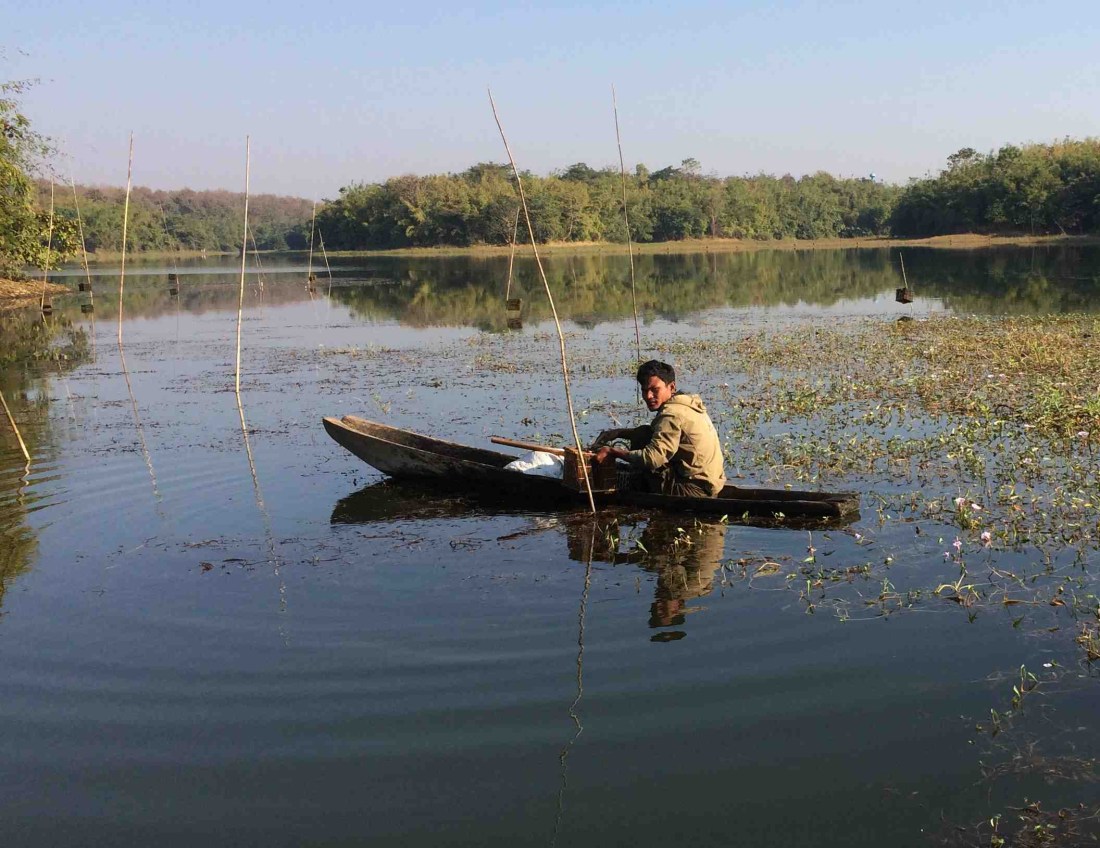
[Above photo: A fresh-water shrimp fisherman emptying and baiting his trap. I don’t know why WordPress flipped the image but I think it looks pretty neat so I’ll leave it that way.]

I arose at 2:45AM, shaved, ate half a mango, drank a cup of tea, and walked 75 steps to the end of my block. Then I awaited my ride, Dr. Kyi, to drive me to the capitol 4 hours north. A steady stream of taxi’s honked their question so insistently that I was forced to repeatedly wave, “No.”. At 3:35 AM Dr. Kyi pulled up. After some driving around Yangon’s suburbs, already quite busy with street merchants transporting their wares, we changed cars and 4 of us headed up the pike. The wholesale flower market was bustling at that hour.

We drove at 140Km up the safe but bumpy divided highway, stopping once for tea and once for breakfast (good mohinga!), finally arriving at Nay Pyi Taw’s hotel zone. My kind of road trip, plenty of refreshment stops. The conference, a country-wide meeting on substance abuse surveillance and treatment programs, was in a very modern, attractive hotel and functioned identically to any of ours, except it was conducterd largely in Myanmar. Often slides and handouts were in English. It was astonishing to learn that, as of last year, being a drug addict was no longer illegal in Myanmar.  Addicts are to be treated, not punished. I’m not quite sure how it works because it is still illegal if you are caught in possession. Hm.

The US has more people in jail than any country in the world and our incarceration rate is the highest, as well. And we think about China as being a police state and the US as “the land of the free”!  Almost a quarter of our inmates are drug offenders, excluding dealers. If someone feels hopeless about their ability to improve their lot in life, or is stupid enough to try an addictive substance a few times for fun, or has gotten hooked as a result of treatment for chronic pain, punishment doesn’t seem like the right approach. Perhaps they need to be in a treatment facility where they don’t have access to drugs but do to yoga, vocational training, education, and supportive psychotherapy services, as well as exercise and healthy eating. Looking at our recidivism rates, it’s clear that punitive approaches don’t work.  We know the “War on Drugs” has made some people very rich and drugs are cheaper, more potent, and more plentiful on our streets than they have ever been. Certainly, a Wall will make the builders a profit but do nothing to slow the flow.

I’m lying in bed at a resort outside of town now, in a very pretty room. It was an elegant teak stilt house, moved here and refurbished with a gorgeous teak interior.  It is set on a lake created by a dam 30 years ago so the vegetation around it is mature. It is so perfect and pretty, it feels at moments like the Truman Show, illusory. Yet it is genuinely lovely.

After an elegant mohinga for breakfast—There is a competition between the soup base and the garnishes to be the best!—and a cup of Myanmar tea, we jumped in a boat and headed up the lake to Elephant Camp. The motor was a 4 cycle gas affair, 13 hp, with a long-tail shaft and propeller, mounted on a swivel on a short deck at the rear of the boat, costs about $350 new and moves the boat, with 4 people, nicely.  Compared to our new $9000 outboard on the Island—well, they aren’t comparable but this arrangement is very clever and very inexpensive. Couldn’t tow a water skier, though.  We passed a very slender man in a small dugout canoe emptying fresh water shrimp from tiny reed traps. The traps were ingenious, similar in principle to lobster and crab pots.  The shrimp are salted and dried and used for garnish in, for example, tea leaf salad.

We arrived at Elephant Camp and walked up a hill through clumps of bamboo and trees  scattered with picnic tables. Since it was Chinese New Year, families were coming to enjoy the forest and the elephants. For a small sum we got a couple of plates of corn cobs and sugar cane and fed the elephants by hand.  There are allegedly 50,000 muscles (a suspect number) in an elephant’s trunk and it takes them a few years to learn to use it well.  They are remarkably delicate with them (It’s tempting to say, “Dextrous”, but that’s not quite right). Then we climbed a platform and settled into a padded pack saddle (howdah) on the back of an elephant and the mahout, sitting on the elephant’s head, took us for a ride on jungle paths. It was amazingly fun. The mahout jiggles his left foot constantly, gently scratching the elephant’s ear.  If he stops, the elephants stops instantly. I’ve been reading Elephant Bill by Lt.-Col. J. H. Williams, OBE. He worked for the British Forestry Department for many years, extracting teak from the forests of Upper Burma, before, during, and after WW2. He became an expert on the care, training, and use of elephants. It’s a very colonial-era book, unsurprisingly, but a fascinating look into that time in Myanmar. It’s on Kindle. He talks at length about the intelligence and memory of elephants, which is prodigious. It always is conflictual, domesticating animals, like elephants, for our ends. At least we aren’t eating them!  And, really, it shouldn’t matter that they are intelligent. Would we want out developmentally delayed child to be treated badly by virtue of low cognition? Mother Nature is impassive and lets us do what we want without moralizing, which can allow us some pretty depraved practices. I remember in the old film, Mondo Cane (A Dog’s World), seeing geese in Alsace confined to crates where they were force-fed corn via a grinder and funnel to fatten their livers for pate de fois gras.

Nay Pyi Taw is described as “soulless” in the Lonely Planet Guide and “a bizarre monument to the megalomania and bombast of the country’s ruling generals” in the Insight Guides. I found it otherwise, perhaps not a PC position. In fact, if the government were still occupying the Secretariat, the massively elegant seat of the British government here in Yangon, I’d find that sad. The Secretariat was built by the British with forced Burmese labor. And as Myanmar becomes more democratic, as it is gradually, and the lovely plantings around Nay Pyi Taw mature, I think it will be a stunning place, if lacking that colonial twist we seem to love to see in former colonies. Again, it is complicated, like everything everywhere. But I think the Myanmar people can be proud of their grand capitol without snide travel writers—dare I say with a post-colonial mentality—dismissing it. There!

The meetings were lively and informative, even if a lot of the information slipped through my language filter. They have many methadone treatment programs around the country and methamphetamine is making a big entry into the heroin scene. We had a wonderful dinner at our lakeside resort with about 20 of the senior psychiatrists and lots of good talk. I sat next to a man who has been flying to Bangkok for several years to take an EMDR course. He’s now completing supervisor training so he’ll be able to teach it here. Nine of the academic psychiatrists are going to an international conference in Sidney soon. I am very impressed with the commitment and leadership of psychiatry here.  And the openness and generosity of everyone. The psychiatrists I’ve met seem to lack the competitive, in- or out-group mentality, so common to middle schools in the US, that infests American academia.  They are smart and informed without that.

Which leads me to another topic that depresses me. Strong and pushy seem to prevail in many, if not most, arenas, a form of natural selection. Sociopaths have an advantage since they can easily do things the rest of us cannot.  It means that kindness, attention to feelings and to process, not achievement, often lose.  General happiness and community well-being rarely are the outcome. More likely, the strong and greedy succeed in domination, control, and accumulation. As I see, and hear, how much China is acquiring all over SE Asia and recalling how they have done the same in Africa, I am impressed with their long-term planning, not so impressed with ours, and appalled by both. It is a repeat, on a mightier scale, of the colonial takeover of the “third world”, as it used to be called.

Might makes right and, if wedded to long-term goals, is going to leave our country, and our democratic institutions and ideals, however imperfect they are, in the dust, especially if we support an illiterate, racist, misogynist chief who impulsively leads from his “gut”, not from any reasoned thought process that recognizes historical precedent and human needs.  2020 is increasingly looking like a watershed election, as were the mid-terms. It feels like the future holds a rapidly increasing number of “watershed” moments.

Unfortunately or not, the Virginia 3 must exit, since appearance is so crucial in politics. I do believe in redemption, but not inside of public office. Public office should be reserved for those who don’t carry the burden of past racist behaviors (certainly as adults) or are not credibly accused of sexual assault, like Justice Kavanaugh. Why is it always men?!! Always.

Days in a Life

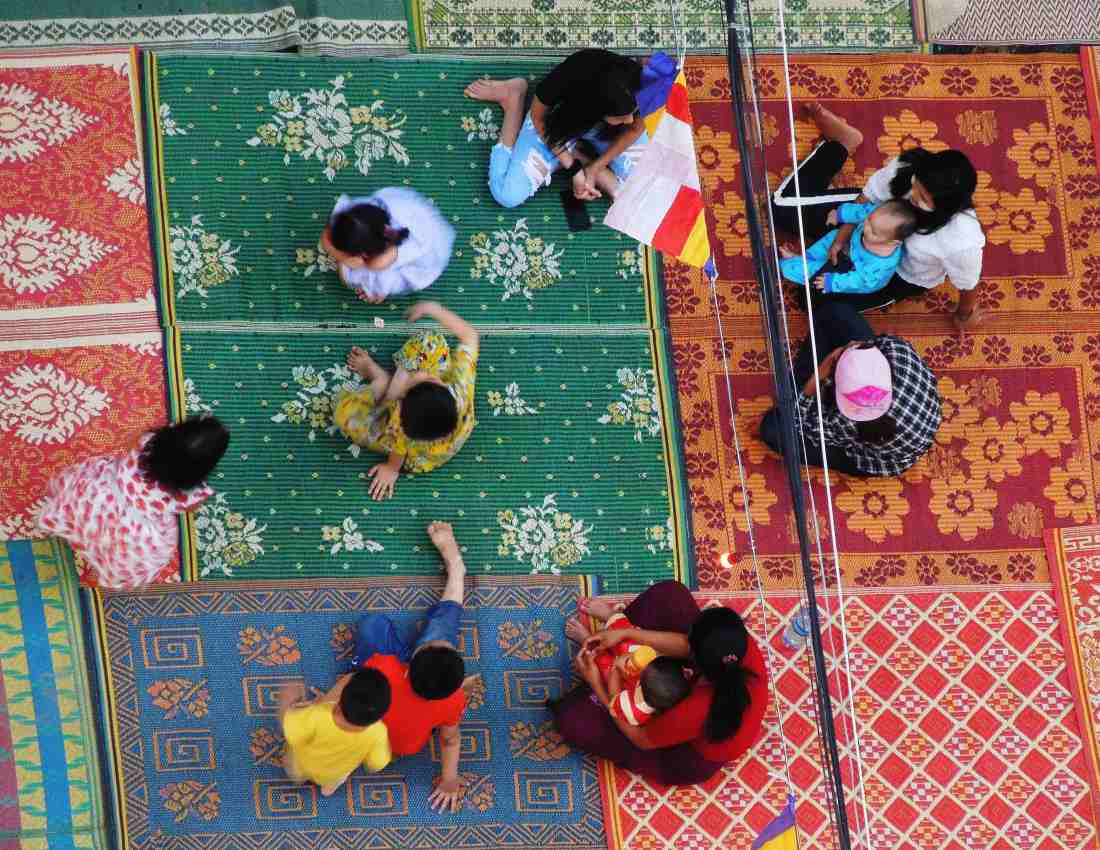
[Above photo: Children playing in the street below my deck before the monk speaks.]

3 February, 2019

I was talking with a cabbie who asked for my age. 78yo. He said, “My father is 70yo. Men that age in our country are—“and he demonstrated, shrunken, crumpled over. I’ve been very fortunate and not needed to abuse my body seriously with food, drink, or tobacco. I’ve always liked physical exercise and currently try to get my steps in, as well as 25 minutes of stretching and small-weight lifting each day. I have now abandoned the lift in the building and regularly walk up the 9 floors. And I take all the pedestrian overpasses here, both for the stairs and to avoid getting killed by aggressive cabbies. Death has, since I was a child, hung round my door.  Outwardly it is from identifying with my father who died at 55yo when I was 9. Less consciously it is because I always anticipated a fatal punishment for my Oedipal victories. Now I’ve outlived my father (d at 55yo), my mother (d at 78yrs 3 months), my grandfather (d. in his mid-40’s) and my brother (d. at 42yo). They all had full lives, even if nipped in their respective buds. If mine ends on this distant shore, I’ll have seen my share of splendors and tragedies. Perhaps my turn of mind is prompted by the fact that we’ll leave at 3:30AM tomorrow morning for Nay Pyi Taw, a 5 hour drive. We would never do this in Malawi, where we might encounter 18 wheelers parked in the middle of the highway showing no taillights or a pile of rocks set across the road by a group of men who would rob you when you stopped. No second thought about it in the US and apparently not here, either.

This week I’ll note here the days of life in my week, as much to confirm for myself how inconsequential they are right now as to give you a flavor. I want my class to begin!

Monday 28 January I wrote my blog and had my language lesson. There is too much new vocabulary with no familiar cognates and my brain is exhausted after 1 ½ hours. I can now count to ten: tit, nit, thone, lei, nga, chauk, khun hnit, shit, koe, ta seh. I can also count into the millions and billions but I’ll never need those numbers, given my Fulbright salary.

Tuesday 29 January  I was fleshing out my presentation for Grand Rounds tomorrow when—of course—my first electricity blackout descended. In the middle of the day. I had no computer charge or internet to search for articles. 5 hours. Oh, well, I’ve learned to roll with these little inconveniences. I know enough off the top of my head to talk for 1 ½ hours about Safety and Quality in Child and Adolescent Mental Health. So I didn’t stress unduly and wrote up what I could.

I also trudged in the heat to City Mall St. John and bought a huge pop-up mosquito net for my bed. One “bugged” me all night. I finally cornered and exterminated her in the bathroom. There isn’t malaria to worry about here, as in Malawi, but there is dengue, which is no fun at all and for which there is no treatment other than fluids, antipyretics, and rest. The net, with springy plastic poles, was so cleverly folded that I had trouble restoring its desired, “popped up”, shape. Now it is a massive 6 foot high dome over my entire king-sized bed. And I sleep like an infant. An infant’s only worry is, “Will the breast be there when I want it?”. I’ve given up on that for now, so I just rest without anticipation.

Wednesday 30 January I met Dr. Tin Oo at the head of my street and he drove (flew?) me—-He is a true road warrior!—to the Yangon Mental Hospital. We had snacks and he taught a class in his office about psychiatric assessment to a group of 4 Emergency Medicine Residents, while I read through The Child Law: Rules related to the child from the Ministry of Social Welfare, Relief, and Resettlement. It is a good document, although it deals too generally, in my opinion, with the abuse of children. Basically, it derives from the 1990 United Nations Convention on the Rights of the Child (UNCRC), the first internationally ratified document of its kind. All but 2 of the UN members have signed and ratified it. Myanmar was one of the first to do so, in 1991. Somalia hasn’t because it doesn’t have a recognized government. And, you guessed it, neither has the US of A. Both 42 (Bill Clinton) and 44 (Barack Obama) vowed to ratify it but never did. What is with our cooperative spirit here? Many of the rights were drawn from our Constitution; others we’ve contributed to the Articles. All I can imagine is that the UN is too politically unpopular in the US. We lack the long view in the US and are such a parochial nation sometimes, despite the vast well of individual generosity to be found. I think we are just too far from other countries so most people don’t travel or even have passports. I imagine Zeno* would have felt right at home, excepting his toga would have gotten him shunned, perhaps jailed. [Actually, it’s xeno (foreign or strange)-phobia.]

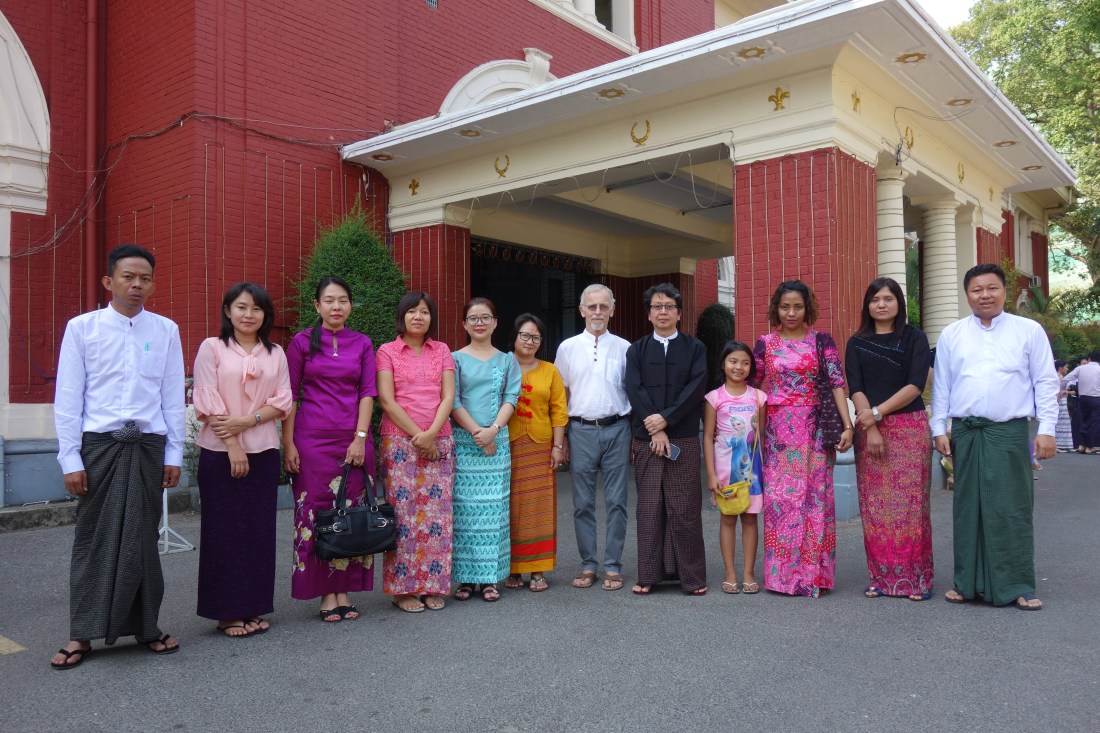
Dr. Tin Oo and I walked through many buildings and covered walkways in the 1200 bed mental hospital to get to the auditorium.  We sat at the head table, Dr. Tin Oo being the Chief, and 80 psychiatrists and psychiatric residents from the 3 local medical schools (University of Medicine 1 & 2 and Military University of Medicine) sat at tables arranged in a U while we were served tea leaf salad, coffee, tea, grapes, sunflower seeds, and mandarin orange slices. Then Dr. Kyi Min Tun summarized a 5 day conference he’d attended on communicable disease prevention in hospital settings.  Time for lunch.  I’m thinking, I like this pace! Then back for my little talk.

It was fun, passing from the history of the concept of childhood to the history of protections for children in different countries. Among the “Factory Laws” passed in England, in 1833 one asserted that only children over 9yo could work in woolen and cotton mills and they couldn’t work more than 60 hours/week! I think it was similar in the coal mines. Then, eventually, along came compulsory education and the UNCRC.  I talked about what was needed for Safety and Quality in Child and Adolescent Mental Health including: a strong, developmentally-attuned, incorruptible judiciary and smart, understanding laws;  robust medical and social service systems of care for children; and a comprehensive system of mental health care services adequately staffed by well-trained, up to date professionals of a variety of stripes. Then I gave a couple of clinical examples from Malawi and asked for questions. I couldn’t get the audience to be very interactive, as I had expected, and we all laughed together at that. It was fun and I hope imparted some useful ideas.

Afterward, Dr. Tin Oo asked if I would like to accompany him for two days at a meeting in Nay Pyi Taw, the new and deserted-looking capitol. Of course. At this juncture I’ll accept any invitation, not knowing what doors it might open. Well, no “girly massages” as I am always solicited by young men when I walk through the Sule Pagoda area which tourists frequent. I feel I’m being allowed to get a little closer to things with this invitation and I am most eager to be of assistance.

In the evening, as people are warming up for Chinese New Year on 5 Febuary a group of revelers in red costumes with drums and cymbals made a huge noise walking the length of my block of Sint O Dan Lan. I hope to return from Nay Pyi Taw on the 5th in time to see the Dragon Parade.

Thursday 31 January The water system has two reservoir tanks tucked in the ceilings of the bathrooms. I must turn on a pump occasionally to fill them. But I use very little water. There is a small booster pump that activates when I turn on the faucet or shower so there is better pressure than simple gravity feed. The booster pump was running continuously when I got up this morning and yet there was no water pressure. Hm. After sleuthing around, I noticed that the outside walkway was flooded and a faucet was open and flowing freely. It is on a side of the apartment where I never go. There is, however, a fire escape. I think there must have been a prowler in the night who caught his clothing on the faucet in passing. I cannot explain it otherwise, unless someone is just messing with me. ( On further reflection, I’ll bet it was the 14yo girls who live in the building doing a prank.  I once ushered them off my deck. They had come up the fire escape, being bored teens. No self-respecting cat burglar would leave a faucet gushing away.) There has also been a chronic leak in the kitchen sink drain, so I called the owner’s representative and he sent someone. I explained it all to him and he fixed the leak. He didn’t have much English and used a translation app that worked really well so I installed and tried it: I said, “A thief”. The app wrote, “Oil”. I said, “The drain leaks.” The app wrote, “Toast”. I have great hopes for it but clearly haven’t mastered it yet! Now to study my Myanmar so I can wow! my instructor tomorrow. And communicate with plumbers. I’ve added “Help!”, “Get away!”, and “Thief!” to my vocabulary.

After talking with his boss, the handyman is going to put a locked cover over the fire escape to prevent intruders. Maybe I’ll get a long rope so I can repel from my deck railing to a nearby roof if a fire starts. Ah, the joys of city living!

Then beers [sitting] on the deck at 5PM with Cecily and her friend, who are hopping a bus for parts unknown (to me) tonight. They are leaving their kathundu for me to keep. Kathundu only eat dust and mosquitos, so I may be reluctant to part with them when she returns. ( I later learned that kathundu means “stuff” in Chichewa.)

Friday 1 February I discovered that in the morning there is the most amazing fruit, vegetable, and meat/fish market on 18th street, one short block from my digs on Sint O Tan Lan.  Later in the day it has all folded up so I have never seen it previously. The early bird, and all that.

Speaking of birds, crows predominate here; they are small and have a varied call. There are pigeons, as well. And house sparrows. An occasional hawk wheeling overhead. But virtually nothing else. We had such a wide variety of birds moving through our garden in Blantyre that this feels pretty impoverished, as clever as crows are.

Saturday 2 February I walked early, before the noonday sun, to Bogyoke Market and bought some Shan shorts—-traditional hand-woven, naturally-dyed fabric.  One size fits all and you must fold over the extra waistline and secure it with a tie which is attached behind.  Less than $5, with two flap pockets. And three white shirts for teaching. And a small suitcase since I don’t want to carry a backpack to Nay Pyi Taw. .

Pleased with my purchases—the shirts are a light weight cotton and cost about $5.50 each—-I arranged to meet an acquaintance of a good friend from the Bay Area. She is a primary school teacher, 60yo, 4 kids grown and off, and has lived and worked in Caracas, Mumbai, and, now, Yangon. I got wind of a little restaurant serving Kachin food and we met nearby, across from the huge Hledan Center. My god, and I thought Chinatown was busy! A fantastic street food scene with yummy grilled fish. Have to return and take a chance sometime. Anyway, Mu Ai Kachin is a tiny hole-in-the-wall up a narrow alley that serves the most exquisite food, presented with an artist’s touch. I let Ruth order and I skipped around the corner to buy some beer. We tucked into a wonderful and beautiful meal, leaving after several hours, stuffed.

Sunday 3 February I’ll write my blog, pack for the early departure, study Myanmar, and, possibly, mop the floor today. I wash and dry my feet every night before bed, they get so dirty padding around. I could wear sock or slippers, I suppose, but everyone seems to accept that feet get dirty and can be cleaned. With all the unstructured time I now have, I realize how work has kept me from having to be very disciplined. Three areas present themselves daily: my stretching-exercise routine, my language study, and, when a craving is upon me, limiting my intake of something sweet in the house. Usually I just have nothing around except fruit and that makes it easy. But I bought a box of raw palm sugar balls which are so good. But I almost threw them out rather than have to limit myself to one or two a day. Then I thought, that is so weak and stupid. So I’ll exercise that discipline muscle, as well.

There are acrobats performing on my street on a series of pedestals of varying heights (4 feet-8 feet) to cymbal/drum music every night now as Spring Festival approaches. And percussion accompanies the “little” dragons, 2 or 3 people, as they go into each shop on the street, presumably for donations. As I sit on my deck writing, the congregation in the old Baptist Church on the corner—75 yards away as the crow flies, as they often do—is singing something with many verses to the tune of “Happy Birthday”. Since Christmas is past, I’ll guess it’s a hymn in Myanmar to that tune. The girls at the school in the same church during the week really belt out songs; it thrills a little, to hear the energy in all those unified voices.

What great works of benefit to all we could do if we just had thoughtful and enlightened leadership!

*I include this for fun. Zeno of Elea, a 5th c. B.C.E. thinker, is known primarily for propounding a number of ingenious paradoxes. The following reconstruction attempts to capture something of how Zeno may have argued. For anyone (S) to traverse the finite distance across a stadium from p0 to p1 within a limited amount of time, S must first reach the point half way between p0 and p1, namely p2.

Before S reaches p2S must first reach the point half way between p0 and p2, namely p3. Again, before S reaches p3S must first reach the point half way between p0 and p3, namely p4. There is a half way point again to be reached between p0 and p4. In fact, there is always another half way point that must be reached before reaching any given half way point, so that the number of half way points that must be reached between any pn and any pn-1 is unlimited. But it is impossible for S to reach an unlimited number of half way points within a limited amount of time. Therefore, it is impossible for S to traverse the stadium or, indeed, for S to move at all.

Too clever by far!

Bago Bound

28 January 2019

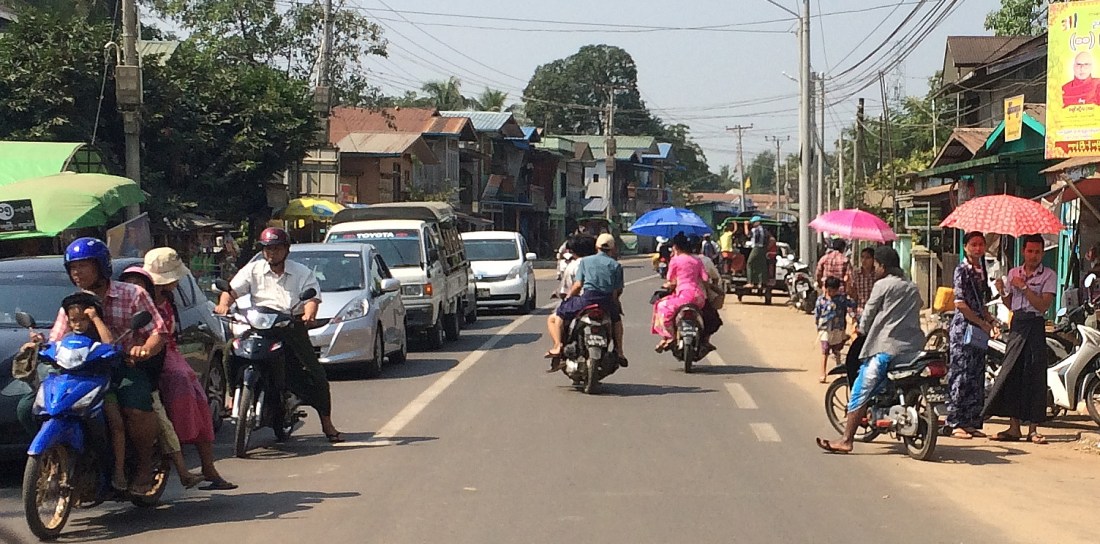
[Above photo:  Bago street scene. Women on motorbikes holding umbrellas, sitting side-saddle are just terrifying to me. I’m gripping anything metal until my knuckles are white!]

Instead of taking the ferry to Dalah and exploring the temples and pottery at Twante as I planned last week, yesterday I taxied to the main Yangon train station and caught the 8AM to Bago. Bago, formerly Pegu, was a capitol of Burma.  Feuds, earthquakes, and a shift of the river leaving it without a port diminished its stature; now it is largely a city of reconstructed monuments and ordinary people. When I attempted to buy a round trip ticket at the first window in the station, I was told the train was already full and had already left the station. It was 7:25AM. The man at the window directed me to a second window. When I went there, they shook their heads and sent me back to him. He then asked if I wanted an Upper Class or Lower Class ticket (The division compliments of the occupying Brits, no doubt).  Imagining massive crowds, struggling for a seat, loose animals, and recalling all the photos I’ve seen of Indian trains with people hanging off of them, I opted for Upper Class, 80 cents vs 20 cents for the two hour ride. I gave him 1500 kyat and awaited my 300 in change. “No change right now”, he said. “Wait a bit”. The next lady in line was waiting there for some reason and graciously gave me 300 kyat after 10 minutes, saying she’d collect from him.  300 kyat is 20 cents.

I went to the train. There were two cars with reversed C’s on them, that being the symbol for 1, as in Car Number 1. I boarded the first of them and sat in A-7, thinking, “It’s not very upper class but it’s comfortable, quite clean, and not at all crowded”. I chatted with a teacher from Bago, an interesting and friendly man. At the first stop, lots of passengers got on and someone produced another A-7 ticket, Lower Class. As we tried to figure it out, a conductor arrived and escorted me to the other Car #1. There was my Upper Class seat waiting, faded plush, reclining, with an eating table and a drink holder and a large fan with whose switch I didn’t mess. These are likely 90yo British railway cars, still in service.

The ride was pleasant, as I love train travel. It was pretty noisy, clacking along at 25mph maximum, and every few minutes there would be a large bump in the track and the metal plates at the connection between two cars would clash. The noise was like cymbals being approximated with force next to my ears or several large plate glass windows being shattered. Disconcerting at first but, then, to what we can quickly become accustomed!  We passed the detritus of the city outskirt: ragged, dirty people, tumbledown shacks, fetid canals, ditchbanks covered in plastic and garbage, skinny dogs scavenging. Then it was suddenly country, with square rice paddies a brilliant green, water buffalo working in others, simple but neat little houses, a feeling of rural industry, egrets aplenty, and cooler air.

As we arrived in Bago and I disembarked, a young-appearing man (actually 38yo) asked if I would like a ride around the temples on the back of his motorbike. $8 for 4 ½ hours. “I drive slow.” And, “The monuments are a little far apart.” I thought for 10 seconds and, breaking #1 rule—never ride on a motorbike without a helmet and gear—I said, “Yes.” He did drive slowly, it was a very, very long way between the monuments, and we had no mishaps, even though everyone drives all over the place, on the wrong side of the road, cutting across traffic unpredictably, etc.

He was a sweet guy. Separated from his wife with two kids, 8 and 10, both boys. He sees them a lot, although he lives with his uncle. He dropped out of school in 11th grade—nervous laughter, “There was a little problem.” Where did he learn so much English? “I don’t know. I never studied it. I just picked it up.” Clearly a bright guy. Isn’t luck of birthright such an indiscriminate, unfair thing?  He’ll be driving that old, underpowered Chinese motorbike or something similar for the duration, I suspect.

After seeing a number of stupas, a massive 125yo boa constrictor creepily eyeing the small children in the room where we all sat next to him/her on the cool tile (no barrier) and watched him/her move about, and a palace or two, reconstructed after one of many terrible earthquakes here, I asked  Zawmoe to take me to a nice place and I’d buy us lunch. Well, I broke Rule # 2 next.  He drove through back streets to a little street food place. It was popular and we had to wait about 15 minutes for a group of fundraisers for a temple to finish up and make table space. We then settled in and, I kid you not, were brought 15 or more dishes—-beef, fish, chicken, pork, all manner of vegetables, tea leaf salad, a soup, a wonderful fermented bean salad, and tea and palm nut sugar for dessert. Oh, and rice, of course. It was incredibly tasty. The total for both of us was $1.93! I haven’t had a moment of illness and it was a great experience.

We visited another temple, 2/3 of whose height I ascended on very steep stairs, a massive reclining Buddha—his pinkie is 10 feet long—, and a little elaborately carved temple with 4 large gilt Buddha statues back to back and hundreds of niches with little Buddha statues all around the walls. In the reclining Buddha temple families were sitting on mats, nibbling, chatting, and a disheartening number of them were, as in America, either together or on their own, engrossed in smart phones.  We returned to the train station where I paid and thanked Zawmoe for his excellent driving and guiding.  Buying my ticket, I struck up a conversation with a young UK pediatrician, Caroline who, with her hospitalist boyfriend Ilim, was working in 4 different hospitals in the delta region, attempting to upgrade the skills of the local GP’s. Touchy business, coming in and telling someone you have a better way for them to do what they have been doing for years, I think.

We chatted a bunch and then I sat in my assigned seat for the return trip, adjacent to the UK Ambassador for a neighboring country and her visiting friend.  The ambassador looked tired and not too cheerful; I’d imagine the job alone could grind you down. Think about having to keep your lip zipped about our current president or, if you were a conservative, through 8 years of Obama. For a lifetime of service. Not a job I’d be eager to take and probably I’d not be able to stay there.

I walked home and was so exhausted from the trip I ate dinner and went to bed at 8:15PM, sleeping undisturbed until 5AM. I awakened to find a photo of Linda’s welcome back to Malawi by the Finches as well a photo shoot of her amazing-looking quarters for the two weeks in Blantyre. I felt strong pangs of longing to be in the mix there. I also awoke to an invitation to speak at a 5 hour CME event at the Yangon Mental Hospital in two days.

The topic is Safety and Quality in Treatment. At first I was bamboozled but quickly wrote an outline in my head about the history of childhood, the United Nations Convention on the Rights of the Child (of which Myanmar was a very early signatory), and issues crossing Public Health, Policy, Child Protection, Psychotherapy, and so forth. I am surprised at how quickly a talk on a large topic I’ve never thought about in its entirety formed in my mind. Actually, it’s a great topic to introduce myself in Myanmar. I even had my tutor teach me this morning how to say, in Myanmar, “I am happy to see you all today. Unfortunately I don’t speak Myanmar well, so I must talk in English.” It should be a hoot.

Now I’m off to have lunch with Clemmie Borgstein, who leaves tomorrow to return to her orangutans in Borneo. We’ll eat at Nourish, next to her yoga studio. The name reminds me of Café Gratitude in LA and Berkeley where, when you order, the dishes are named after humble virtues so you are forced to name them. The waitstaff won’t take your order if you say, “Pita with hummus”.  You must vocalize, “Love’s Open Heart” or whatever the dish is named. Frankly, the food was interesting but the ambience was a pain. It made me feel someone was twisting my arm until I evinced virtue. Say, maybe the House can pass legislation requiring that the current White House occupant must eat take-out once per day from Café Gratitude, served by their waitstaff!

Senses Assaulted

20 January 2019

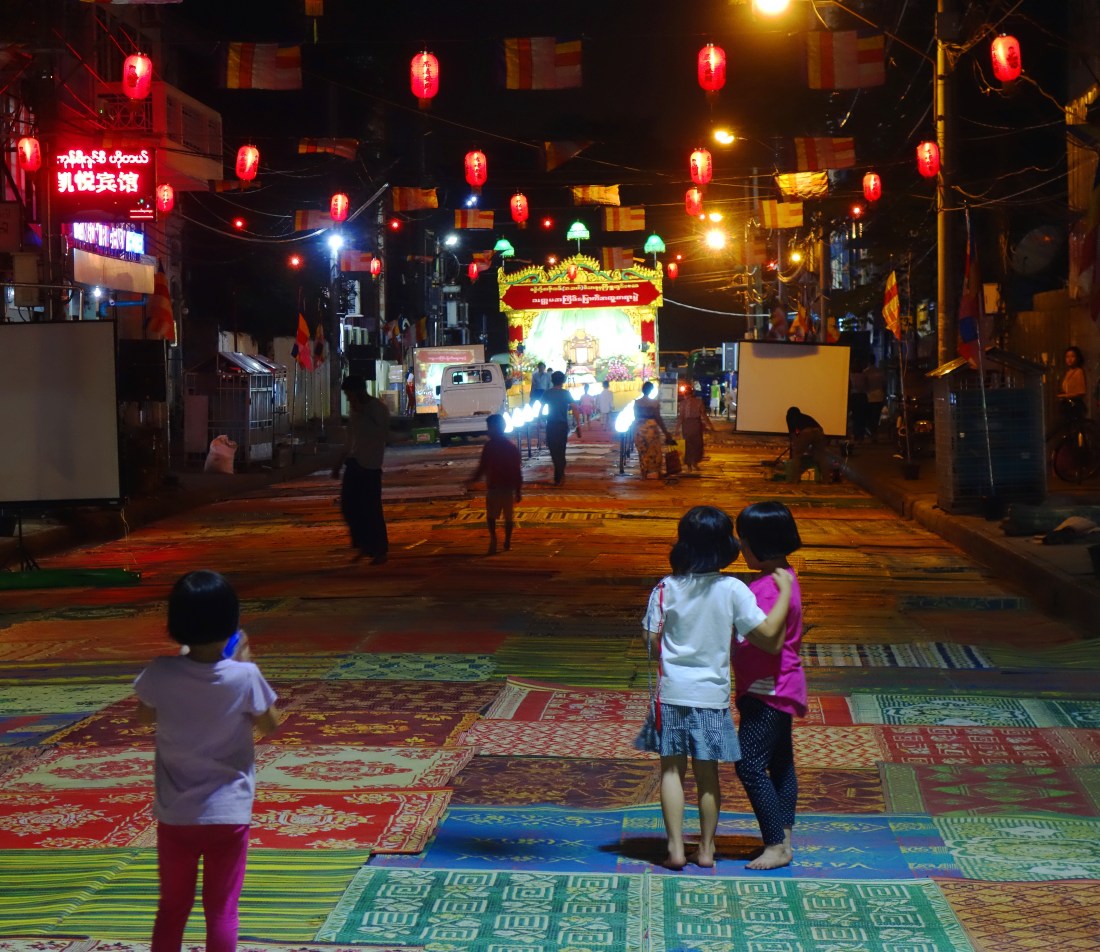
[Above photo: Preparing for the evening entertainment on Sint O Tan Street, where I live.]

Except for touch, my sensory organs are on high alert. The smells of this town are largely food-related: cooking food, fresh fruits, rotting food, and digested food, with lesser associated fragrances of flowers, bodies, cigarettes, car exhaust. They can come in swift succession, so the mind switches from pleasure and yearning to repugnance in a stride.  Taste is generally controllable. Proprioception is activated by the crowded, uneven, and hole-pocked sidewalks and aggressive drivers, causing me to jump, lean, bend, and switch rapidly from moving forward to quick stops to stepping aside to leaping off or onto the curb. The sun is bright every day and at night the number, positioning, and colors of lights are infinite. Finally, the ever-changing but ever-present sounds. A muezzin calling to prayer, a monk reciting or advising, a megaphone advertising, music blaring on massive speakers—I recall a time when my JBL 15’ whoofer was outsized—, ambulances’ claxons, random car and bus sounds, lots of automobile horns, especially at the end of the day. The roar of portable mosquito abatement machines belching noxious fumes into the drainage canals beneath the sidewalk, the fumes floating up through the sidewalk cracks like sulfurous emissions from the netherworld. The person in the apartment underneath me who, inexplicably, begins hammering on something at 5:30AM an average of one in three mornings. I’m screwing up my courage to visit: knock on the door, point at my watch, and make hammering motions while expressing exasperation on my face.

That much Burmese is beyond my dreams. I can say, “Hello”, “Thank you”. “Excuse me” although the grocery store clerk didn’t get it so maybe my pronunciation is far off, “Do you have any…?” and “Where is the…?” although I cannot yet fill in the nouns so they are not of much use. Anyway, having tea on my deck this morning it seemed much noisier than ever and I wonder if I’ve washed some wax out of my ears or am I in the premonitory stage of a psychotic break. Young schizophrenics, before overtly psychotic, may experience noises as too loud, vehicle speeds as terrifyingly fast, etc. An autistic child in my office once shifted attention rapidly, turning his head. Puzzled, I realized that someone at a distance in the building had flushed a toilet. It does make sense to me, in the case of schizophrenia, that as your focus moves from the external world to the preeminence of your own thoughts, the ability to assess the outside becomes compromised and startling, if not threatening.

As to the language, I’ll start Burmese/Myanmar lessons tomorrow at 10:15AM in my apartment with Pwint Phue Wai. I’ll do it 3x per week as after classes start I’ll be pressed for time and perhaps only do it 1x/week. I’m not intimidated any longer by the fact that, like Vietnamese, Thai, and Chinese, it is a tonal language. I’ve just finished the Ken Burns “Vietnam” series and watching Robert McNamara repeatedly chanting what he thought was “We’ll win” over and over before a crowd when he actually was saying “The little yellow man slips away” or something to that effect should give me pause. The crowd was captured on film laughing. But I’m not at war, I’ll be humble, and people love it when you try their language, even if it is butchered.

The Goethe Institute is a German culture export all over the world. Astrid Kraft was a neighbor and friend in Berkeley who works at the Goethe Institute in San Francisco. The Institute in Yangon is a major hub of culture here, including a wonderful performance space, gallery, and café, housed separately in a colonial mansion and two new, modern buildings, respectively. I attended a piano recital there by a Japanese concert pianist and, more recently, went to an evening of exploring “Dialogue” as a means of conflict resolution. The panelists were Burmese: a leading punk rocker, a documentary filmmaker, a performance artist, a university student in political science, a newspaper editor, and a survivor of 20 years in prison for his role in the 1988 uprising (He has started a new political party. Hard to keep a good man down!). The moderator was a German scholar. We all wore little headphones and if the moderator spoke in English, the headphones produced Burmese. If the panelists spoke in Burmese, the headphones reproduced English. The Burmese were a bit hesitant, the moderator too forceful, and the translator not so good. Pulling headphones on and off was exercise. They never really managed to get a dialogue going themselves, let alone explore the general dimensions of dialogue. However, the evening was saved as I sat next to a friendly couple from Norway, Stein and Eva. He directs the PRIO Peace Institute in Oslo and she is Country Director for RAFT which is an organization promoting peace here. Moreover, I found out online that he researched and wrote a much-lauded book on the beginning of the Vietnam War, the crucial period being in 1946. And I had just completed the Burns’ series. Anyway, Eva has a book group at their home on Monday and he and I shall have a meal at a local French restaurant. And wine and talk.  Company!

Yesterday the parked cars all left my street —Sint O Tan Street—and a firetruck with lots of sweepers moved down my block, hosing and sweeping it.  Then mats were put down covering the entire street for the length of the block. A shrine, complete with a throne, roof, lights, and many huge bouquets of flowers was erected at one end of the street. Orange lanterns were strung over the entire street. At 8PM a monk entered the shrine, sat on the throne, and spoke over a PA system to the many who had assembled, removed their shoes, and sat on the mats facing him. Local entertainment at considerable effort.

This is a very religious society and Yangon is no exception with many Buddhist temples, mosques, Hindu temples, an old synagogue with the founder’s ancient son as the only congregant, Anglican churches, Baptist churches, Methodist churches, Catholic churches, and doubtless more. Some broadcast their music;  many don’t but all will have some. The contrast of the beautiful spire of the Anglican church next to the ultramodern Pan Pacific Hotel (and co-occurring mall, Junction City) juxtaposes the sacred and the profane. Buddhists seems to blend it better; neon and gold all over the hundreds of little temples at the Shwedagon, emphasizing the beauty and value of Lord Buddha.

I am in the final throes of completing my Curriculum for the course. I want to finish it before I begin taking weekends to tour about. But yesterday afternoon I went to a large SE Asian regional art exhibit. It was housed in the Secretariat, the immense and beautiful  government building complex designed by the British and built with forced labor. After the British left, it was used as the seat of the Burmese government. General Bogyoke Aung San, Daw Aung San Su Kyi’s father and the liberator and first president of the new republic was assassinated here. It has been abandoned and closed to the public since the capitol was moved to Naypyitaw in 2005.  It is a magnificent building of grand conception with  40 foot ceilings, beautiful ironwork, and stunning masonry.

The exhibit was 65 installations of conceptual art and less than interesting for me. I find that for me conceptual art often reveals more the idiosyncrasies of the artist than a universal truth, a comprehensible or coherent statement, remarkable skill or technique, or a trigger for my self-reflection. The most enjoyable installation was sitting, sipping tea, and chatting with others as we picked and cleaned mung beans from a huge pile in the middle of the table. It actually was brilliant in its simplicity and so engaging, a little recreation of village life

The sun was slipping down when I left the exhibit so I decided to ride the ferry across the Yangon River to Dalah ($2.65 RT) and back. I always love water doings and water traffic and it was a great way to enjoy the end of daylight.  Every culture has their own shape and style of boat; Burmese rivercraft have long overhangs and slice easily through the water. When travelling in SE Asia on previous trips I have wondered how I could purchase a local watercraft and get it home for use on the Island.  It would be a bit of exotica in Penobscot Bay, for sure. Next weekend I’ll take the ferry to Dalah and rent a motorbike to visit the numerous temples, including one with snakes, and a pottery in nearby Twante.

Tomorrow at midnight I will have been here 4 weeks. All said, it’s going OK although I am tired of suppers alone.


Note: If you enter <apsychiatristinmyanmar.com> in your smartphone browser and, after the site loads, draw your finger down on the screen, you will see a button “Follow” appear at the bottom. Press it and enter your email address to get a notification when I post.

When you get the notification, click on the green logo (or whatever it is) in the upper left side of the screen and it will bring up my post, complete with photo. If you just click the title, you don’t get the photo.

Visitors!

13 January 2019

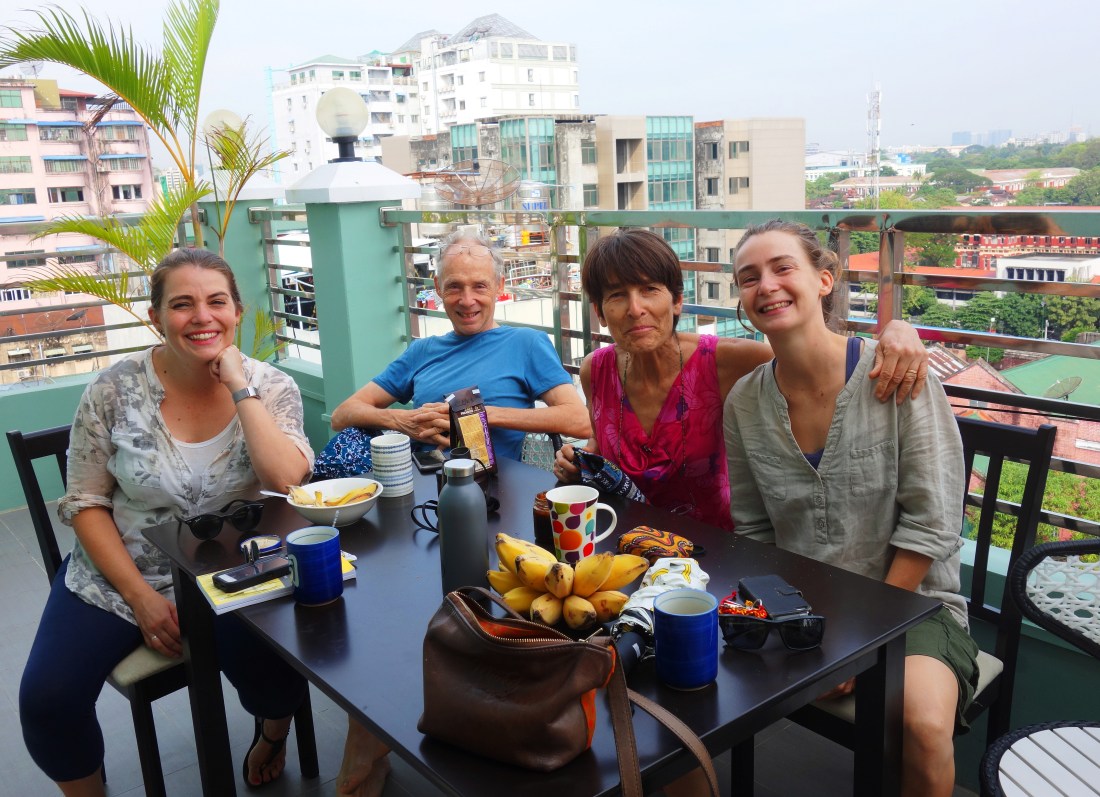
[Above photo: L to R: Cecily, Eric, Sophie, and Clemmie Borgstein visiting from Yangon, Malawi, Malawi, and Borneo, respectively, on my deck.]

A day of dusting, mopping, several runs for supplies, making salads, getting the table and chairs onto the deck, and coordinating take-out from the local Chinese-Burmese restaurant prepared the way for the arrival of Eric and Sophie Borgstein from Blantyre. Cecily has been working here 5 months and Clemmie came a week ago from an orangutan orphan sanctuary in Borneo where she has been working for a year. The other two Borgstein children, Edward and Bella, are climbing in the Rwenzori Mountains in eastern Uganda (which contain 6 of the 10 highest peaks in Africa). They all bring animation, joy, love, and tales of adventures past and future.

I realize how strange it feels to me to live alone in this city. I have learned that Yangon and environs contain about 10 million people.  I don’t yet have a solid connection to my work.  In addition to my friendship with Sophie and Eric, it is wonderful to share my space with others. I can retreat into a productive solitary life but much prefer a social one.

Cecily led us around town yesterday, through the massive Bogyoke Aung San Market, down passageways and alleys lined with street sellers of handicrafts, gems, food, and clothing. Some of the textiles are very lovely, the rubies are beautiful but leave me cold, and the siren songs of huge sacks of fried grasshoppers fall on deaf ears, though I’ll surely try them once. Crispy-crunchy, salty.  I bid on a painting I’d seen before that I really liked; my offer was accepted and I purchased it for later pickup. We returned to the apartment for a 2-hour rest before the evening meal and subsequent drinks. Sophie napped in their room; Eric and I alternately read and napped in the living room. He, being a surgeon, has learned to sleep anywhere, anytime.

After a lively supper with 4 of Cecily’s female friends, all having come from UK to work here for 6+ months on different projects, we 9 went to the Bar of Double Happiness, one street east of my apartment on Sint O Tan Street. Why Double Happiness? Because mojitos cost 1000 kyats, about 66 cents each so you can easily afford two. Or four. Caipirinha’s also.  But they use grain alcohol instead of cachaca., there is no vestige of a lime, and they seem to have forgotten the sugar.  Pretty strong, grim drinks without any refinement or embellishment. I’ll drink beer there the next time I go.

They are off to brunch with the UK ambassador’s mother-in-law who works in Malawi but is visiting. Then massages. And likely supper, at which I’ll join them. Finally, they all catch the 9PM night bus for Bagan, arriving at 5AM. They’ll tour there, riding electric motor scooters to visit the temples (>3000 are left of an original 10,000). Temples were built by wealthy people to improve their karma so that they might return in a higher life form. The process was to atone for their wickedness. It is convenient to get rich however you can and then use a bit of the proceeds to earn honor and cosmic forgiveness for stepping on so many necks while gathering your fortune. The Borgsteins will all return in 10 days after, no doubt, much fun and many surprises. An intrepid family of travelers.

Dr. Tin Oo drove me to the Yangon Mental Hospital last week. It is a 1500 bed facility stretched over many acres.  We drove for an hour and 45 minutes to arrive. It takes the same to return. Dr. Tin Oo does this 5 days per week, as do most of the other psychiatrists there. In Augusta, Maine, they built the state mental hospital, the second in the US, across the Kennebec River from the front steps of the state capitol building. The legislators must see it every time they walk out of the capitol building, a good way to remind them of their duty to the mentally ill. Not so in Myanmar, where the major mental hospital is so far out of town it is difficult to find.

Lack of skill and staffing shortages restrict patients to largely custodial care plus medication. Still, no one seemed overmedicated and the patients were pretty tranquil. There is no occupational therapy and no attempt at rehabilitation, as is the case in most of the developing world.  I met several eager young psychiatrists who had completed advanced training or degrees in London, Boston, and California and would certainly do much more if given the resources. There is a substantial outpatient methadone maintenance program, as heroin is plentiful and addiction is common.  Methamphetamine is cooked in the border areas and is also an increasingly problematic source of addiction.

I’ve decided not to invest my time in travelling to and from there regularly until my teaching begins in early February. I think it is better spent in preparing my course and settling in so the edges of my life work easily when I am finally busy.

I’ll stroll over to the market now, get a bite of lunch, and then retrieve my painting. I have a good spot for it in the living room. If I feel the patience, I’ll try to fiddle with my new printer to connect it to the wi-fi network so I can scan papers to my computer. I suspect my printer difficulties are that I am somehow not reading the finest of fine prints and not following the directions precisely.  Relationships are flexible but not computers.

And there is that business of increaingly accurate facial recognition software and 200 million cameras surveilling the population of China. And about 500,000 in London. Eric Blair (George Orwell) was prescient, down to the details.

Settled, 2019

6 January 2019

[Above photo:  After lunch with [retired] senior faculty of University of Medicine 1 Dept. of Mental Health]

Excepting that the sink drain leaks (I have a bucket under it and shall let the maintenance guy enjoy his Sunday, today.) and the light in my bathroom doesn’t go on (In the daylight with the door open I can see well enough to shave.), my domicile is settled. Oh, I need soap dishes and a few similar bits but I have a mop and internet and a cold watermelon and thin quilts for the beds (There are no top sheets to be had in Myanmar, unless I have someone sew me one.) and am very comfy.  I noticed two days ago that I can see the river from my living room. I love my birds-eye perch and if I ever get a pied a terre in NYC or Paris it will have to be a penthouse!

The city, and it is considerable with a population of > 4.5 million, hums beneath me day and night. Friends came over yesterday evening for some bubbly, bringing organic carrots and hummus from the Farmer’s Market (How can you tell a farmer’s market from the open-air food stalls everywhere?) and two packs of cards as a housewarming gift. We sat on the deck as the sky darkened, experiencing the cool river breeze that comes up each morning and evening, as one of them described her life at a chimpanzee rescue program in rural Borneo. The salty snacks simply stimulated our appetites so we dropped down to the street, walked 25 paces left and entered a little restaurant for dim sum and a variety of tasty vegetable dishes. $12 for all 3 of us and we ate a lot.

In preparation for their coming, I did a little shopping for the salty snacks, cheap whiskey (a liter of Crown Royal “Aged in Oak Casks” for 3000kyat or less than $2—David, I’ve won the contest!), a yoga mat, and an electric kettle for tea water.  I was supplied with a bottom-of-the-line electric kettle, all plastic, which heats up really quickly but doesn’t turn off so all the water boils away and it blows the circuit breaker. I could use it, keeping an eye on it like a tea kettle on the stove, but I don’t like the idea of the boiling water leaching out plastic resins into my tea water. As I was cruising the neighborhood on my couch with Google Maps, I realized that I’d walked past an Orange, a local supermarket chain store within a block of my house, many times without seeing it. Must be a mistake, I thought. Nope, a tiny storefront in an old, narrow building opened into a full-service grocery/department store, 5 stories tall. And next door, San Har Gay, another familiar department store, a bit more upscale, with tiny escalators ramping up 4 or 5 stories. I have noticed several times in passing by that as a promo in front of the latter store there is a young man with a megaphone, a large cardboard box filled with new purses and a huge crowd of jostling women—-Filene’s basement. Every so often he shouts something—I imagine, “50% off for the next 2 minutes!”—and the clutch of women becomes frenzied, pushing and elbowing as they grab for the purses. Consumerism at its most entertaining!

To get around, I use Grab, an app like Uber or Lyft. It helps me to know in advance the cost of a trip. Every second vehicle is a taxi here, which isn’t a bad thing if it decreases the need for a personal automobile. Motorbikes are banned from Yangon; some people use e-bikes. I Grabbed a cab to have brunch yesterday with one of the other Fulbrighters in a very fancy mall near where she is staying 25 minutes north of my apartment. She is an interesting woman, a Korean, who has tenure at Seattle Pacific University, a small liberal arts college. Her field is clothing design and here she has 100 students to whom she is teaching principles of entrepreneurship.  She stays in a $22/night hotel near the university and shall do so for 4 months. I’d go nuts in a hotel for more than two weeks. I like to cook and, at this time of life, want space and privacy. I’m already thinking how will I work it if I come back to keep up whatever momentum toward the development of children’s services I facilitate here?  Especially after living in this little palace.  It will sort itself out.  Jaeil had helpful suggestions for me re. positioning myself to have maximal impact here, not the sort of strategic thinking I do automatically.

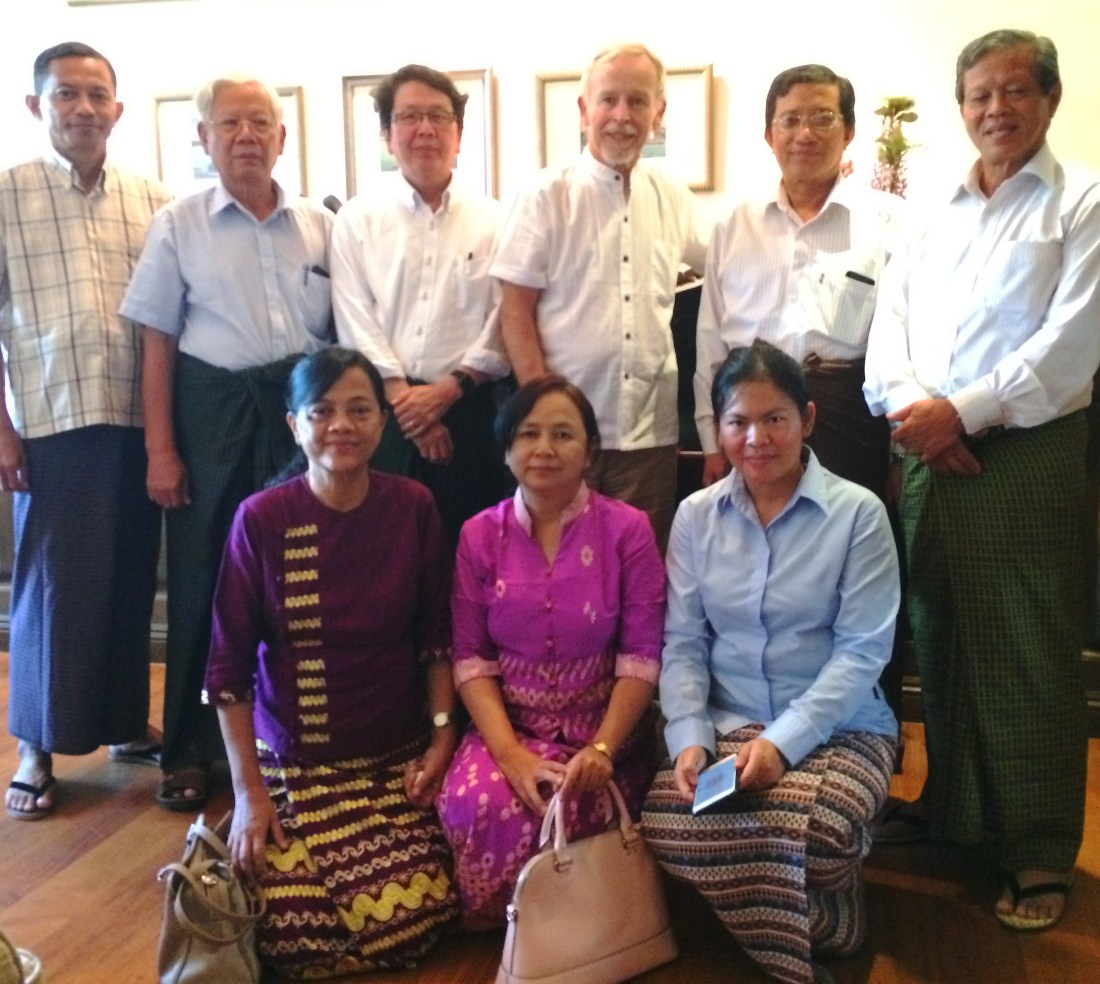
I had lunch last week with 6 senior faculty, all retired from the University (at 60yo), arranged by the department head, Dr. Tin Oo.  A young psychiatrist, his “Assistant” as she described herself, gathered me from my hotel with her husband, a merchant marine sailor, and drove me to the restaurant. It was a lovely building on a lake and we had a dark, wood-paneled dining room and delicious food to ourselves. Everyone was very friendly. One of the men gave me a history of psychiatry in Myanmar, from the first “Lunacy Act” to the present time. I then explained my thoughts in general about the course. It turns out, and I’d not known this, that they are bringing in academic psychiatrists from all over the country for it. They’ll live here for 9 months and breathe Child and Adolescent Psychiatry so they can return and begin to teach it, starting services in many locales.  I was stunned.

Space for a clinic is at a premium so we plan to start with 3 rooms, each having 3 students. One will be the interviewer, the other two making observations which they shall record and present in order to stay active. Then they’ll rotate for the next patient. Over nine months they should have a decent exposure. One of the faculty suggested that the clinic should run 8AM-5PM 5 days per week with lectures and reading afterwards.  I gasped, imagined the life draining out of me as I managed and supervised all of that, and said, ”I want them to love Child Psychiatry, not hate it.”, carefully leaving questions of my age and stamina out of the discussion.  So we settled on 8AM-1PM 4 days per week for the clinic, an hour lunch break, and 2 hours of lecture afterward for 7 months. It could leave them sleepy for the lectures but what to do?

My concerns about teaching them have to do with cultural ideas about pursuing their curiosity and ana deh. The latter has been described to me as “a reluctance to say anything that might cause another to lose face”.  I’ll be as sensitive as I can but also very direct. I fear they’ll nod that they understand what I am saying but, not wanting to embarrass or challenge me, silently muddle along in confusion.  Of course, no one likes to lose face or feel criticized or not know something we think we should know. That is what being a student is all about, however.  One problem is that they haven’t formally been students for awhile and it may be difficult to slip into that role again. My point will be that we should all be students with each patient we see, enduring the uncomfortable feelings of uncertainty and confusion, as well as the excitement, that come with true learning.

Critical thinking is apparently not taught.  Rather, in keeping with the Asian stereotype, students are taught by rote learning and are very diligent with that. I figure they’ll all be intelligent, since medical school entry is difficult.   I have some time to develop their minds. But adhering to the DSM-5, as necessarily reductionistic as that is, and psychopharmacology imperatives will not serve them, or their patients and families, well. One helpful vehicle I can use is to keep stressing the integration of the Bio[logical]Psycho[logical]Social approach to thinking about each patient.  We all must learn the new microculture of each patient and each family we see. A family system may look familiar to us at first glance but, given the complex critters that we are and how strongly influenced we are by early and ongoing experiences, every family culture is, not surprisingly, different.

I am starting to wear sandals around like everyone else. Footwear all comes off before entering a temple or a house.   Seeing 7 or 8 apartments in a day while wearing my running shoes was a nuisance.  Also, with sandals there are no socks to wash. And your feet feel pretty free in flip-flops, unless you stub your toe on uneven concrete. I bought a new pair the other day, CIORs, manufactured by the Jiakeey Company of Fujian Province, China. “The CIOR is a kind of combinative shoe which is full of medical functions and healthy design. The special functions of it are complete support of your cervical vertebra and strong stability and supports on your body. Furthermore, the high quality arch design and rubber outsole play an important role in anti sliding. We firmly believe that our best selling shoes, the CIOR, can provide you health, comfort and safety.”  How could I not buy them? I’m still struggling with how they are supposed to attach to my neck.

Approaching 2019

[Above photo: From my deck—Yangon General Hospital in foreground, Shwedagon Pagoda in rear.]

31 December 2018

This year is incompetently, impulsively, and dishonestly growling to a close. Talk about losing youthful idealism. In His case, I don’t think it ever existed. If I’d seen him as a child in my office and with his parents, I’d have felt sympathy for him and his plight but I feel none now.  2019 holds great promise of improvement.

Although I resisted joining Facebook for years, thinking I would be unable to ignore its siren song, I finally became slightly active and joined the Yangon Expat Connection, requesting leads to an apartment. BAM!! 8 or 10 realtors were on it. Impressive. I scheduled 6 realtors and saw 16 apartments in two days. Some were large, soulless marble affairs in peripheral townships. Number 12 is a 9th floor penthouse, two bedrooms/bathrooms, a deck with plants and outdoor furniture, views of everything, a “Smart” Sony TV the size of a movie screen, new furniture to my specifications, and a nice river breeze. Oh, and free utilities, cable TV and WiFi. I’ve never had cable TV. Plunk in the middle of Chinatown, which is where I want to be. The bustling side streets hold tiny restaurants, fresh meat, flower, and vegetable stalls, etc. There are blocks with nothing for sale but new and rusty tools, piles of used angle grinders and electric drills, and rusty and new bolts. On adjacent blocks are clothing, dishware, and so forth. The price of the apartment is half of the housing stipend Fulbright gives us, so I’ll pocket the balance and use it for taxes. There is almost everything you could want in my neighborhood.

Except true love which is back in Maine, of course. However, I have had companionship in the form of the daughter of good friends of ours in Malawi who has been working here on a project with the British National Health Service helping Family Medicine docs improve their critical thinking. See what you can do if you have a coherent single-payor universal health care system? Global health care teaching and improvement. Anyway, Cecily has shown me around and taken me out to supper with her friends. We ate at an Indian vege place, then moved for great gelato to Sharkey’s, and finally landed in a bar where a loud band played covers of jazz classics, taking great liberties. Dave Brubeck’s Take Five has an unmistakable beginning which the band used before venturing out on their own musical voyage. I doubt Dave will sue for copyright infringement. I had a Japanese Mule, which had sochu, mint, lime juice, and their home-brewed ginger beer, almost healthful.

I can see I’ll spend most evenings alone. The apartment with its views and privacy will be ideal for the same. And if I want something, I can just bop down the stairs and get it. There is no need for a fridge, although I have a new one, except for the left-overs as all food is freshly available. And think of the stair training, going 9 floors several times a day. There is a lift if I want to use it.

Three days ago I walked to the Shwedagon Pagoda and up its many stairs, circling it. I could not recall if one is supposed to walk clockwise or counterclockwise so I watched others.  They were evenly divided so I guessed counterclockwise, which I later discovered is wrong. Even with its construction hairnet, the Shwedagon is magnificently glittery. One Burmese queen donated her weight in gold to be put on the dome.  I can see it from one end of my new apartment deck. It is an estimated 2500 years old.

Two days ago I cruised through 2/5 floors of the National History Museum which is right up the street from my hotel. There were lots of amazing artifacts, including the massive gilded Lion Throne, returned from India to where it had been taken. Think of the lives of royalty, with their silver chin rests, gilded arm rests, lacquerware pillows, and glorious silver betel nut juice spittoons.

There is a prehistoric floor with cases and cases of fossilized teeth and jaws and tusks of animals great and small from the Pleistocene (5 million years ago) and the Eocene (40 million years ago). Stegodon was a massive elephant with tusks to match, dwarfing our current pachyderms; it made me feel pretty insignificant in the Grand Design to see Stegodon’s fossilized molars from 5 million years ago, imagining him chewing up tree branches and leaves.

I rode the train today to sightsee. The circular route takes about 3 hours to traverse the periphery of Yangon, travelling at 15 mph. I could not find the station so looked in my trusty phrase book and the second person I asked actually understood my primitive attempts at Burmese. The ticket cost the equivalent of 12 cents, a bargain for just about anything. But the circular train either hasn’t run for 6 months or won’t run for another 6 months; I couldn’t discern. So I took the train running between downtown Yangon and Pyay, planning to get off at some town and catch the return. After about an hour and many stops and pauses, I exited at Insein (pronounced “insane”) where the feared prison is. I crossed the tracks and got on the train going the other direction, passing the stop near my hotel so I could locate the next one, which will serve my apartment.

Even though it is a national holiday, New Year’s Eve, the outbound train was full. There was a constant flow of vendors working it, carrying and selling bags of lychee fruit, bushels of clementines, baskets of quail eggs, bags of peanuts, sliced green mango with a dab of turmeric or hot sauce, and so forth. I bought clementines and lychee fruit and have been devouring them in my hotel room. The watermelon seller was remarkable, a tiny woman (4’8” on her tip-toes) carrying a little plastic stool and a large tray on which were a broad, very sharp knife and large wedges of watermelon. These she would expertly chop into smaller slices, slip them into a plastic bag, and discard the rind. I watched her halve, quarter, and further slice up an immense watermelon, then stand and put the entire tray on her head and cruise through the train crying out her watermelon pitch. It was impressive. One very enterprising youth had prepacked plastic bags of clementines and with a very deep voice he moved quickly, selling out his entire bushel in only one of the cars. Others with full bushels, but not pre-packed, didn’t sell nearly as many. People really like pre-packed food, unfortunately for the environment.

I’ll again join Cecily and her friends for supper tonight, then probably retire to my new apartment roof to watch the fireworks while the youngsters go clubbing. They are sweet and interesting but there is a generational thing here that I cannot ignore.

I’ll wish at midnight, wherever we are, for Peace on Earth and Good Will Toward Men, Women, Flora, Fauna, and the rest of the Environment of our amazing little sphere.

Yangon, Christmas Day

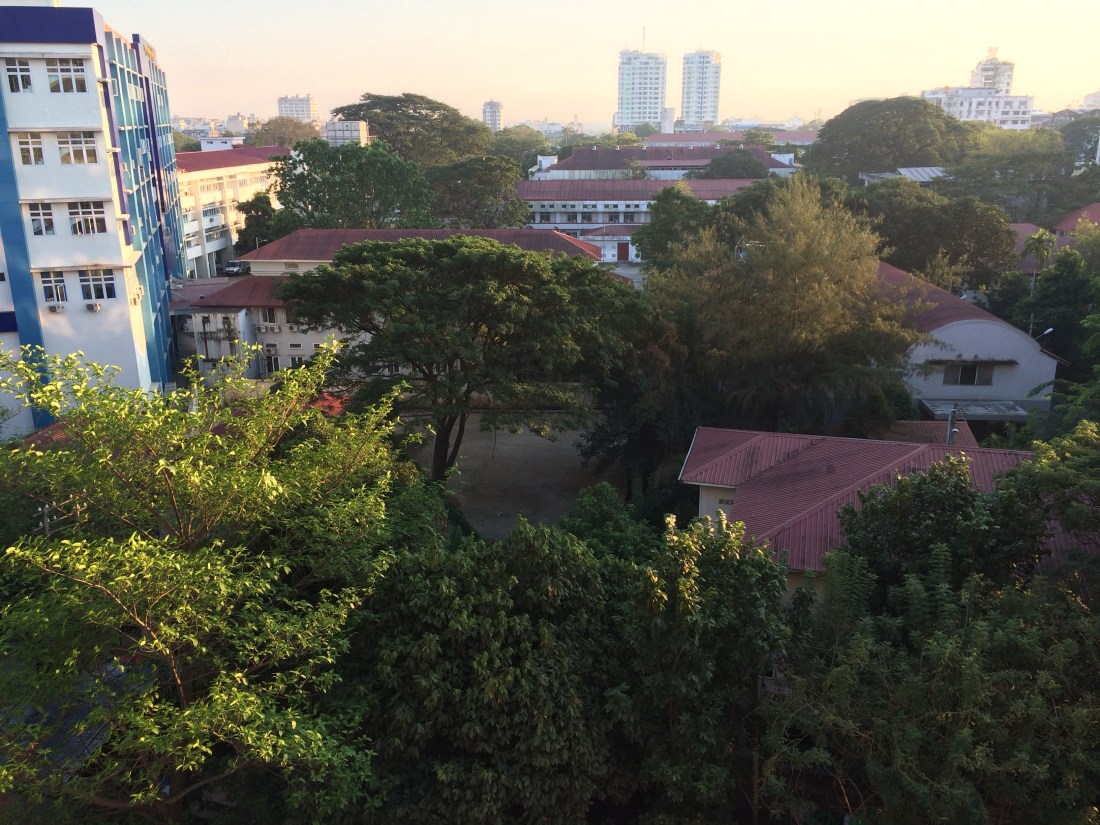
[Above photo:  A Room With a View. Mine.]

25 December 2018

After a not-so-bad 29 hour flight (3 planes, 3 legs), during which I slept at least 5 or 6 hours (Thanks, melatonin.), I was met by the Head of Psychiatry, Dr. Tin Oo and Dr. Kyi Min Tun, a young psychiatrist on faculty. They were most helpful and welcoming. As we drove to my hotel, Dr. Tin Oo showed me a live stream on his phone of a fire that had just broken out in the large (1500 bed) mental hospital, presumably from faulty wiring in the dining room. After dropping me off at 1AM, they were driving over to witness and help. Is this a bad omen?

My entry here was otherwise undramatic and painless—-no forms to fill out demanding to know if I was bringing in fruit or vegetables, no inspection of my bags, a quick and simple wave through customs. The guidebooks and Fulbright folks are pretty clear that you need 6 months of rent upfront in $100 bills, uncreased, but that you cannot bring in more than $10,000 without declaring it. I don’t want to declare that I am carrying more than $10,000 in US bills on my person in the middle of the night in a foreign-to-me city, so I brought in $9900 plus change. No one even asked me.  Can I learn to be worried when the need arises, not anxious when there is no clear advantage to me for that? What do you think, Linda? It seems part of my fiber, I fear.

I suspect that for most who live in this Buddhist city today is a simply a weekday like any other, excepting that museums and banks are closed.  There is Christmas music in the mall, a tree with lights on it in the  hotel lobby, and the staff are wearing those red hats with white fur and pompons, chirping, “Merry Christmas” to me as I pass; they are feeling it more than I am, I think. It always feels strange to me to see a decorated conifer in a tropical country in December.  If Linda were here, we’d go to Mass, as I’d like to see how it is done here.  The Christmas Mass in Mzuzu, last year, led and directed by Father Richard (who baptized Linda’s first when she gave birth in Malawi in 1980), was a dramatic spectacle to behold. Wild music throughout, complete with ululation and drumming, costume changes, and a living creche with a baptism of a new-born baby boy named, you guessed it, Jesus. Probably 3 hours worth, never a dull moment. None of this nodding-off bringing-in-the-sheep.

I rose late, showered, and had both noodle soup (with chicken, garlic, napa cabbage, hot peppers, etc) and mohinga (fish stew with fried garlic and onions, parsley, fish cake, hot pepper flakes) for breakfast. I topped it off with slices of honeydew and watermelon to lower my temperature to survivable.

The Taw Win Garden Hotel on Pyay Road is well-located for me, equidistant between the Yangon Children’s Hospital and University of Medicine 1.  The hotel appears to be newish and is suspended above 5 floors of shopping mall. I got my phone sorted—-SIM card and calling/data plans—at the phone store, bought a recently-written book on the history of Myanmar, and strolled to the above two worksites in order to orient myself. 20’ gradual walk to each.

Walking on busy Pyay Road I saw elderly couples shuffling along in longyis and sandals, groups of young women with thanaka cream on their cheeks chatting it up, numerous stray dogs appearing of similar parentage, and individuals or small groups moving very gradually on the hot 1PM sidewalks. Once I had discovered University of Medicine 1, I slipped into quiet, shady side streets. They were lined with small sidewalk restaurants, men sleeping on mats on the sidewalk, and one well-dressed man who squatted at the edge of the sidewalk to relieve his bladder. The advantage of a longyi! There were many taxi drivers, either snoozing in their parked cars or tooting to let me know they were available as they drove past. After one or two I stopped waving my hand “No”; they realize that if I don’t respond, I don’t want their services. I passed what must have been a factory or distributing point for “Raspberry Ketone Product 1200mg To Assist Weight Reduction”, as three or four cars advertising the supplement were parked together. Small Pharma.  It was street life not unlike in Blantyre, although the streets are well-paved and it is a much more successful-appearing metropolis. There are many fewer people carrying heavy items on their shoulders.  I passed a cluster of embassies for the republics of China, Egypt, Indonesia, and Malaysia. China had very beautiful gardens; Egypt looked the most down-at-the-heels, consistent with their lower GDP and correspondingly less of a presence in Myanmar. The National History Museum is nearby but had a sign that said, “The Museum Closes Today”, which I assume meant “Closed”. So I returned to my room, having completed a loop.

My hotel room is huge, with a king-sized bed, a massive walk-in shower and a nozzle to match, a couch and writing table, and a balcony with a view over trees, shorter buildings, and busy train tracks. A room with a view of the Shwedagon Pagoda costs $20 more per night.  I figure I’ll just walk to it whenever I want. It must be two kilometers from here.

Cecily Borgstein, the elder daughter of our good friends in Malawi, has been working for an NGO here and has been so friendly and generous of her time. She found me a magnificent penthouse to rent , which was unfortunately a bit too distant for my walk-to-work plan. She left me a darling little spiral zip-up pouch with a wooden ballpoint pen inside as a Christmas gift. And she was willing to get me from the airport and to meet me today for a meal. I am so beat after my flight and sleep/wake dislocation that I plan to meet her tomorrow when I’ll be more fun.

The rest of today I’ll, well, rest. I’ll go to the market downstairs and get some fruit—mangosteens if in season. I’ll settle for mangos or most anything if the former aren’t available. Mangosteens are my favorite of all fruits: sweet and tart, very juicy, easily accessible. They are ubiquitous here when in season but not available in Malawi. The closest thing we had were lychee, which are similar but smaller and less flavorful. Then, later, I’ll get some supper, either in the hotel or at one of the many little restaurants in the mall.

Yangon is 12 ½ hours ahead of Bar Harbor, so it shouldn’t be difficult for Linda and I to keep in touch. My morning is her evening and vice versa. Six or 7 hours difference is much more difficult—excepting weekends, someone is either sleeping or working.

Next Post, Myanmar

[Above photo: A door on the second floor of the Masonic Building in Belfast, Maine.]

15 December 2018

The year is rushing to a close. Actually, there are just fewer days until the end of the year. I’m rushing about. “Where does this road go?” “It don’t go nowheyah, mistah. It’s stayin’ right theyah.”

I doubt that Bracie, Linda’s cat, notes the approach of the year’s end. She is a salvaged cat who was feral, living off the land in Bracie Cove on Mt. Desert Island, having litter after litter. Did you know that cats kill upwards of a billion birds a year in the US? Anyway, Bracie has been badly traumatized and, living in the wild, at first she was not very sociable. She is infinitely more so now. I’ve always liked cats. My first pet, at 5yo, was a cat. So I naturally wanted Bracie to like me and want to curl up on my lap, as friends’ cats often do to their owner’s surprise. Two plus years ago I picked her up for that purpose and was rewarded with panic and claws. Lesson learned. Now I just stroke her a lot and feed her small amounts of cat food throughout the day. She has no governor on her appetite, having been starved, and will eat until she throws up if given limitless food. She’s getting plump and Linda suggests she substitutes food for love.  The vulnerability necessary to allow love frightens her. Catanalysis. How far have I fallen? Not so different from lots of us, I think. Anyway, she’s a marmalade cat with a wonderfully thick coat. On very cold days I keep thinking of a warm hat and censor the thought.

As the year ends, Boss Tweed is applauding a conservative Texas judge’s ruling (Is there anything worse than a conservative Texan? How about a conservative New Yorker? Or a conservative Kentuckian? Maybe the whole lot of them.) tossing out the Affordable Care Act. Merry Christmas, you with pre-existing conditions. Our Prez? “ It was a big, big victory by a highly respected judge, highly, highly respected in Texas.” And, “We will get great, great health care for our people.” I don’t know about you, but repeating an embellishing adjective doesn’t convince or reassure me. Actually, just the opposite.

On an even drearier note, I’m starting a book by JB MacKinnon, The Once and Future World: Nature As It Was, As It Is, and As It Could Be.  In it he chronicles how we are so adaptable that we ignore changes in the Natural World, unless we live in cities where we don’t see the changes at all, and incrementally we adjust to the new baselines without realizing the degree of our loss. Yes, we recall the tales of bison roaming the plains—-but did we know they were in California and New England as well? And that deer were nearly extinct 300 years ago because their hide—buckskin—was so desirable? A Muskogee brave might have killed 400 deer in a year to sell their meat and skin. The point is that we recall dramatic shifts like the slaughter of the bison or whales to near-extinction but not the gradual but just as consequential loss of so many other species. Anyway, it’s a brilliant book and recalls an Eden of protein development and exchange beyond what we have imagined.

We do inhabit a still-glorious globe with sites and moments of stunning beauty. As we sat in the hot tub last night—-it was 40 degrees out, balmy in comparison with recent evenings—, drank our cider/beer, and watched the half-moon bright enough to cast shadows, it was still and felt pristine, although I’m sure the other animals whose land we inhabit don’t think so.

I’m almost set to go. Taxes, Will, Advanced Directive, Curriculum, Readings, short-sleeved shirts and light-weight khakis ironed, batteries charged, car serviced before I give it to Ari… So many details. The sun is streaming through the window now, but since it is so low in the sky it barely clears the trees and provides little warmth. It is a cold land and Mainers a hardy bunch.

We’ll have a supper-cum-slide show for friends in 2 days. Culling out the best of the best from our two month trip is not easy. I favor leopard over zebra, rhino over springbok, Victoria Falls with double rainbows over the Okavango River. I guess the only way to experience that countryside fully is directly. We don’t want to induce Slide Show Coma, which would be easy to do for someone sitting in a comfy chair in front of a fire after a good meal with wine.

Ariane’s mother generously helped her to buy a house. It is a beauty, on 10 acres, on Deer Isle.  The deal isn’t yet complete but it seems likely. It will be so nice to have her settled nearby; the best part is that she loves it here and is resourceful enough to make it work well for her.

I haven’t mentioned how beautiful the stands of deciduous trees are without their leaves. Will I feel that way about myself in my winter? Will those I love feel that way about me? As we drove through Vermont and New Hampshire, the groves of white birch were just spectacular, rising from the snow like white fur on an immense polar bear’s ruff. Trees are wonderful things, their physiology so amazing, sucking water a hundred feet into the air into their leaves. And their presence—huge sticks in the ground, roots generally hidden, reaching for the sky with their arms.

I favor leaders who have gotten their hands in the soil, not soiled their reputations. It is grounding to work in the ground rather than just pound over the pavement.

Touring the West (of New England)

[Above photo: A covered bridge, constructed in 1871, in Conway, MA]

11 December 2018

We’ve taken four days and driven a loop to see some of Linda’s relatives, including her beloved 107yo aunt, Pierena. She was Linda’s father’s sister, born in Pittsfield of Italian immigrant parents. Her memory is still sharp, although she’s not walked for the past 2 years, is hard of hearing, and processes  things more slowly than 2 ½ years ago. Back to her in a bit.

We stayed the first night in Littleton, where the grandchildren live with Linda’s daughter and their father. Since I don’t have grandkids of my own bloodline, I so enjoy these: 5yo Amelia and 2 1/2yo James. The many levels of interaction and attachment are fascinating to watch, as Amelia is alternately very sweet and helpful with James and then quite bossy. James, for his part, is less subtle, trying to emulate his sister and then trying to eliminate her. They are so clever. Amelia, starting kindergarten this year, can tell you the first letter of a word after you say it. “Zebra”. “Z”. “George” (a tough one). “G”. Since James is so attentive to Amelia’s accomplishments, he’ll be doing it at 4yo!  It is remarkable to see how Kyle and Rachael pull off good parenting, each working full-time jobs with long commutes.

I so pity the poor 16yo girls, and their babies, who I saw at Seneca Center. Determined to get pregnant so as to have someone to love them, they were naturally met with limitless demands on their time, attention, affection, and ingenuity. And demands which they were so ill-prepared to meet, since their own mothering had been so lacking. Amazingly, some were able to rise to their infant’s needs.

We swung by Conway, MA in the Berkshires to re-visit the site of a very happy childhood memory of mine. When I was five years old, after my mother’s first month-long hospitalization for depression, she and I took the train from Seattle to Washington, DC to see old friends, the Lloyds.  I was so tired at their dinner party for my mother that I put my head in the warm, soft mash potatoes and fell asleep! We then went to Boston and somehow got to Conway in the Berkshires where my grandparents had a small ancient farmhouse in which they lived half the year. There was a tumble-down barn nearby where we kept two horses my mother rented for us.  We rode them daily on the local dirt roads and through the covered bridges. My grandfather, a very kindly and gentle man, let me beat him at casino and canasta repeatedly until I thought I was a genius. It was a lovely, warm time, the softest memory of a childhood filled with more-than-optimal family drama.  The only sour note for me, and I recall thinking it then in some form, was that it seemed unfair that I should be allowed to go and that my brother, Charles, only 2 ½ years older, was not. My mother’s absence had been at least as hard on him.  Linda suggested that in those days the youngest child was often taken to ease the load of the parent staying behind with the rest of the brood.

Next we drove to Pittsfield, at the western edge of Massachusetts, to visit the newly-bereaved widow of Linda’s beloved first cousin, John. Bobbi was lovely and took us in fine detail through John’s descent into Alzheimer’s over an 11 year period. Threats and rages, disappearances, and so forth were contained by her love for him.  It was a sobering but very endearing account, a terrible end to a wonderful, loving relationship.

Then to Linda’s brother’s home in Selkirk, south of Albany. He and his wife have a beautiful old house on 30 acres of Hudson River-front. They were welcoming and fed us well.  I caught up on more of the Orsi family history. Linda and I had talked as we drove about how complex it is to blend already-formed family cultures in old age. Well, I’m old; she’s not. We each attempt to open ourselves to understanding the ebbs and flows of family history, emotions and rituals in order to more fully align with the other.

Richard is a Family Medicine physician, running his own clinic with two nurse practitioners, a lab assistant, etc., working 80 hours/week to maintain his independent operation. He notes that he has been unable to hire a partner, since current Family Medicine graduates all seem to want to be hospitalists, which allows for a more controlled and less demanding lifestyle.

Now we are finishing a visit in Manchester, Vermont. It is a little town 20 miles north of Bennington where Aunt Pierena lives with her daughter and son-in-law. Manchester is nestled up against the Green Mountains and deer, fox, and bear abound. Larry and Janice bought a 244yo house a year ago, big enough to accommodate all their kids’ families for gatherings. It is in pristine shape and spectacularly lovely. It was the Weller Tavern and served for gatherings of locals, beginning in 1774, who pledged  their lives in support of “friends and neighbors”, like Ethan Allen and his Green Mountain Boys, who were being persecuted by the British Crown. Ethan Allen shortly after surprised the British and took Fort Ticonderoga on Lake Champlain, the first victorious sortie in the Revolutionary War.  There are numerous fireplaces with adjacent brandy warmers, 2 foot wide pine floor planks, and a cozy room with built-in benches and an ancient bar. I look at a house like this and, after my initial flush of admiration and appreciation, think “Lots of trim to keep up with.” They love keeping a beautiful home, so it suits them.

Next we’ll arrange to FaceTime with Linda’s sister, Donna, at her ashram in Kerala, S. India, so Pierena and three more Orsi women can chat. Then it’s a 7-8 hour drive to Bar Harbor through the Green Mountains in VT and the White Mountains in NH.

In eleven days I head west to San Francisco, Hong Kong, and, via Dragonair, Yangon. I’m hoping Dragonair is not a close relative of Lion Air, whose plane just crashed into the sea soon after leaving Jakarta, killing all aboard!

I apparently have some apprehension about my next steps.