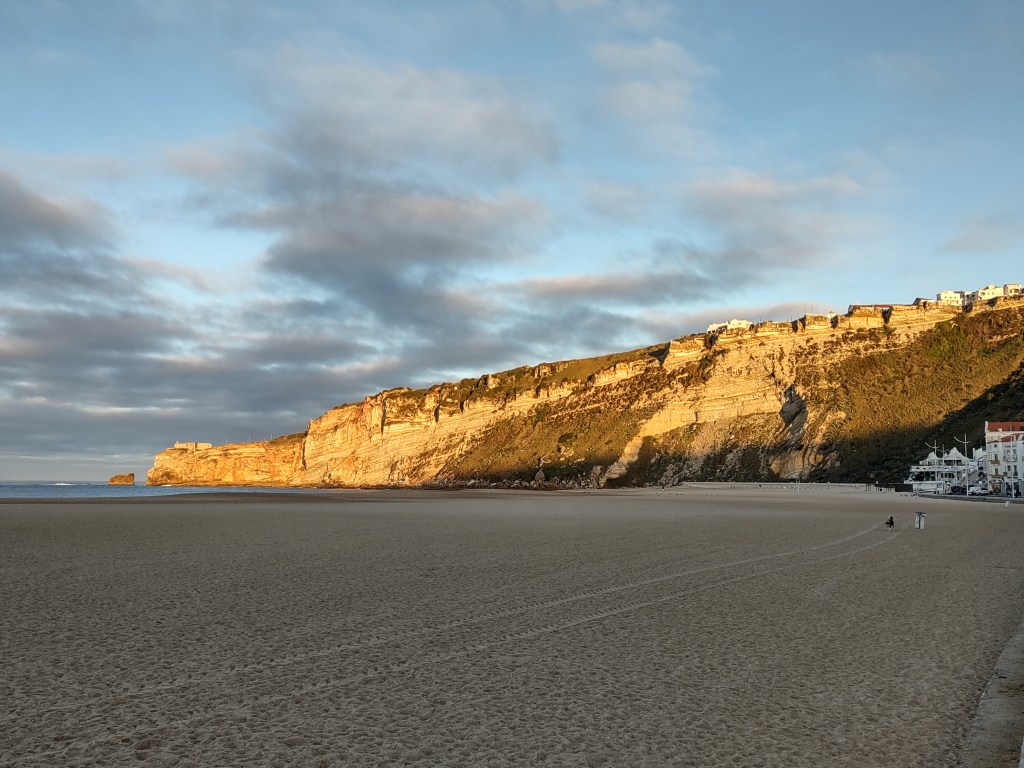
[Above photo: Promontorio do Sitio in Nazare, Portugal with the lighthouse at the far left, on top of the little stone fort. From there in April 2024 you could have seen, when storm-driven waves rushed from the Atlantic through the unusual deep canyon system, Sebastian Steudtner surf the face of a world-record 93.7 ft wave. ]
8 December 2024
The bus stopped at the roundabout in Condeixa, a couple of kilometers from the Roman ruins at Conimbriga, reportedly the most extensive and best-preserved on the Iberian Peninsula. As I was leaving the bus, I asked the driver which direction I should walk. He motioned me back on the bus, closed the door, and drove me to the entrance. And adamantly refused a tip.
Some days later, arriving at the central bus terminal in Lisbon, Sete Rios, I was making my way to the metro for my flight home. Suddenly, I realized I’d put my Kindle and glasses in the seat pouch in front of me and proceeded to have a 2 hour spirited conversation with my seatmate, a civil engineering professor from the University of Aveiro. Did you know that Portugal often has 3 or 4 days in a row when all its electricity is generated without hydrocarbons? Solar, wind, and hydro, in that order.
I rushed back into the large terminal to be greeted with many buses exactly the shape and color of mine. Where was #57? I asked a driver whose bus sign said “Lisboa” if he had just come from Nazare? Nope. Panic must have registered in my face because he said, “Jump on.” and shut the door behind me. “Don’t worry.” Then he drove the bus out of the station and into the yard where the buses are cleaned and fueled for their next trip. Asking the elderly attendant where #57 might be, the latter looked puzzled, shook his head, and then pointed. I hopped off, rushed to the indicated bus, and as I poked my head in the back door, the woman who was sweeping up smiled at me, handing me my Kindle and glasses.
These examples are representative of my experience over 17 days in Portugal. Polite, friendly, and helpful people abound. Beginning with my nephews, who generously drove south from their new home outside of Porto to meet me at the Lisbon airport. We spent the day walking around Lisbon, stayed in a nice hotel, and drove to Coimbra the next day. Coimbra is the site of Portugal’s oldest university, which is housed in a former royal palace, on top of a steep hill overlooking the Mondego River. I won’t bore you with a granular description; it is a splendid medieval town with tiny twisting lanes and students in black cloaks busking in groups. It was especially fun since Keith had looked at numerous houses there before purchasing their current one. He recalled the prices and the details of each place, which needed new electricity (all of them), which needed a new roof or new floors. Stone, it turns out, has a long half-life. And all the buildings and walls are made of stone.
Everywhere I went, which also included Guimeras, Porto, and Nazare, all the sidewalks are tiny polished cobblestones and the streets are their larger siblings. Everywhere I’d turn there was another 1000yo stone church, often as not covered in azulejos, the [blue] tiles which either illustrate a scene or are simply geometric, after their Moorish invaders artistic predilections.
Delicious pastry shops abound—coffee and a pastry in the late morning is a national pastime and I participated eagerly. My record was 3 pastel de natas in a day but I often had 2. Heavenly, especially if warm. A crispy phylo crust filled with a sweet, egg-yolk custard. Best I don’t learn how to make them.
I heard Fado, a haunting, longing café music several times. A Portuguese guitar sounds much like a mandolin, despite having a much greater size and corresponding volume. It is accompanied by one or two regular guitars, sometimes a stand-up base, and then a man or woman vocalist. When done well, it seizes you.
I walked 7-9 miles per day, everyday. It is more than it seems because all of the towns I visited were on steep hills.
The best, of course, was seeing my two nephews and their mother, my sister-in-law. They have moved from the US onto an estate of a couple of hectares outside Marco de Canaveses (cannabis) which they purchased for a song from a banker’s widow.
Zillions of fruit and nut trees, olive trees and camelias, 6 levels of terraced land which looks to a vineyard on the opposite hillside and down into a deep, heavily forested valley below. Gordy is something of a wizard with plants and has several tilled garden patches for vegetables and flowers. There is a beautiful 3 or 4 bedroom house, with two small 2 story stone houses from the 1820’s in good repair. All in all, they seem happily settled after a year and without buyer’s remorse.
They’ve made friends with the neighbors, several of whom help—gardening, house cleaning, language tutoring, pasturing their sheep, etc. My nephews had a large barbecue for them and relieved their neighbors’ fears that stereotypical rich, pushy Americans had moved into the area.
I especially liked Porto, which is ancient, bustling, and fascinating, large enough to hold my interest. If I moved to Portugal, and I don’t have plans to although I’ll certainly return to visit family and explore more, I could settle there.
The only part I did not like is one I’d encounter on any trip: eating supper alone. Sometimes I’d find another person who spoke English eating alone and we’d eat together. Mostly it was me in a restaurant full of couples. It was nice to watch them having fun, chatting; I just wanted to be doing the same. Somehow it isn’t bad when I am here, eating at home.
I’m reading Legacy of Violence: A history of the British Empire by Sue Elkins. It won a Pulitzer. And is a stunning recounting of the excesses of British Liberal Imperialism and the rationalizations for the same. Cloaked in humanism, it was patronizing at best, helping to bring along the “childlike” colonial subjects, often brown people but including the Irish, as well. “Legalized lawlessness”. The details are gruesome and the policies self-serving, whether massacring civilians, raping women and burning their homes, tying suspected “troublemakers” to cannons and detonating them, all in the name of ‘helping”. Some stand out as exceptionally evil leaders. Churchill was a product of the upper class and generally supported the racism and “necessary” violence.
I had always naively thought of the British Empire, when I thought of it at all, as a grand thing. Grand it was, in the sense of large: at its peak it governed 25% of the world’s land mass and people. Leopold’s ruinous reign in Congo was possibly more brutal overall. But the self-delusion of the Brits, imagining that they were doing good in civilizing savage children, allowed them to use brutal coercion routinely.
Which brings us to our current situation. Which I can’t bear to think, let alone write, about. I suspect we’ll get through it. A lot of poor people are going to suffer, however, and a lot of rich people will get more wealthy. Such a strange tic, needing to increase a massive fortune.

 A Psychiatrist in Myanmar