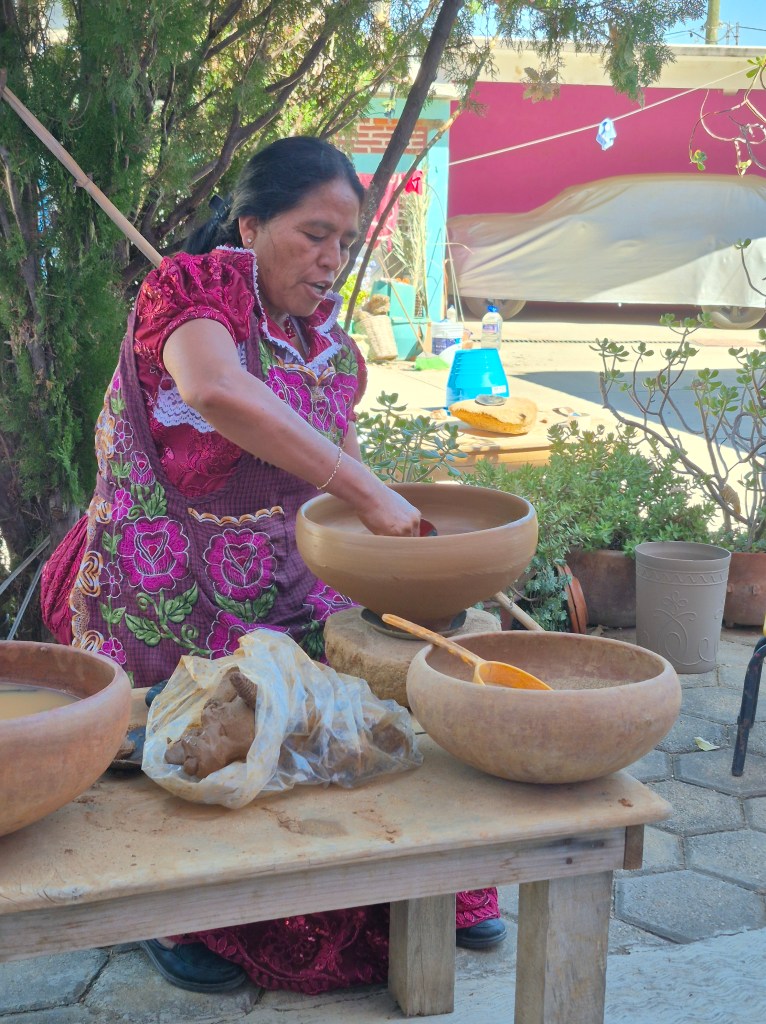
[Above photo: Zapotecan pottter Macrina Mateo Martinez turning a pot.]
February 10, 2026
I was invited to join friends from long ago—I don’t want to say “old friends, although we are getting there—for a week in Oaxaca. Two of them are nurses I worked with when I was in Family Medicine at the Neighborhood Health Center in Alviso [between San Jose and the southern tip of SF Bay] 1968-1971. The other is the husband of one of them with whom I have done a little construction. Both of the nurses, being smart and not afraid to work hard, have gone on to positions of prominence. Esperanza was the head of the Community Health Workers in California, as well as the Chairperson of the National Board of Planned Parenthood. Kate is a full professor emeritus at Stanford and has developed self-management health care modules—-arthritis, diabetes, cancer, etc.—which are currently used all over the world (including in both Israel and Palestine). Arch is an engineer who worked on the BART extensions and, in retirement, has built houses with Habitat in the Bay Area and in Portland, OR.
The primary logistical problem for my trip was going from a frigid, snow-bound Boston to a semi-tropical Oaxaca with daytime temperatures in the 77-83 range. I drove from Portland to Boston with my friend, Eliot, the day before my flight. He had an extra ticket for a concert of the Boston Symphony Chamber Players at Jordan Hall. It was fantastic! I’d never been to Jordan Hall before; it is beautiful with excellent acoustics. The best piece was the Brahms Piano Quartet #1 with the first violin, viola, and cello of the BSO plus Song-Jin Cho, an international ascending star.
We then drove to Eliot’s sister, Leslie’s, home, a massive house on a hill south of Boston. She’s married to a former governor of Massachusetts and the two of them are a lively couple. She cooked us a wonderful supper, I retired to a huge apartment over the garage(s), and awoke to 5’ of new snow. Eliot whisked me to the Braintree-Logan shuttle and the rest was a snap. I left my warm clothes in his car, to retrieve in Portland after my trip, taking only my long underwear and a light Uniqlo down jacket for my departure and return.
Esperanza had secured us a terrific 3 bedroom, 4 bathroom house 2 blocks from the Zocalo (the large old central square, which includes the cathedral). After entering a door on our street, one walks a long way back in the compound to our place, which means that it was totally quiet, peaceful, and secure. We spent a lot of time on the patio, which had a large table and chairs and was roofed by 3 colors of bougainvillea. There was a bird’s nest, with bird, in one of the branches.
I hadn’t been to Oaxaca since 1966 after graduating from medical school. I only visited it for a few days before moving on to San Cristobal de las Casas and a stay in the middle of the Chiapas Highlands with the Lacadon Indians, a group that were so inaccessible the Spaniards didn’t bother trying to harass them. We flew in and out in a small Cessna back then.
It was so easy with my friends, meals together, lots of catching up. Despite there being quite a few tourists in the center of town, the vast predominance was locals. It never felt spoiled, the way Venice or Paris can in high tourist season.
I’d arise around 6:30AM; they’d all sleep until 8:30 or 9. Then I would stroll around the Zocalo until one of the cafés opened. I’d either have breakfast, often huevos con chorizo, or just a cappuccino and watch people warming themselves in the sun as their days began. The chorizo in Oaxaca lacked the punch of chorizo I’ve had in different parts of Mexico, but I enjoyed the revival of my memory, eating the same in a tiny simple food stall on a back street in San Cristobal with my then new friend, Winifred Pulst, an anthropology PhD candidate at the University of Heidelburg.
There is a terrific museum in an old stone mansion near the Zocalo with a remarkable collection of pre-Columbian ceramics. One of the great Mexican artists—Rufino Tamayo—spent 20 years collecting and displaying it, donating it all to the state for care. It helped me to realize there were many more than just Aztecs and Mayans there, and the other groups had their own distinctive takes on the world: Olmecs, Mixtecs, Toltecs, Zapotecs, etc.
Also, in the immense former convent, Santo Domingo de Guzman, were several wonderful exhibits, including an ancient library (many 5-600year old volumes), vast amounts of exquisite Mixtec gold jewelry and adornment from Tomb 7 of Monte Alban, and a retrospective of Manuel Jimenez, famed for carving animals of wood and painting them with hallucinatory brilliance (alebrijes). His work evolved from the simple to incredibly sophisticated painted carvings. He had 4th grade schooling and tried to be a farmer, a laborer, a trumpet player, and many other occupations until he realized that carving animals was his thing. The exhibit was magnetic.
Finally, Esperanza arranged for us to visit a living legend, Macrina Mateo Martinez. In the small village of San Marcos Tlapazola, about an hour outside of Oaxaca, she founded an all-women pottery collective which we visited. She is Zapotec and learned pottery from her mother. At 15yo, speaking no Spanish, she determined to go to Mexico City to sell her work, despite her parents’ strong objections. The rest is history. She now is internationally celebrated and has travelled the world.
She told us her story, and that of her clay, as she created a lovely serving bowl. Her technique was fascinating. Our indigenous pottery from the southwest is coil-built. She has a stone base with a shallow depression carved out of it. On that she places a thin, curved piece of shell or pottery and uses her hand to rotate it as she turns her piece on top. It was miraculous to watch this thing of beauty arise from her skilled eye and hands.
We spent time, alone and together, in the huge central market in Oaxaca. As in most central markets, you can buy most of what you need—or want—, from huaraches to mole, there. It is fun to get lost in these markets, discovering, as you do, new delights. We went to “Smoke Alley”, in a separate part of the market, one night for grilled meat with delicious fresh vegetable sides. I discovered that I was withoutmy glasses later that evening, so the next day I returned. As I approached, the keeper of our booth quietly reached up and handed them to me. He refused to take any money, which was my experience throughout the trip.
Mexico has gotten a bad name from the violence perpetrated by the cartels. I guess I’d avoid Sinaloa and some of the border towns but my experience in Puerto Vallarta, Yelapa, Guanajuato, Oaxaca, and Merida (Yucatan) over the years have all been positive with kind, generous, and helpful people. I’ve found it to be a wonderful place to travel, so very different from the US and yet so close and accessible.
We are having a long snowy, cold spell, unlike any winter I’ve experienced since moving here in 2021. The sidewalks have 2-3 foot snowbanks on each side. Some nights have been in the negative numbers. I’ll drive to Bennington, VT on Friday for a couple of days of cross-country skiing with my medical school roommate, Harold. I seem to be more sensitive— toes, fingers, and nose—to cold than I used to be. It’ll be fun to see him and cruise through the woods on skis.
Of skis, I realized the winter Olympics were starting and I impulsively bought a TV on which to watch , having raced for 4 years in high school in Denver. The TV is big—55”—for me and with good definition. Watching the men and women descend the downhill course at Cortina d’ Ampezzo was terrifying.
It made me realize that I never really liked downhill racing; it always scared me. Jumping didn’t, however, as it allowed for much more control, even though there was considerable speed at the take-off. And it was in a downhill race that I lost my line, went into the trees, knocked myself out, and spent the night in the hospital. The benefit of that was it was the pretext the Air Force used to not directly confront my refusal to be drafted for Vietnam; I was honorably discharged with a 4F. I didn’t have to go to Federal prison (like DT should).
The racers’ comments about the downhill course in Cortina were “You just are struggling to survive.” It looked like it, as well. The network uses drones to follow the skiers down, which makes for an incredibly immersive experience.
This is droning on too long. I had a wonderful time with my friends in Oaxaca; it is so easy with people you’ve known for a long time. You can get to real talk so quickly, simply continuing a conversation that began and was left off many years ago.
I plan to do a workshop next January in Thailand for my Burmese students who are living there. Then I’ll go on to Malaysia to travel for fun. The prospect of the long flights out and back are not to my liking but it will be wonderful to see them all and return to SE Asia for a bit during Maine winter.


