7 July 2019
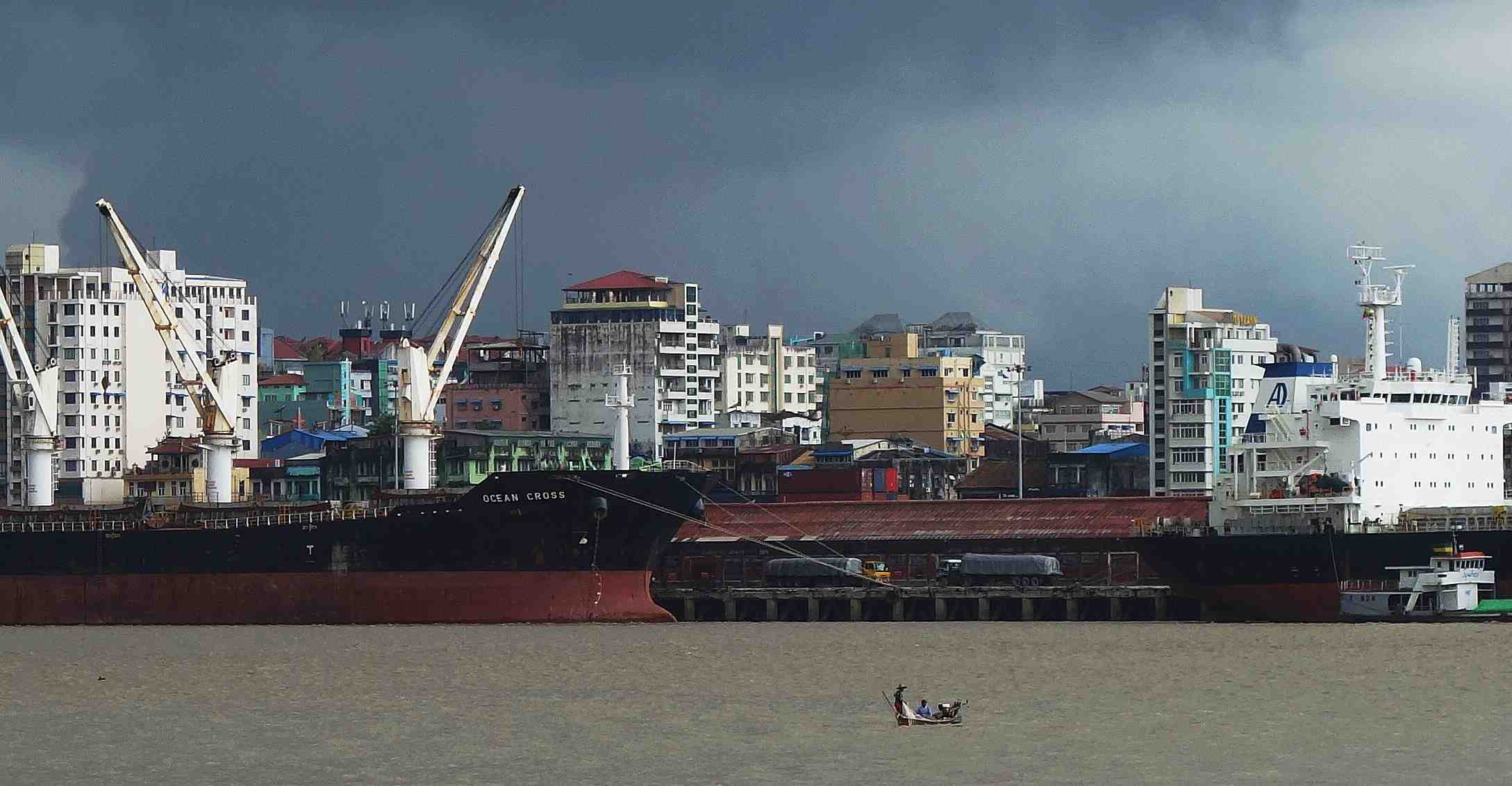
[Above photo: A massive storm cloud approaching over Yangon, exploding in rain 10 minutes after the picture was taken.]
I reached out to someone I met at the Peace Corps swearing-in ceremony I attended a few months ago and, lo and behold, I finally have a social network. He, Jose, and his wife, Irene, are directors of two different NGO’s, and their neighbor, Kelly, who is within 15 years of my age, is also a PC alumnus and the director of a large NGO. They have all spent their lives in and out of conflict zones in Benin, Bangladesh, Sri Lanka, and Myanmar, doing this work for 20-30 years, and they know how to have fun. We had a poker game last night with three others, including a Pakistani carpet merchant who is a long-term friend of theirs, and laughed ourselves silly. The title of this post is a 7 card game, 9’s and 3’s wild and if you have a 4 you can draw an extra card. It generates a massive pot so, even if stupid in the world of serious poker, it is very exciting. We ended, happily exhausted and with money redistributed to the two who actually played throughout with strategy, with a single round of “Indian Poker”. Everyone puts a card on their forehead so you can see the others’ but not your own and you bet for the high card. Not much thinking there.
My history of playing poker is a dismal story. I lost $5 in a game in my freshman dorm in college at a time I didn’t have $5 to lose. The evening was enlivened by a visit from two young Cambridge locals. One of our number had maliciously tossed a couple of milk cartons full of water from the 3rd floor suite onto the sidewalk close to where the two were standing. Up they came, one with a blackjack and the other with brass knuckles. It was their mistake, as two of our number were, as freshmen, stars on the varsity hockey team and were very happy to mix it up. No blows were landed but one of the visitors was suspended off the floor against the wall for a few minutes while he cooled down. I watched, breathless.
4 or 5 years ago I was invited to a poker game in Petaluma, California (45′ north of Berkeley) where I was consulting briefly for Seneca Center. Their psychiatrist, who they all adored, had dropped dead while taking a stroll. The leadership and staff were in grief so it was difficult for me to break it to them that just because he felt that Celexa (an antidepressant) was “very helpful for these kids”, it didn’t justify him putting them all on it. Plus, he gave mood stabilizers in the absence of Bipolar Disorder. Clearly a failure of his imagination and understanding of attachment behaviors.
Anyway, I drove north to the evening game and realized that it had been ongoing for many years. All the participants were seasoned players, even the woman who dropped in briefly for one hand in which she cleaned me out while one of the other fellows asked me impatiently, “What are you doing?”. I realized that they were helpfully refilling my wine glass at regular intervals and no one else was even sipping theirs. I dropped $90 and learned three good lessons. If you want to lose at poker, drink. If you want to lessen the pain of losing at poker, drink. Finally, if you don’t know who the patsy is, it’s you.
Last night after a few impulsive moves at the beginning in which I lost half my stake, I settled down and played with some strategy and discipline, gaining back most of my losses. Less than the price of a movie at Reel Pizza in Bar Harbor for 5 hours of hilarity. My luck was pretty awful, in addition to my play, but both improved a bit as the evening advanced. The blatantly manipulative trash talk kept us howling. “Man up! You can do it. He’s bluffing again. See him and raise him.”
One of them directs an organization that works with refugee children, so he invited me to accompany him to look at kids in several camps in two major conflict zones, in Rakhine and Kachin states. I can’t go on the proximate trip in 3 weeks because of my teaching but I can go at the end of my stay. I’ll think about how to gather information on post-trauma symptoms in the children and their parents and ways to address them.
It is slowly dawning on me that we may not get therapy rooms—ie rooms with doors— in which my group of students can learn. I’ll keep trying, but there seems to be major resistance to securing them among the powers that be. The students have learned how to do a proper assessment on everyone and what a good management plan would look like, as well as the difference between bad and good medication practice. I am teaching them, currently, a time-limited therapy called “Interpersonal Therapy” which is evidence-based, manualized, and used world-wide as one of the WHO mhGAP treatments. They also are learning Play Therapy, principles of behavior management, and the theory and technique of Psychodynamic Psychotherapy, as well as elements of CBT. Psychodynamic psychotherapy is my drug of choice but it is also the most difficult for them to learn and to do well. After we read some papers, I’ll do a presentation or two, and we do role plays, there is often the question, “Professor, but what is the therapy?” I remind them that this is not removal of an appendix or writing a prescription, that listening, understanding, and deepening the patient’s understanding of themselves in a special kind of conversation or helping them to alter their responses is the therapy. I do love the way they begin a case presentation or lead the discussion of a paper: “Professor and my colleagues…….”. They are respectful but unruly, a combination appealing to me . I may change my first name; I’ve gotten used to “Professor”. It has a gravitas that “George” lacks, since the latter recalls 41 and 43 and Mad King George. There is Curious George, however.
We read and discuss theory, do role plays, and occasionally have the opportunity to work with a patient several times in our one room with a door that closes (I suppose we could use one or both of the bathrooms, but that would present interesting transference and play therapy issues.). We may have to settle for no supervised ongoing psychotherapy experience for them for the present time. I won’t participate in developing the curriculum for the year-long course in Child and Adolescent Psychiatry they plan to start in January unless I am promised that there will be reasonable psychotherapy facilities. Since psychotherapy isn’t currently done in psychiatric training or practice here and since resources, both money and space, are very limited, I can understand the minimal motivation to secure the same. But Child and Adolescent Psychiatry is largely a matter of intimate talk and play with adults and kids, not the writing of prescriptions, so confidentiality is crucial. If they want a decent program here, they must create the spaces for it. You don’t do surgery in a large open room with people walking through.
When I head down Anawrahta Street on my way to the bus each morning, every week or two there is a sudden collective look of fear and a scramble of the fish, meat, fruit, and vegetable vendors. At first I thought I was not noticing an imminent deluge but later realized that the arrival of the police has triggered the activity. I imagine that vendors are not supposed to block the roads or the sidewalks with their stands and wares. But they all do, making roads impassable on 17th and 18th streets and the sidewalk nearly so on Anawrahta. When the police arrive, they all scuttle about, dragging their stalls, mats, umbrellas, carts, etc. full of whatever back to the sidelines. The police cruise slowly, menacingly by in their little Suzuki truck, and the whole game resumes. I am tempted to do in-depth interviews with a vendor and write their life story. I imagine it would be full of poverty, oppression, deprivation, loss, abuse, death, and sadness, but perhaps also joy and love and laughter, although likely not in equal measure. It would be a very interesting but voyeuristic experience. Perhaps if I were a more talented writer it could be a part of something that would help to change their lot. So many fascinating directions in which to travel through this life; the difficulty is choosing which star to follow.
Before July 4th, I’ll admit I had fantasies that a soldier in one of the two stationary Abram tanks, trucked to the Mall in order to bolster his fragile bone-spurred draft-dodging image, would throw caution to the wind and sacrifice himself and the Lincoln Memorial for the greater good. The Blue Angels might have assisted. But the crowds were too great a liability to support even my fantasy. I want to help them see the light, not plunge into infinite darkness.

 A Psychiatrist in Myanmar
George!! Beware DSM section 312.31/ICD F63.0…
LikeLike