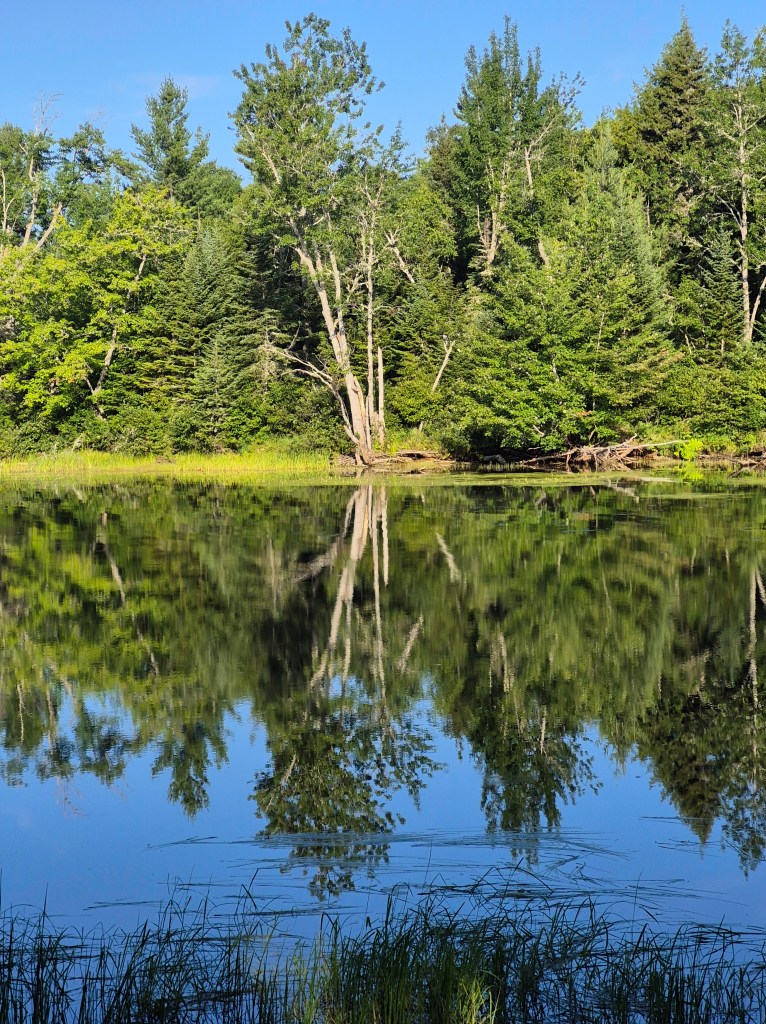
[Above photo: Morning on Umbagog Lake]
July 26, 2026
I happened to have been reading Kenneth Roberts’ Arundel, a 1930’s account of colonial Maine (Massachusetts, at that time) and Benedict Arnold’s ill-fated expedition to wrest Quebec from the British in the winter of 1775, when Harold, my friend and roommate from medical school, and I set off on a 5 day camping, canoeing, and fishing trip that nearly coincided with part of Arnold’s route.
Their tale was of deception, betrayal, spies, and misery, maplessly traversing mountains, bogs, and wild rivers in bateaux unsuited for such a voyage. They were at times starving and freezing, and many members of the army deserted. Certainly, many were hopeless. At the very beginning of the actual siege in a blinding snowstorm, Arnold was seriously wounded and couldn’t lead or inspire his troops; his counterpart, General Montgomery, was instantly killed. The attack failed.
Harold and I experienced the opposite circumstances, traveling in late July so as to avoid black flies, “Guardians of the Wilderness” as is printed on a tee shirt I have. The weather was warm and, excepting a single brief thunderstorm and shower, ideal. However, with the warmth, the water heats and the trout are pushed from steams into the cool depths of adjacent lakes. Despite our accumulated fly fishing skills—I have fished in the Cascades, the Rockies, the Bitterroots, and the Sierras and Harold has additionally travelled all over the world with wealthy friends on fly-fishing expeditions—we caught only Small-mouth Bass.
What are bass doing in these waters? Maine reputedly has the most extensive native Brook Trout fishery in the contiguous 48. We are told that a [perhaps disgruntled] fisherman intentionally introduced the Bass some years ago. They have flourished, and are more successful predators, supplanting their dainty troutish neighbors with gusto. I wonder if it was a class thing. Fly fishing for trout in my mind is associated with the Middle and Upper Classes, whereas Bass fishing is definitely a Working Class pursuit, ironically requiring less work.
After paddling 8 miles from the banks of the Androscoggin River, across Umbagog Lake, to Cedar Stump Campground [Maine] on the lower end of the Rapid River, we discovered a glorious setting for 3 nights. The river was smooth, broad, and relatively deep in front of us. It was outfitted with a stone and metal fire ring, a picnic table, and an outhouse of dubious provenance. Animals had eaten and scratched several entries to the interior of the latter, perhaps to avoid inclement weather. There was a rich and pungent fragrance of many phenols, so put for gentler sensibilities.
Of the 6 or more sites at the campground, only two others were taken and they were at a distance. A group of 15yo Outward Bound girls and boys were segregated on both sides of the river for one night. It was entertaining for us, and likely thrilling for them when two girls got in their canoe at twilight and crossed the river to mix it up with the boys. The following two nights we enjoyed complete peace.
Fishing upstream the next morning, we were approached by a uniformed young woman from the Maine Department of Inland Fisheries. I trembled inwardly somewhat, realizing my fishing license was back at our campsite. She assured us that she wasn’t Enforcement, just surveying the rivers and fisherpersons in her territory to see what was being caught.
She was very informative, telling us of the varied methods Fisheries uses to perform their monitoring task—telemetry, sampling by gill netting, determining fish age by examining the scales, etc. She assured us that the Bass were The Enemy and that there was no catch or size limit. “Just toss them on the bank if you don’t want to eat them.” Which we did, frequently.
Bony, scaly, and muscular creatures, their dorsal fins are sharp and dangerous. Breaking their necks, as I do with fish before cleaning them, was challenging as they were built very sturdily. Nothing like the sleek and lovely mackerel we’ve been catching and eating at the island this summer. I caught a zillion small ones; Harold wasn’t so lucky but later, back at camp, caught a hefty one which he cleaned and scaled. I’d brought olive oil, lemon, pepper, and salt, hoping for trout, and we fried his. It was fresh and tasty, if concealing many bones.
One day we hiked upstream to the destroyed lower dam on the Rapid River, which connects Lake Richardson with Umbagog Lake. In addition to fishing a number of wonderful, deep pools, we again encountered the Outward Bound group and their two leaders. The kids looked miserable, having to portage their gear and canoes up a 3 mile carry road. Some of the girls were tiny, in truth, and I was unable to imagine that they could carry a 65# canoe by themselves. I think the larger girls and the boys carried them and the littlest ones carried paddles, etc. I felt for them and said admiring words as we passed them.
We also encountered a fellow, perhaps 35 or 40yo, towing his very lightweight (27#) carbon fiber canoe on a wheeled dolly, his gear stowed within. He had rigged the canoe with a seat on the floor and foot braces, and he used a kayak paddle. He’d spent 22 days on the Northern Forest Canoe Trail, which stretches 740 miles from Old Forge, New York, through Vermont and New Hampshire, and ending in Ft. Kent, Maine, with a brief foray into Canada. He was out for another week and planned to finish the route next summer. Harold asked about food supplies; he described a meal mixture of simple ingredients he’d created and could obtain from most stores along the way: red lentils, nutritional yeast, rice, beans, herbs, etc. It seemed like a lot of days and nights paddling, portaging, and camping alone, to me.
Our second campground, #29 [New Hampshire] was across the lake in the direction we’d originally come, in an area of marsh and very still water. However, our return trip was complicated by rising wind and waves. It was a serious struggle to paddle across the lake and we encountered gusts that would stop us in place. We decided to shelter behind a point 1 ½ miles across from #29. I was fearful that we might capsize and, although the water was warmer than the sea, we would be at risk of hypothermia. If we did capsize, we had little possibility of re-entry and so would float for hours, awaiting the wind to push us to the lee shore some miles to the North.
We ate lunch, read, and snoozed on large flat rocks. I explored across the little point to see how the lake surface looked. It was frothy! After something like 5 hours, the wind gradually dropped and we crossed uneventfully.
The birdlife was splendid and included huge Great Blue Herons, Bald Eagles, Stellar Jays, many female Common Mergansers with growing chicks swimming behind, and Loons. The latter called, both day and night, which provided a familiar eerie background music. We also saw a few deer, browsing at the water’s edge. I had hoped that we might see a moose, as it looks like moose territory.
Umbagog Lake is surrounded by a large wildlife refuge. Although it has numerous campsites scattered along its shores, many are accessible only by boat, which usually means canoe. We saw a few kayaks and a few small skiffs with outboards but my fear of jet-skis or speedboats was unwarranted. A friend I went swimming with in Casco Bay yesterday, upon hearing my description of the trip, noted that she prefers civilization and although she enjoys car camping, isn’t drawn to wilderness. Since childhood I have enjoyed the-wilder-the-better and seek it preferentially.
A trip of this sort always evokes nostalgia in me. I think of my childhood canoe, the good family times boating on Lake Washington, and of my many trips into wilderness, including kayak and canoe trips into very wild coastal British Columbia and down coastal rivers in California.
In 1958 Chas and I rented a red aluminum canoe from the University of Washington Boat House for 10 days, assuring them that we’d be using it on local fresh water lakes. We paddled it across the narrow ship canal to the Seattle Arboretum, where we’d parked Chas’ VW bug. We had a sturdy luggage rack, lifted the canoe onto it and secured it. Immediately we headed north to Lund, B.C, which is as far as the coastal road goes, before launching. We were filled with a sense of accomplishment at our deception and with the anticipatory thrill of adventure. But that is another story.
Harold and I are odd friends. He has been massively successful, with a Lasker Award, a Nobel Prize, the Director of the NIH, the President of Memorial Sloan Kettering, and chairs of the Gates Global Challenge Grant Committee and the WHO Committee on International Biomedical Research, among many other accomplishments. He also is very friendly, has an MA in English Literature, and has rubbed elbows with presidents, emperors, cabinet members, and shakers and movers of various kinds (George Soros, David Koch, Henry Kissinger, etc.). In short, he and his wife have travelled in rarified circles.
I have been successful enough, in my own terms, and have led a life of interest to me. But…
However, we enjoy getting into the woods together. Living in the woods is an equalizer, even if Harold is usually the first one on the trail or to have his line in the water. Mutually ignoring the discomforts of simple living, of mosquito bites, sore muscles, sleeping on the ground, and the ever present dirt encourages our similarities. In addition, I always come home with a greatly expanded understanding of the fundamentals of cancer research and treatment, as well as a recommendation for a good book (This trip it is The Way We Live Now by Anthony Trollope).
One evening when he poured out a warm, reconstituted freeze-dried dessert—banana-peanut butter-oatmeal—that looked like the loose, brown product of someone suffering from cyclosporosis, we immediately howled. “Try serving that at an elegant dinner party”. More laughter.

 A Psychiatrist in Myanmar